

Croissants, apple
Whole food · Baked Products

Photo: Wikipedia
A flaky, buttery croissant pastry encasing a sweet, spiced apple filling, offering a delightful contrast between crisp layers and soft fruit. Each bite delivers a comforting blend of buttery richness and tart-sweet apple, with a moderate calorie profile for a pastry. It provides a balanced mix of carbs for energy, some protein, and a touch of fiber from the fruit.
Calorie split: 12% protein · 58% carbs · 31% fat
↓ Full nutrition💚 Why it's loved
People adore the harmonious blend of buttery, flaky pastry with warm, spiced apple, creating a nostalgic and comforting treat. Its versatility makes it a beloved choice for breakfast, brunch, or an afternoon snack with coffee.
⚠️ Watch-outs & how to enjoy it better
The refined carbs and added sugars can cause blood-sugar spikes, especially for those with insulin resistance. To counteract, pair it with a source of protein (like Greek yogurt) or healthy fat (like nuts) to slow digestion, and practice portion control by enjoying half with a balanced meal.
Key benefits
- Provides quick energy from carbohydrates
- Contains some dietary fiber from apple filling
- Offers a small amount of protein
- Satisfies sweet cravings with fruit-based filling
- Convenient portable breakfast or snack option
🍽️ Popular dishes

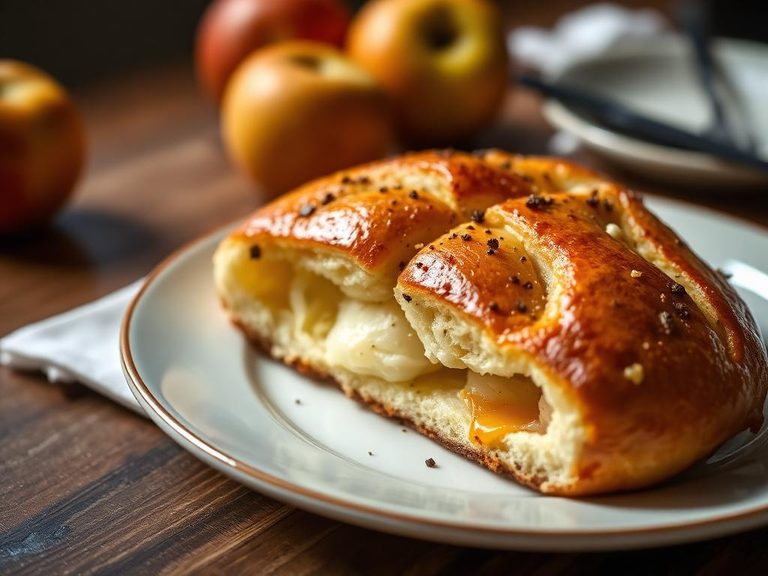

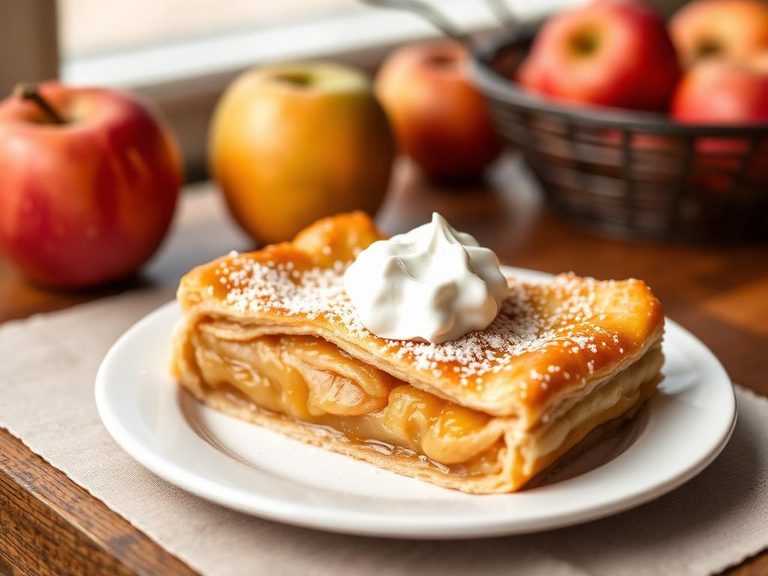

🌍 Where it's eaten
💡 Did you know?
The classic croissant dough technique, laminating butter into dough, was actually perfected in Vienna before becoming iconic in French viennoiserie.
Full nutrition (USDA data · scales with serving)
| Water | 45.6 g |
| Energy | 254 kcal |
| Energy | 1063 kj |
| Protein | 7.4 g |
| Total lipid (fat) | 8.7 g |
| Ash | 1.2 g |
| Carbohydrate, by difference | 37.1 g |
| Fiber, total dietary | 2.5 g |
| Calcium, Ca | 30.0 mg |
| Iron, Fe | 1.1 mg |
| Magnesium, Mg | 13.0 mg |
| Phosphorus, P | 58.0 mg |
| Potassium, K | 90.0 mg |
| Sodium, Na | 274 mg |
| Zinc, Zn | 1.0 mg |
| Copper, Cu | 0.04 mg |
| Manganese, Mn | 0.21 mg |
| Selenium, Se | 19.0 ug |
| Vitamin C, total ascorbic acid | 0.50 mg |
| Thiamin | 0.23 mg |
| Riboflavin | 0.16 mg |
| Niacin | 1.6 mg |
| Pantothenic acid | 0.60 mg |
| Vitamin B-6 | 0.03 mg |
| Folate, total | 57.0 ug |
| Folic acid | 44.0 ug |
| Folate, food | 13.0 ug |
| Folate, DFE | 88.0 ug |
| Vitamin B-12 | 0.20 ug |
| Vitamin A, RAE | 94.0 ug |
| Retinol | 90.0 ug |
| Vitamin A, IU | 380 iu |
Fat & fatty acid profile (per 100g)
| Fatty acids, total saturated | 5.0 g |
| SFA 4:0 | 0.21 g |
| SFA 6:0 | 0.13 g |
| SFA 8:0 | 0.07 g |
| SFA 10:0 | 0.17 g |
| SFA 12:0 | 0.18 g |
| SFA 14:0 | 0.66 g |
| SFA 16:0 | 2.1 g |
| SFA 18:0 | 0.91 g |
| Fatty acids, total monounsaturated | 2.4 g |
| MUFA 16:1 | 0.20 g |
| MUFA 18:1 | 2.2 g |
| MUFA 20:1 | 0.00 g |
| MUFA 22:1 | 0.00 g |
| Fatty acids, total polyunsaturated | 0.63 g |
| PUFA 18:2 | 0.60 g |
| PUFA 18:3 | 0.12 g |
| PUFA 20:4 | 0.02 g |
| PUFA 20:5 n-3 (EPA) | 0.00 g |
| PUFA 22:6 n-3 (DHA) | 0.01 g |
| Cholesterol | 31.0 mg |
Amino acid profile (per 100g)
| Tryptophan | 0.09 g |
| Threonine | 0.26 g |
| Isoleucine | 0.33 g |
| Leucine | 0.56 g |
| Lysine | 0.32 g |
| Methionine | 0.15 g |
| Cystine | 0.14 g |
| Phenylalanine | 0.36 g |
| Tyrosine | 0.24 g |
| Valine | 0.37 g |
| Arginine | 0.31 g |
| Histidine | 0.17 g |
| Alanine | 0.30 g |
| Aspartic acid | 0.46 g |
| Glutamic acid | 2.0 g |
| Glycine | 0.30 g |
| Proline | 0.71 g |
| Serine | 0.38 g |
FAQ
Is an apple croissant a healthy breakfast option?
It can be part of a balanced diet but is best enjoyed in moderation. Pair it with protein (like eggs or yogurt) and fiber (like whole fruit) to create a more nutritionally complete meal and stabilize energy levels.
How should I store leftover apple croissants?
Store at room temperature in an airtight container for 1-2 days. For longer storage, freeze them for up to a month. Reheat in a toaster oven to restore crispness.
What's the difference between an apple croissant and an apple turnover?
A croissant is made with laminated, yeasted dough for distinct flaky layers, while a turnover typically uses puff pastry or pie crust, which is denser and less layered.
Nutrient density (calculated · NRF9.3)
Nutrient Rich Foods index: beneficial nutrients (protein, fiber, vitamins, minerals) minus saturated fat, added sugar & sodium, per 100 kcal.
NRF9.3 index — Fulgoni, Keast & Drewnowski, 2009. Computed from USDA nutrients.
Weight-loss friendliness (composite index)
Energy density 2.54 kcal/g · 12% calories from protein · 2.5 g fiber · 0.0 g sugar per 100 g.
Composite of energy density (Rolls et al., 1999), protein & fiber satiety, minus sugar. A calculated heuristic — ranks satiety-per-calorie, not a clinical measure.
Dietary load (calculated from USDA values)
Potential renal acid load. Positive = acid-forming, negative = alkaline-forming.
Sodium-to-potassium ratio: 3.04 (lower is better — aim for ≤ 1)
Sodium:potassium per WHO potassium guidance. Computed from USDA nutrients.