

Rice crackers
Whole food · Snacks
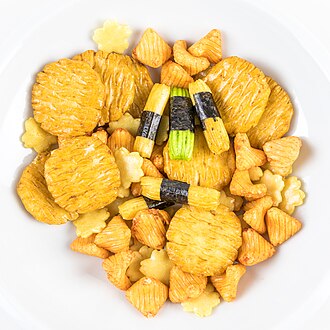
Photo: Wikipedia
Rice crackers are light, crisp, and airy snacks made from puffed or baked rice, offering a satisfying crunch with a neutral, slightly savory flavor. Their texture ranges from delicate and melt-in-your-mouth to hard and crunchy, depending on the variety. Nutritionally, they are a high-carbohydrate, low-fat, and low-protein food, providing quick energy but minimal satiety.
Calorie split: 10% protein · 80% carbs · 11% fat
↓ Full nutrition💚 Why it's loved
People love rice crackers for their pure, satisfying crunch and versatility as a neutral canvas for flavors like soy sauce, seaweed, or sesame. They are a beloved, portable snack in many cultures, often enjoyed with tea or as a light accompaniment to meals.
⚠️ Watch-outs & how to enjoy it better
Due to their high glycemic index and lack of fiber, they can cause rapid blood sugar spikes and offer little lasting fullness. To counteract this, pair them with protein (like edamame or cheese) or healthy fats (like avocado or nut butter), and practice portion control. Some varieties are also high in sodium, so opting for low-salt versions is advisable for those monitoring intake.
Key benefits
- Gluten-free and suitable for celiac diets.
- Low in fat and cholesterol-free.
- Provides quick energy from complex carbohydrates.
- Light and easy to digest for sensitive stomachs.
- Long shelf life and convenient for snacking.
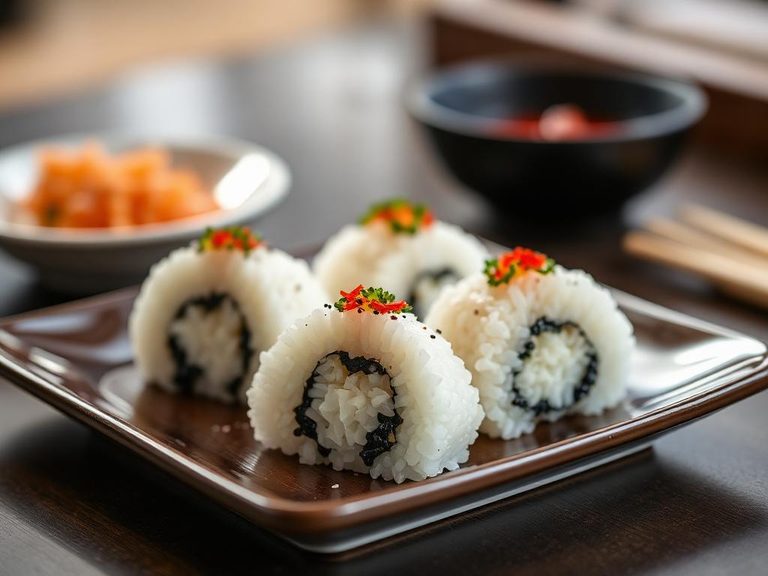
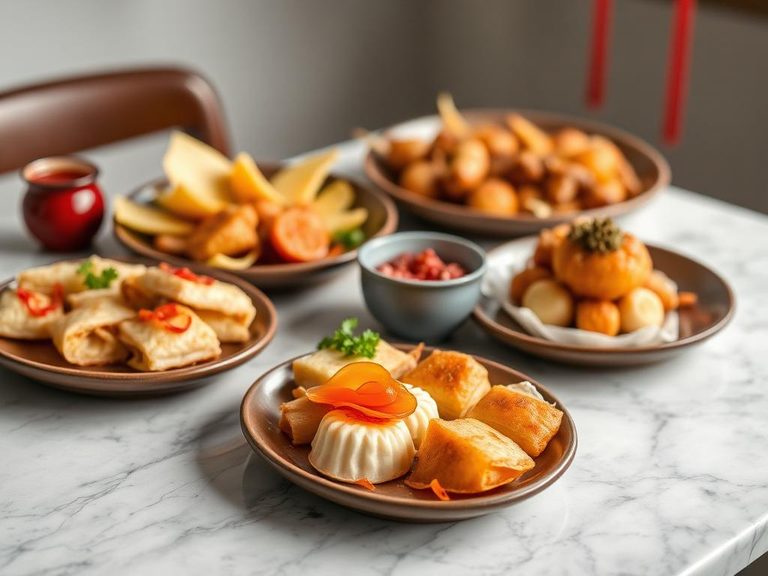
🍽️ Popular dishes

🌍 Where it's eaten
💡 Did you know?
The word 'senbei' in Japan is so iconic that it's used as slang for a small, round, flat object, and traditional senbei shops often let you watch the crackers being grilled and glazed over charcoal.
Full nutrition (USDA data · scales with serving)
| Water | 0.11 g |
| Energy | 416 kcal |
| Energy | 1739 kj |
| Protein | 10.0 g |
| Total lipid (fat) | 5.0 g |
| Ash | 2.2 g |
| Carbohydrate, by difference | 82.6 g |
| Fiber, total dietary | 0.00 g |
| Total Sugars | 0.00 g |
| Calcium, Ca | 0.00 mg |
| Iron, Fe | 0.00 mg |
| Magnesium, Mg | 156 mg |
| Phosphorus, P | 362 mg |
| Potassium, K | 243 mg |
| Sodium, Na | 233 mg |
| Zinc, Zn | 2.2 mg |
| Copper, Cu | 0.30 mg |
| Manganese, Mn | 4.1 mg |
| Selenium, Se | 25.5 ug |
| Fluoride, F | 0.00 ug |
| Vitamin C, total ascorbic acid | 0.00 mg |
| Thiamin | 0.44 mg |
| Riboflavin | 0.10 mg |
| Niacin | 5.5 mg |
| Pantothenic acid | 1.6 mg |
| Vitamin B-6 | 0.55 mg |
| Folate, total | 22.0 ug |
| Folic acid | 0.00 ug |
| Folate, food | 22.0 ug |
| Folate, DFE | 22.0 ug |
| Choline, total | 33.4 mg |
| Betaine | 0.00 mg |
| Vitamin B-12 | 0.00 ug |
| Vitamin B-12, added | 0.00 ug |
| Vitamin A, RAE | 0.00 ug |
| Retinol | 0.00 ug |
| Carotene, beta | 0.00 ug |
| Carotene, alpha | 0.00 ug |
| Cryptoxanthin, beta | 0.00 ug |
| Vitamin A, IU | 0.00 iu |
| Lycopene | 0.00 ug |
| Lutein + zeaxanthin | 0.00 ug |
| Vitamin E (alpha-tocopherol) | 1.3 mg |
| Vitamin E, added | 0.00 mg |
| Vitamin D (D2 + D3), International Units | 0.00 iu |
| Vitamin D (D2 + D3) | 0.00 ug |
| Vitamin K (phylloquinone) | 2.1 ug |
| Alcohol, ethyl | 0.00 g |
| Caffeine | 0.00 mg |
| Theobromine | 0.00 mg |
Fat & fatty acid profile (per 100g)
| Fatty acids, total saturated | 0.00 g |
| SFA 4:0 | 0.00 g |
| SFA 6:0 | 0.00 g |
| SFA 8:0 | 0.00 g |
| SFA 10:0 | 0.00 g |
| SFA 12:0 | 0.00 g |
| SFA 14:0 | 0.00 g |
| SFA 16:0 | 0.00 g |
| SFA 18:0 | 0.00 g |
| SFA 20:0 | 0.00 g |
| SFA 22:0 | 0.00 g |
| Fatty acids, total monounsaturated | 3.0 g |
| MUFA 16:1 | 0.01 g |
| MUFA 18:1 | 3.0 g |
| MUFA 20:1 | 0.01 g |
| MUFA 22:1 | 0.00 g |
| Fatty acids, total polyunsaturated | 1.6 g |
| PUFA 18:2 | 1.6 g |
| PUFA 18:3 | 0.06 g |
| PUFA 18:4 | 0.00 g |
| PUFA 20:4 | 0.00 g |
| PUFA 20:5 n-3 (EPA) | 0.00 g |
| PUFA 22:5 n-3 (DPA) | 0.00 g |
| PUFA 22:6 n-3 (DHA) | 0.00 g |
| Fatty acids, total trans | 0.00 g |
| Cholesterol | 0.00 mg |
| Phytosterols | 8.0 mg |
FAQ
Are rice crackers gluten-free?
Yes, traditional rice crackers made purely from rice are naturally gluten-free. However, always check labels for added flavorings or coatings that might contain wheat or barley.
Why do rice crackers have so many carbs?
They are made almost entirely from rice, which is a starchy grain. The puffing or baking process removes most moisture, concentrating the carbohydrate content.
Can rice crackers be part of a healthy diet?
In moderation, yes. They are a better choice than many fried snacks due to lower fat content, but they should be paired with protein or fiber to create a more balanced snack and prevent blood sugar spikes.
Nutrient density (calculated · NRF9.3)
Nutrient Rich Foods index: beneficial nutrients (protein, fiber, vitamins, minerals) minus saturated fat, added sugar & sodium, per 100 kcal.
NRF9.3 index — Fulgoni, Keast & Drewnowski, 2009. Computed from USDA nutrients.
Weight-loss friendliness (composite index)
Energy density 4.16 kcal/g · 10% calories from protein · 0.0 g fiber · 0.0 g sugar per 100 g.
Composite of energy density (Rolls et al., 1999), protein & fiber satiety, minus sugar. A calculated heuristic — ranks satiety-per-calorie, not a clinical measure.
Dietary load (calculated from USDA values)
Potential renal acid load. Positive = acid-forming, negative = alkaline-forming.
Sodium-to-potassium ratio: 0.96 (lower is better — aim for ≤ 1)
Sodium:potassium per WHO potassium guidance. Computed from USDA nutrients.