

Pork, fresh, loin, tenderloin, separable lean only, cooked, broiled
Whole food · Pork Products

Photo: Wikipedia
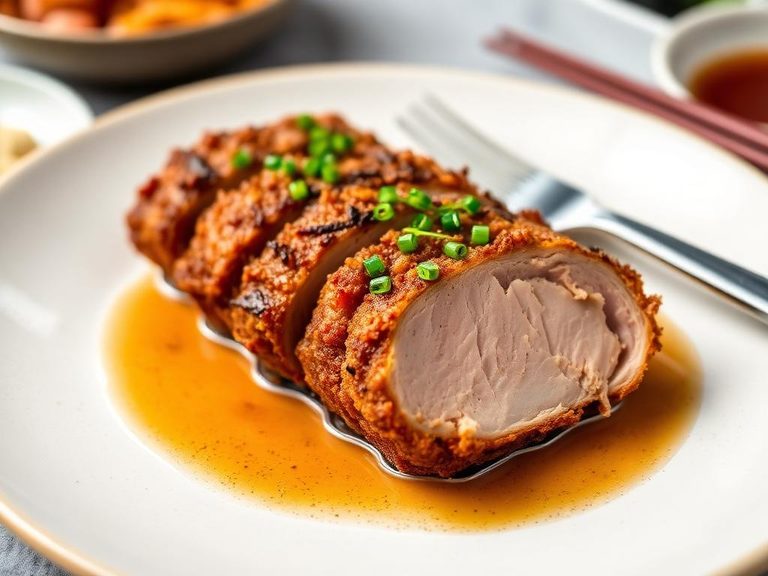
This is the lean, central muscle of the pork loin, prized for its exceptionally tender, fine-grained texture and mild, subtly sweet flavor. When broiled, it develops a beautiful golden-brown crust while remaining juicy and succulent inside. It's a nutritional powerhouse, delivering over 30 grams of high-quality, complete protein per 100g with virtually no carbohydrates.
Calorie split: 68% protein · 0% carbs · 32% fat
↓ Full nutrition💚 Why it's loved
People adore pork tenderloin for its remarkable tenderness and versatility—it's a blank canvas that readily absorbs marinades and seasonings, making it a weeknight staple and a dinner-party favorite. Its lean profile allows for quick, high-heat cooking methods like broiling or grilling without drying out.
⚠️ Watch-outs & how to enjoy it better
Its very leanness means it can become dry and tough if overcooked, which is a common pitfall. Those monitoring sodium intake should be cautious with pre-marinated or seasoned versions. To counteract dryness, use a meat thermometer to pull it at 145°F (63°C) for a slight blush of pink, and consider brining or marinating to lock in moisture.
Key benefits
- Excellent source of complete, high-quality protein
- Very low in fat compared to other pork cuts
- Naturally carbohydrate-free
- Rich in B vitamins, especially thiamine (B1) and niacin (B3)
- Good source of minerals like selenium and phosphorus
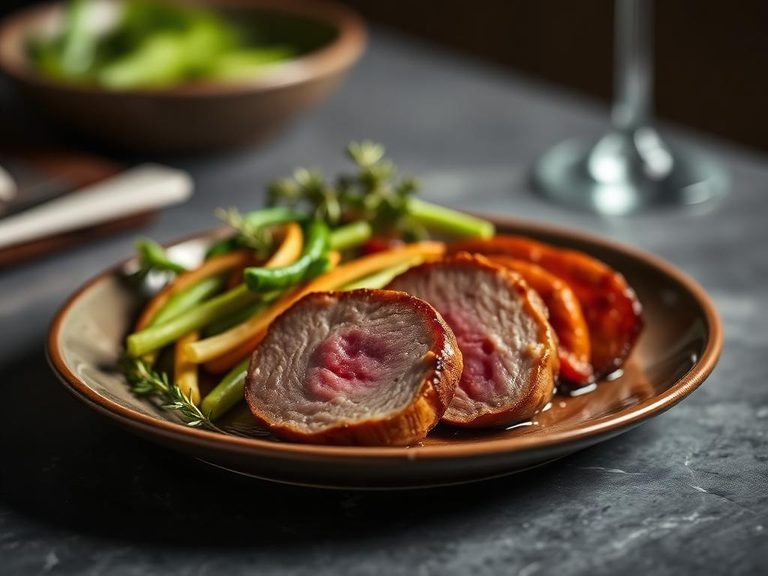
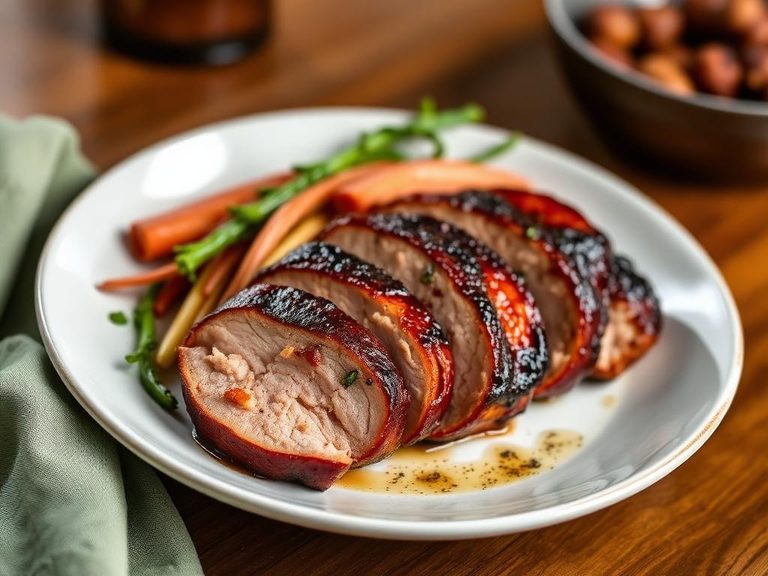
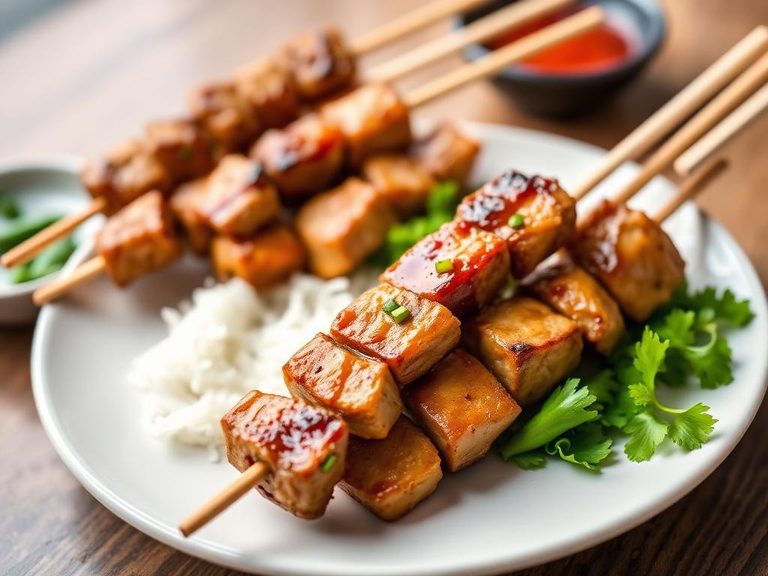
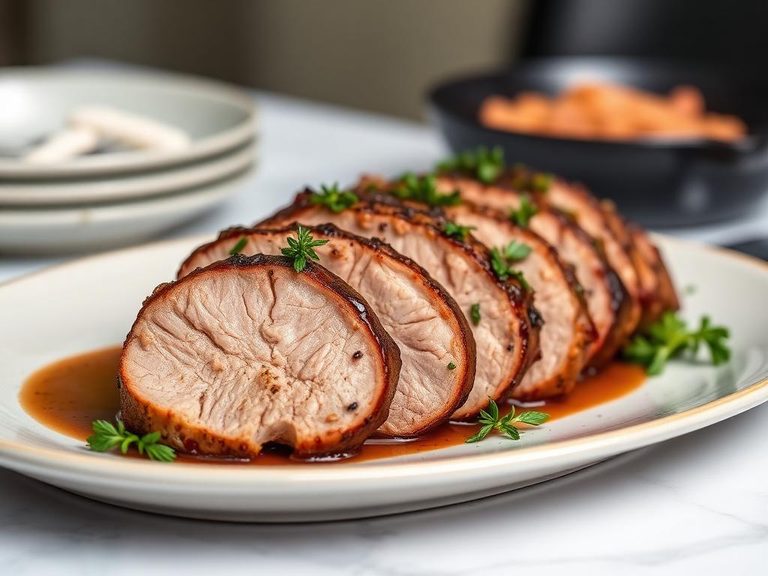
🍽️ Popular dishes
🌍 Where it's eaten
💡 Did you know?
Pork tenderloin is one of the leanest cuts of meat available, containing even less fat than a skinless chicken breast.
Full nutrition (USDA data · scales with serving)
| Water | 62.3 g |
| Energy | 187 kcal |
| Energy | 782 kj |
| Protein | 30.4 g |
| Total lipid (fat) | 6.3 g |
| Ash | 2.5 g |
| Carbohydrate, by difference | 0.00 g |
| Fiber, total dietary | 0.00 g |
| Calcium, Ca | 5.0 mg |
| Iron, Fe | 1.4 mg |
| Magnesium, Mg | 36.0 mg |
| Phosphorus, P | 295 mg |
| Potassium, K | 451 mg |
| Sodium, Na | 65.0 mg |
| Zinc, Zn | 3.0 mg |
| Copper, Cu | 0.07 mg |
| Manganese, Mn | 0.01 mg |
| Selenium, Se | 51.6 ug |
| Vitamin C, total ascorbic acid | 1.0 mg |
| Thiamin | 0.99 mg |
| Riboflavin | 0.39 mg |
| Niacin | 5.1 mg |
| Pantothenic acid | 0.92 mg |
| Vitamin B-6 | 0.53 mg |
| Folate, total | 6.0 ug |
| Folic acid | 0.00 ug |
| Folate, food | 6.0 ug |
| Folate, DFE | 6.0 ug |
| Vitamin B-12 | 1.0 ug |
| Vitamin A, RAE | 2.0 ug |
| Retinol | 2.0 ug |
| Vitamin A, IU | 7.0 iu |
Fat & fatty acid profile (per 100g)
| Fatty acids, total saturated | 2.2 g |
| SFA 10:0 | 0.01 g |
| SFA 12:0 | 0.01 g |
| SFA 14:0 | 0.07 g |
| SFA 16:0 | 1.4 g |
| SFA 18:0 | 0.74 g |
| Fatty acids, total monounsaturated | 2.6 g |
| MUFA 16:1 | 0.19 g |
| MUFA 18:1 | 2.3 g |
| MUFA 20:1 | 0.05 g |
| Fatty acids, total polyunsaturated | 0.56 g |
| PUFA 18:2 | 0.49 g |
| PUFA 18:3 | 0.01 g |
| PUFA 20:4 | 0.04 g |
| Cholesterol | 94.0 mg |
Amino acid profile (per 100g)
| Tryptophan | 0.39 g |
| Threonine | 1.4 g |
| Isoleucine | 1.4 g |
| Leucine | 2.4 g |
| Lysine | 2.7 g |
| Methionine | 0.81 g |
| Cystine | 0.39 g |
| Phenylalanine | 1.2 g |
| Tyrosine | 1.1 g |
| Valine | 1.6 g |
| Arginine | 1.9 g |
| Histidine | 1.2 g |
| Alanine | 1.8 g |
| Aspartic acid | 2.8 g |
| Glutamic acid | 4.8 g |
| Glycine | 1.4 g |
| Proline | 1.2 g |
| Serine | 1.3 g |
FAQ
What's the best way to cook pork tenderloin without it drying out?
The key is high heat for a short time. Sear it on all sides in a hot pan, then finish in a 400°F (200°C) oven until the internal temperature reaches 145°F (63°C). Let it rest for 5-10 minutes before slicing to allow juices to redistribute.
Is pork tenderloin the same as pork loin?
No. Pork tenderloin is a small, narrow muscle (about 1 lb) from along the spine. Pork loin is a much larger, wider cut from the back. Tenderloin is more tender and cooks faster.
How long can I store raw pork tenderloin in the fridge?
Use it within 3-5 days of purchase for best quality. For longer storage, freeze it in its original packaging or airtight freezer bag for up to 6 months.
Nutrient density (calculated · NRF9.3)
Nutrient Rich Foods index: beneficial nutrients (protein, fiber, vitamins, minerals) minus saturated fat, added sugar & sodium, per 100 kcal.
NRF9.3 index — Fulgoni, Keast & Drewnowski, 2009. Computed from USDA nutrients.
Weight-loss friendliness (composite index)
Energy density 1.87 kcal/g · 65% calories from protein · 0.0 g fiber · 0.0 g sugar per 100 g.
Composite of energy density (Rolls et al., 1999), protein & fiber satiety, minus sugar. A calculated heuristic — ranks satiety-per-calorie, not a clinical measure.
Dietary load (calculated from USDA values)
Potential renal acid load. Positive = acid-forming, negative = alkaline-forming.
Sodium-to-potassium ratio: 0.14 (lower is better — aim for ≤ 1)
Sodium:potassium per WHO potassium guidance. Computed from USDA nutrients.