

Grapefruit juice, white, bottled, unsweetened, OCEAN SPRAY
Whole food · Fruits and Fruit Juices
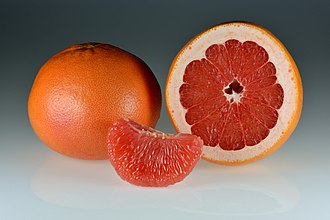
Photo: Wikipedia
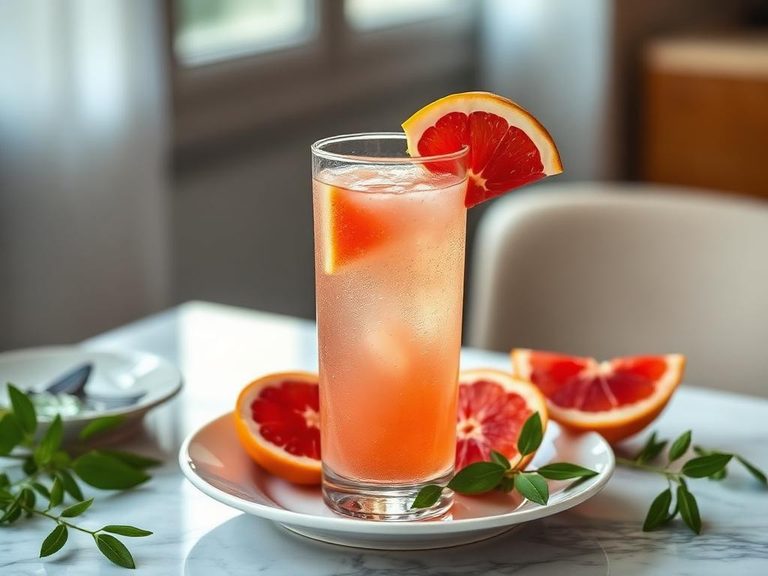
This is a crisp, refreshing bottled juice made from white grapefruits, offering a bright, tangy flavor with a clean, slightly bitter finish and a thin, watery texture. It's a low-calorie, hydrating beverage that provides a quick source of natural sugars and a modest amount of fiber for a bottled drink. Its signature zesty profile makes it a classic palate cleanser and a staple in both breakfast routines and cocktail culture.
Calorie split: 6% protein · 79% carbs · 15% fat
↓ Full nutrition💚 Why it's loved
People adore its bold, invigorating tartness that cuts through sweetness and refreshes the senses. It's cherished for its versatility, equally at home as a morning wake-up call, a mixer in classic cocktails like the Paloma, or a tangy ingredient in salad dressings.
⚠️ Watch-outs & how to enjoy it better
Its high natural sugar content (7.69g per 100g) can cause blood-sugar spikes if consumed in large quantities, making portion control key for those monitoring glucose. The acidity can also aggravate heartburn or acid reflux in sensitive individuals. To mitigate, enjoy a smaller serving (like 150ml) and consider pairing it with a source of protein or fat, such as nuts or yogurt, to slow sugar absorption.
Key benefits
- Low in calories (37 kcal per 100g)
- Good source of hydration
- Contains natural sugars for quick energy
- Provides a small amount of dietary fiber
- Naturally fat-free and cholesterol-free
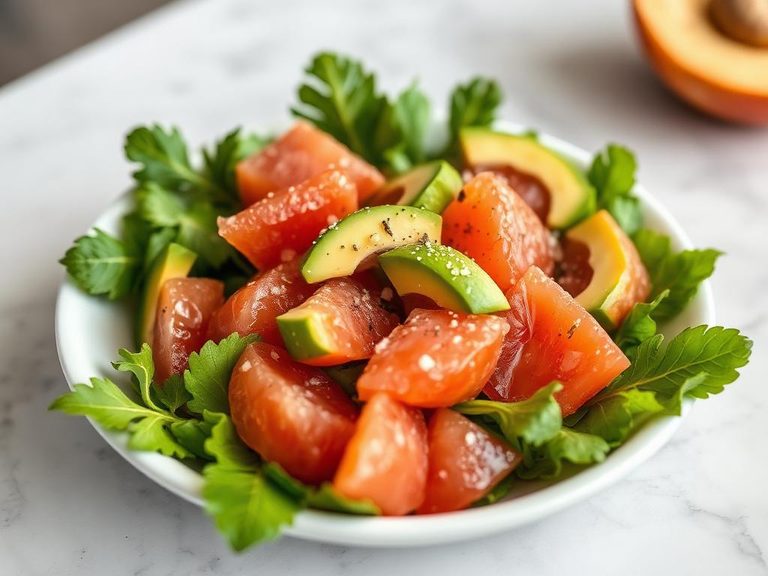
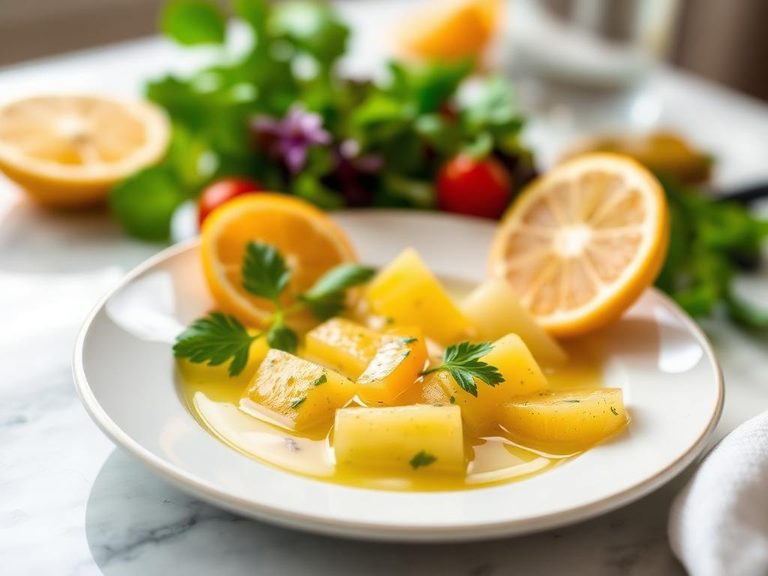
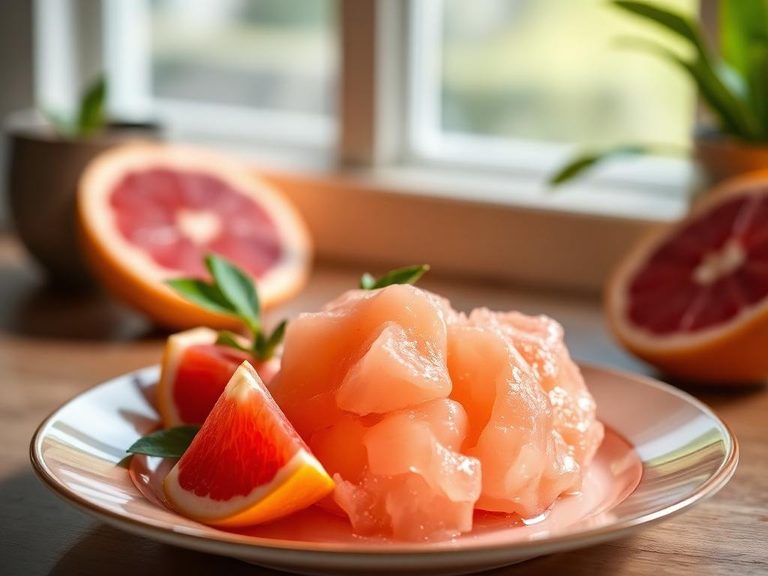
🍽️ Popular dishes

🌍 Where it's eaten
💡 Did you know?
Ocean Spray, a cooperative of cranberry growers, famously pivoted to grapefruit juice in the 1980s after a frost destroyed most of Florida's cranberry crop.
Full nutrition (USDA data · scales with serving)
| Water | 91.0 g |
| Energy | 37.0 kcal |
| Energy | 153 kj |
| Protein | 0.54 g |
| Total lipid (fat) | 0.64 g |
| Ash | 0.29 g |
| Carbohydrate, by difference | 7.5 g |
| Fiber, total dietary | 0.60 g |
| Total Sugars | 7.7 g |
| Sucrose | 1.3 g |
| Glucose | 3.1 g |
| Fructose | 3.2 g |
| Lactose | 0.03 g |
| Maltose | 0.03 g |
| Galactose | 0.03 g |
| Calcium, Ca | 15.0 mg |
| Iron, Fe | 0.08 mg |
| Magnesium, Mg | 9.0 mg |
| Phosphorus, P | 17.0 mg |
| Potassium, K | 142 mg |
| Sodium, Na | 2.0 mg |
| Zinc, Zn | 0.05 mg |
| Copper, Cu | 0.03 mg |
| Manganese, Mn | 0.02 mg |
| Vitamin C, total ascorbic acid | 31.1 mg |
| Thiamin | 0.07 mg |
| Riboflavin | 0.02 mg |
| Niacin | 0.26 mg |
| Pantothenic acid | 0.28 mg |
| Vitamin B-6 | 0.04 mg |
| Folate, total | 15.0 ug |
| Folate, food | 15.0 ug |
| Vitamin B-12 | 0.00 ug |
| Vitamin A, RAE | 2.0 ug |
| Retinol | 0.00 ug |
| Carotene, beta | 20.0 ug |
| Vitamin A, IU | 33.0 iu |
| Vitamin E (alpha-tocopherol) | 0.21 mg |
| Tocopherol, beta | 0.00 mg |
| Tocopherol, gamma | 0.00 mg |
| Tocopherol, delta | 0.00 mg |
| Tocotrienol, alpha | 0.00 mg |
| Tocotrienol, beta | 0.00 mg |
| Tocotrienol, gamma | 0.00 mg |
| Tocotrienol, delta | 0.00 mg |
| Vitamin D (D2 + D3), International Units | 0.00 iu |
| Vitamin D (D2 + D3) | 0.00 ug |
| Alcohol, ethyl | 0.00 g |
| Caffeine | 0.00 mg |
| Theobromine | 0.00 mg |
Fat & fatty acid profile (per 100g)
| Cholesterol | 0.00 mg |
Amino acid profile (per 100g)
Estimated from Grapefruit, sections, canned, juice pack, solids and liquids — USDA does not publish this profile for Grapefruit juice.
| Tryptophan | 0.01 g |
| Threonine | 0.01 g |
| Isoleucine | 0.01 g |
| Leucine | 0.01 g |
| Lysine | 0.02 g |
| Methionine | 0.01 g |
| Cystine | 0.01 g |
| Phenylalanine | 0.04 g |
| Tyrosine | 0.01 g |
| Valine | 0.01 g |
| Arginine | 0.08 g |
| Histidine | 0.01 g |
| Alanine | 0.02 g |
| Aspartic acid | 0.13 g |
| Glutamic acid | 0.18 g |
| Glycine | 0.01 g |
| Proline | 0.06 g |
| Serine | 0.03 g |
FAQ
Is white grapefruit juice the same as pink or ruby red?
No. White grapefruit is the original variety, with a pale yellow flesh and a more pronounced, tart, and slightly bitter flavor. Pink and ruby red varieties are sweeter, less acidic, and have a distinct color from lycopene.
Can I drink this if I'm on medication?
You should be cautious. Grapefruit juice contains compounds called furanocoumarins that can interfere with the enzymes that metabolize many common medications (like some statins, blood pressure drugs, and antihistamines), potentially increasing their concentration in your blood. Always consult your doctor or pharmacist.
Why does it taste bitter?
The bitterness comes from natural compounds called naringin and limonin. White grapefruit has higher levels of these than sweeter pink varieties. Chilling the juice well can help reduce the perception of bitterness.
Nutrient density (calculated · NRF9.3)
Nutrient Rich Foods index: beneficial nutrients (protein, fiber, vitamins, minerals) minus saturated fat, added sugar & sodium, per 100 kcal.
NRF9.3 index — Fulgoni, Keast & Drewnowski, 2009. Computed from USDA nutrients.
Weight-loss friendliness (composite index)
Energy density 0.37 kcal/g · 6% calories from protein · 0.6 g fiber · 7.7 g sugar per 100 g.
Composite of energy density (Rolls et al., 1999), protein & fiber satiety, minus sugar. A calculated heuristic — ranks satiety-per-calorie, not a clinical measure.
Dietary load (calculated from USDA values)
Potential renal acid load. Positive = acid-forming, negative = alkaline-forming.
Sodium-to-potassium ratio: 0.01 (lower is better — aim for ≤ 1)
Sodium:potassium per WHO potassium guidance. Computed from USDA nutrients.