

Fish, shark, mixed species, cooked, batter-dipped and fried
Whole food · Finfish and Shellfish Products

Photo: Wikipedia
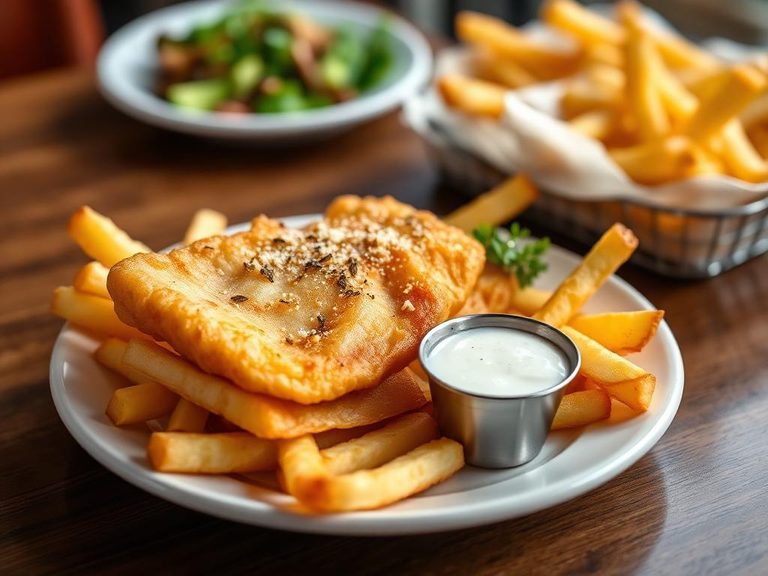
Batter-dipped and fried shark is a golden, crispy indulgence with a surprisingly firm, meaty texture and a mild, slightly sweet flavor. The deep-frying process creates a shatteringly crisp crust that contrasts with the dense, flaky white flesh inside. Nutritionally, it's a high-protein, moderate-fat option with minimal carbohydrates, making it a satisfying, energy-dense meal.
Calorie split: 33% protein · 11% carbs · 55% fat
↓ Full nutrition💚 Why it's loved
People love it for the textural contrast between the crunchy, seasoned batter and the firm, meaty shark flesh, which holds up beautifully to frying without becoming mushy. It's a beloved street food and pub staple in many coastal cultures, offering a satisfying, savory comfort food experience.
⚠️ Watch-outs & how to enjoy it better
The deep-frying method significantly increases the calorie and fat content, which may not suit low-fat diets. Some shark species are high in mercury, so consumption should be moderated, especially for pregnant women and children. To mitigate, choose shark from sustainable, lower-mercury sources and balance the meal with fiber-rich vegetables or a fresh salad to aid digestion.
Key benefits
- Excellent source of lean protein (18.6g per 100g)
- Rich in essential minerals like selenium and phosphorus
- Provides omega-3 fatty acids, beneficial for heart health
- Low in carbohydrates and sugar
- A dense source of energy from protein and healthy fats
🍽️ Popular dishes

🌍 Where it's eaten
💡 Did you know?
Shark meat is sometimes called 'sea chicken' because its firm, dense texture and mild flavor when cooked can resemble chicken breast more than typical flaky fish.
Full nutrition (USDA data · scales with serving)
| Water | 60.1 g |
| Energy | 228 kcal |
| Energy | 954 kj |
| Protein | 18.6 g |
| Total lipid (fat) | 13.8 g |
| Ash | 1.3 g |
| Carbohydrate, by difference | 6.4 g |
| Fiber, total dietary | 0.00 g |
| Calcium, Ca | 50.0 mg |
| Iron, Fe | 1.1 mg |
| Magnesium, Mg | 43.0 mg |
| Phosphorus, P | 194 mg |
| Potassium, K | 155 mg |
| Sodium, Na | 122 mg |
| Zinc, Zn | 0.48 mg |
| Copper, Cu | 0.04 mg |
| Manganese, Mn | 0.05 mg |
| Selenium, Se | 34.0 ug |
| Vitamin C, total ascorbic acid | 0.00 mg |
| Thiamin | 0.07 mg |
| Riboflavin | 0.10 mg |
| Niacin | 2.8 mg |
| Pantothenic acid | 0.62 mg |
| Vitamin B-6 | 0.30 mg |
| Folate, total | 15.0 ug |
| Folic acid | 10.0 ug |
| Folate, food | 5.0 ug |
| Folate, DFE | 22.0 ug |
| Vitamin B-12 | 1.2 ug |
| Vitamin A, RAE | 54.0 ug |
| Retinol | 54.0 ug |
| Vitamin A, IU | 180 iu |
Fat & fatty acid profile (per 100g)
| Fatty acids, total saturated | 3.2 g |
| SFA 14:0 | 0.10 g |
| SFA 16:0 | 2.0 g |
| SFA 18:0 | 1.1 g |
| Fatty acids, total monounsaturated | 5.9 g |
| MUFA 16:1 | 0.22 g |
| MUFA 18:1 | 5.2 g |
| MUFA 20:1 | 0.22 g |
| MUFA 22:1 | 0.25 g |
| Fatty acids, total polyunsaturated | 3.7 g |
| PUFA 18:2 | 2.6 g |
| PUFA 18:3 | 0.19 g |
| PUFA 18:4 | 0.03 g |
| PUFA 20:4 | 0.09 g |
| PUFA 20:5 n-3 (EPA) | 0.26 g |
| PUFA 22:5 n-3 (DPA) | 0.09 g |
| PUFA 22:6 n-3 (DHA) | 0.43 g |
| Cholesterol | 59.0 mg |
Amino acid profile (per 100g)
| Tryptophan | 0.21 g |
| Threonine | 0.84 g |
| Isoleucine | 0.87 g |
| Leucine | 1.5 g |
| Lysine | 1.6 g |
| Methionine | 0.54 g |
| Cystine | 0.21 g |
| Phenylalanine | 0.75 g |
| Tyrosine | 0.63 g |
| Valine | 0.96 g |
| Arginine | 1.1 g |
| Histidine | 0.54 g |
| Alanine | 1.1 g |
| Aspartic acid | 1.9 g |
| Glutamic acid | 3.0 g |
| Glycine | 0.87 g |
| Proline | 0.74 g |
| Serine | 0.79 g |
FAQ
Does fried shark taste fishy?
No, cooked shark meat has a very mild, slightly sweet flavor with almost no 'fishy' taste or smell, which is why it's often compared to chicken or swordfish.
Is the batter what makes it high in carbs?
Yes, the batter is the primary source of carbohydrates (6.39g per 100g). The shark meat itself contains virtually zero carbs.
Can I bake it instead of frying for a healthier version?
You can, but you'll lose the signature crispy crust. For a lighter option, try a light pan-fry in a small amount of oil or an air-fryer to achieve some crispness with less fat.
Nutrient density (calculated · NRF9.3)
Nutrient Rich Foods index: beneficial nutrients (protein, fiber, vitamins, minerals) minus saturated fat, added sugar & sodium, per 100 kcal.
NRF9.3 index — Fulgoni, Keast & Drewnowski, 2009. Computed from USDA nutrients.
Weight-loss friendliness (composite index)
Energy density 2.28 kcal/g · 33% calories from protein · 0.0 g fiber · 0.0 g sugar per 100 g.
Composite of energy density (Rolls et al., 1999), protein & fiber satiety, minus sugar. A calculated heuristic — ranks satiety-per-calorie, not a clinical measure.
Dietary load (calculated from USDA values)
Potential renal acid load. Positive = acid-forming, negative = alkaline-forming.
Sodium-to-potassium ratio: 0.79 (lower is better — aim for ≤ 1)
Sodium:potassium per WHO potassium guidance. Computed from USDA nutrients.