

Chicken, broilers or fryers, skin only, cooked, fried, flour
Whole food · Poultry Products
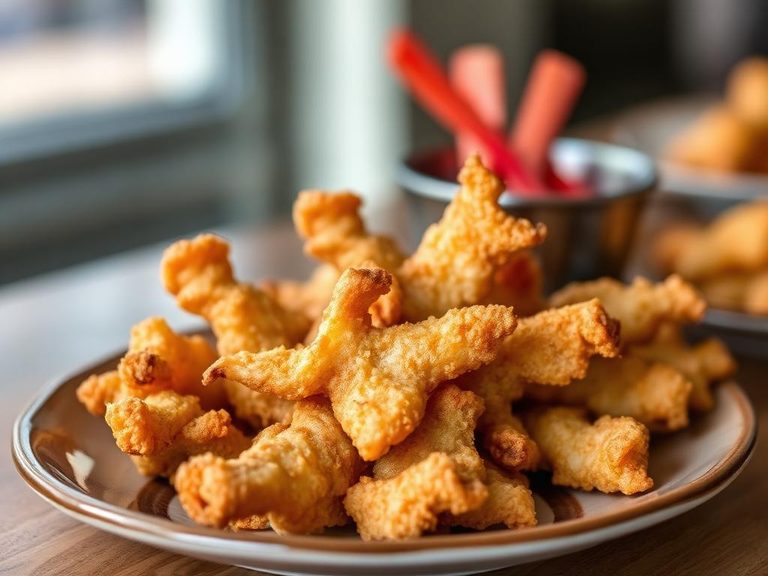
This is the crispy, golden-brown skin of a chicken, separated from the meat and deep-fried after a flour dredging. It delivers an intensely savory, umami-rich flavor with a shattering crunch that gives way to a thin, rendered layer of fat beneath. Nutritionally, it is a calorie-dense powerhouse, packing over 42 grams of fat per 100g, making it a significant source of dietary fat and energy.
Calorie split: 15% protein · 8% carbs · 77% fat
↓ Full nutrition💚 Why it's loved
People adore it for its unparalleled savory crunch and rich, fatty flavor that acts as a flavor magnet in dishes. It's a beloved textural element, often the most sought-after piece of fried chicken, and a staple in comfort food across many cultures.
⚠️ Watch-outs & how to enjoy it better
Its very high fat and calorie density (502 kcal/100g) makes it a poor choice for low-fat diets or those monitoring caloric intake. To counteract this, practice strict portion control, consider it an occasional treat, and pair it with large servings of non-starchy vegetables or a fresh salad to add fiber and volume to the meal without excessive calories.
Key benefits
- Excellent source of dietary fat for energy and satiety.
- Provides a complete protein source (19g per 100g).
- Contains essential nutrients like iron and zinc from the skin and meat residue.
- Offers a satisfying, crunchy texture that enhances meal enjoyment.
🍽️ Popular dishes

🌍 Where it's eaten
💡 Did you know?
In some culinary traditions, chicken skin is not a byproduct but a primary ingredient, meticulously prepared and fried separately to create a delicacy known as 'chicharrón de pollo' or simply 'chicken cracklings.'
Full nutrition (USDA data · scales with serving)
| Water | 28.5 g |
| Energy | 502 kcal |
| Energy | 2100 kj |
| Protein | 19.1 g |
| Total lipid (fat) | 42.6 g |
| Ash | 0.45 g |
| Carbohydrate, by difference | 9.3 g |
| Calcium, Ca | 14.0 mg |
| Iron, Fe | 1.5 mg |
| Magnesium, Mg | 17.0 mg |
| Phosphorus, P | 126 mg |
| Potassium, K | 125 mg |
| Sodium, Na | 53.0 mg |
| Zinc, Zn | 1.1 mg |
| Copper, Cu | 0.08 mg |
| Manganese, Mn | 0.06 mg |
| Selenium, Se | 62.9 ug |
| Vitamin C, total ascorbic acid | 0.00 mg |
| Thiamin | 0.10 mg |
| Riboflavin | 0.17 mg |
| Niacin | 5.8 mg |
| Pantothenic acid | 0.67 mg |
| Vitamin B-6 | 0.10 mg |
| Folate, total | 33.0 ug |
| Folic acid | 29.0 ug |
| Folate, food | 4.0 ug |
| Folate, DFE | 53.0 ug |
| Vitamin B-12 | 0.18 ug |
| Vitamin A, RAE | 70.0 ug |
| Retinol | 70.0 ug |
| Vitamin A, IU | 232 iu |
Fat & fatty acid profile (per 100g)
| Fatty acids, total saturated | 11.7 g |
| SFA 10:0 | 0.00 g |
| SFA 12:0 | 0.03 g |
| SFA 14:0 | 0.31 g |
| SFA 16:0 | 8.5 g |
| SFA 18:0 | 2.6 g |
| Fatty acids, total monounsaturated | 18.0 g |
| MUFA 16:1 | 2.0 g |
| MUFA 18:1 | 15.4 g |
| MUFA 20:1 | 0.43 g |
| MUFA 22:1 | 0.00 g |
| Fatty acids, total polyunsaturated | 9.4 g |
| PUFA 18:2 | 8.7 g |
| PUFA 18:3 | 0.41 g |
| PUFA 20:4 | 0.09 g |
| PUFA 20:5 n-3 (EPA) | 0.02 g |
| PUFA 22:5 n-3 (DPA) | 0.01 g |
| PUFA 22:6 n-3 (DHA) | 0.03 g |
| Cholesterol | 73.0 mg |
Amino acid profile (per 100g)
| Tryptophan | 0.16 g |
| Threonine | 0.67 g |
| Isoleucine | 0.63 g |
| Leucine | 1.1 g |
| Lysine | 1.1 g |
| Methionine | 0.38 g |
| Cystine | 0.33 g |
| Phenylalanine | 0.67 g |
| Tyrosine | 0.45 g |
| Valine | 0.81 g |
| Arginine | 1.4 g |
| Histidine | 0.37 g |
| Alanine | 1.5 g |
| Aspartic acid | 1.6 g |
| Glutamic acid | 2.7 g |
| Glycine | 2.9 g |
| Proline | 1.8 g |
| Serine | 0.80 g |
FAQ
Is this the same as eating the skin on a piece of fried chicken?
Yes, it is the skin that has been removed from the meat, then typically dredged in flour and fried separately, resulting in a more uniformly crispy texture.
Why is the calorie count so high?
The skin is primarily composed of fat. Deep-frying it renders some fat out but also allows it to absorb cooking oil, while the flour coating adds carbohydrates, leading to a very energy-dense final product.
Can I use this in recipes that call for bacon?
Yes, fried chicken skin can be a fantastic substitute for bacon in salads, baked potatoes, or as a garnish, providing a similar salty, crunchy, and fatty element.
Nutrient density (calculated · NRF9.3)
Nutrient Rich Foods index: beneficial nutrients (protein, fiber, vitamins, minerals) minus saturated fat, added sugar & sodium, per 100 kcal.
NRF9.3 index — Fulgoni, Keast & Drewnowski, 2009. Computed from USDA nutrients.
Weight-loss friendliness (composite index)
Energy density 5.02 kcal/g · 15% calories from protein · 0.0 g fiber · 0.0 g sugar per 100 g.
Composite of energy density (Rolls et al., 1999), protein & fiber satiety, minus sugar. A calculated heuristic — ranks satiety-per-calorie, not a clinical measure.
Dietary load (calculated from USDA values)
Potential renal acid load. Positive = acid-forming, negative = alkaline-forming.
Sodium-to-potassium ratio: 0.42 (lower is better — aim for ≤ 1)
Sodium:potassium per WHO potassium guidance. Computed from USDA nutrients.