

Carrot juice, canned
Whole food · Vegetables and Vegetable Products
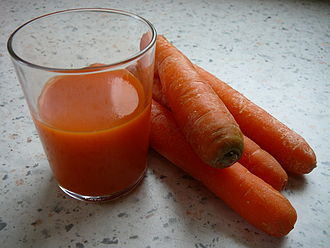
Photo: Wikipedia
Canned carrot juice is a vibrant, sweet, and earthy liquid, often with a smooth, slightly pulpy texture depending on the brand. It offers a concentrated dose of beta-carotene and a quick, natural energy boost with its 9.28g of carbohydrates per 100g. The flavor is distinctly carrot-forward, with a subtle sweetness that can be enjoyed straight from the can or as a base for other beverages.
Calorie split: 9% protein · 88% carbs · 3% fat
↓ Full nutrition💚 Why it's loved
People love it for its naturally sweet, vibrant flavor that feels both refreshing and nourishing, making it a popular standalone drink or a versatile base for smoothies and cocktails. It's a staple in many health-conscious diets and a comforting, familiar taste in various global cuisines.
⚠️ Watch-outs & how to enjoy it better
The high natural sugar content (3.91g per 100g) can cause a rapid blood-sugar spike if consumed in large quantities, which is a concern for those managing diabetes. To counteract this, pair it with a source of protein or healthy fat (like a handful of nuts or a hard-boiled egg) and practice portion control by limiting intake to about 150-200ml at a time.
Key benefits
- Rich in beta-carotene, which the body converts to vitamin A
- Provides a quick source of natural energy from carbohydrates
- Contains a small amount of dietary fiber for digestive support
- Low in fat and cholesterol-free
- Convenient and shelf-stable for long-term storage
🍽️ Popular dishes




🌍 Where it's eaten
💡 Did you know?
The vibrant orange color of carrot juice comes from beta-carotene, a pigment that was first isolated by a German chemist in 1831 and is so potent it can temporarily tint your skin a yellow-orange hue if consumed in very large amounts over time.
Full nutrition (USDA data · scales with serving)
| Water | 88.9 g |
| Energy | 40.0 kcal |
| Energy | 165 kj |
| Protein | 0.95 g |
| Total lipid (fat) | 0.15 g |
| Ash | 0.75 g |
| Carbohydrate, by difference | 9.3 g |
| Fiber, total dietary | 0.80 g |
| Total Sugars | 3.9 g |
| Calcium, Ca | 24.0 mg |
| Iron, Fe | 0.46 mg |
| Magnesium, Mg | 14.0 mg |
| Phosphorus, P | 42.0 mg |
| Potassium, K | 292 mg |
| Sodium, Na | 66.0 mg |
| Zinc, Zn | 0.18 mg |
| Copper, Cu | 0.05 mg |
| Manganese, Mn | 0.13 mg |
| Selenium, Se | 0.60 ug |
| Vitamin C, total ascorbic acid | 8.5 mg |
| Thiamin | 0.09 mg |
| Riboflavin | 0.06 mg |
| Niacin | 0.39 mg |
| Pantothenic acid | 0.23 mg |
| Vitamin B-6 | 0.22 mg |
| Folate, total | 4.0 ug |
| Folic acid | 0.00 ug |
| Folate, food | 4.0 ug |
| Folate, DFE | 4.0 ug |
| Choline, total | 9.9 mg |
| Vitamin B-12 | 0.00 ug |
| Vitamin B-12, added | 0.00 ug |
| Vitamin A, RAE | 956 ug |
| Retinol | 0.00 ug |
| Carotene, beta | 9303 ug |
| Carotene, alpha | 4342 ug |
| Cryptoxanthin, beta | 0.00 ug |
| Vitamin A, IU | 19124 iu |
| Lycopene | 2.0 ug |
| Lutein + zeaxanthin | 333 ug |
| Vitamin E (alpha-tocopherol) | 1.2 mg |
| Vitamin E, added | 0.00 mg |
| Vitamin D (D2 + D3), International Units | 0.00 iu |
| Vitamin D (D2 + D3) | 0.00 ug |
| Vitamin K (phylloquinone) | 15.5 ug |
| Alcohol, ethyl | 0.00 g |
| Caffeine | 0.00 mg |
| Theobromine | 0.00 mg |
Fat & fatty acid profile (per 100g)
| Fatty acids, total saturated | 0.03 g |
| SFA 4:0 | 0.00 g |
| SFA 6:0 | 0.00 g |
| SFA 8:0 | 0.00 g |
| SFA 10:0 | 0.00 g |
| SFA 12:0 | 0.00 g |
| SFA 14:0 | 0.00 g |
| SFA 16:0 | 0.02 g |
| SFA 18:0 | 0.00 g |
| Fatty acids, total monounsaturated | 0.01 g |
| MUFA 16:1 | 0.00 g |
| MUFA 18:1 | 0.01 g |
| MUFA 20:1 | 0.00 g |
| MUFA 22:1 | 0.00 g |
| Fatty acids, total polyunsaturated | 0.07 g |
| PUFA 18:2 | 0.06 g |
| PUFA 18:3 | 0.01 g |
| PUFA 18:4 | 0.00 g |
| PUFA 20:4 | 0.00 g |
| PUFA 20:5 n-3 (EPA) | 0.00 g |
| PUFA 22:5 n-3 (DPA) | 0.00 g |
| PUFA 22:6 n-3 (DHA) | 0.00 g |
| Fatty acids, total trans | 0.00 g |
| Cholesterol | 0.00 mg |
FAQ
Is canned carrot juice as nutritious as fresh?
Canned carrot juice retains most of its vitamins and minerals, especially beta-carotene, but may lose some heat-sensitive nutrients like vitamin C during the pasteurization process. It is still a highly nutritious option.
Can I drink carrot juice every day?
Yes, in moderation. A daily serving of 150-200ml is generally safe and beneficial. However, excessive consumption can lead to carotenemia (a harmless yellowing of the skin) and may contribute to high sugar intake.
Does canned carrot juice contain added sugar?
Most brands of canned carrot juice do not contain added sugar; the sweetness comes naturally from the carrots. However, it's always best to check the label for any added ingredients.
Nutrient density (calculated · NRF9.3)
Nutrient Rich Foods index: beneficial nutrients (protein, fiber, vitamins, minerals) minus saturated fat, added sugar & sodium, per 100 kcal.
NRF9.3 index — Fulgoni, Keast & Drewnowski, 2009. Computed from USDA nutrients.
Weight-loss friendliness (composite index)
Energy density 0.40 kcal/g · 10% calories from protein · 0.8 g fiber · 3.9 g sugar per 100 g.
Composite of energy density (Rolls et al., 1999), protein & fiber satiety, minus sugar. A calculated heuristic — ranks satiety-per-calorie, not a clinical measure.
Dietary load (calculated from USDA values)
Potential renal acid load. Positive = acid-forming, negative = alkaline-forming.
Sodium-to-potassium ratio: 0.23 (lower is better — aim for ≤ 1)
Sodium:potassium per WHO potassium guidance. Computed from USDA nutrients.