

Alcoholic beverage, whiskey sour
Whole food · Beverages

Photo: Wikipedia
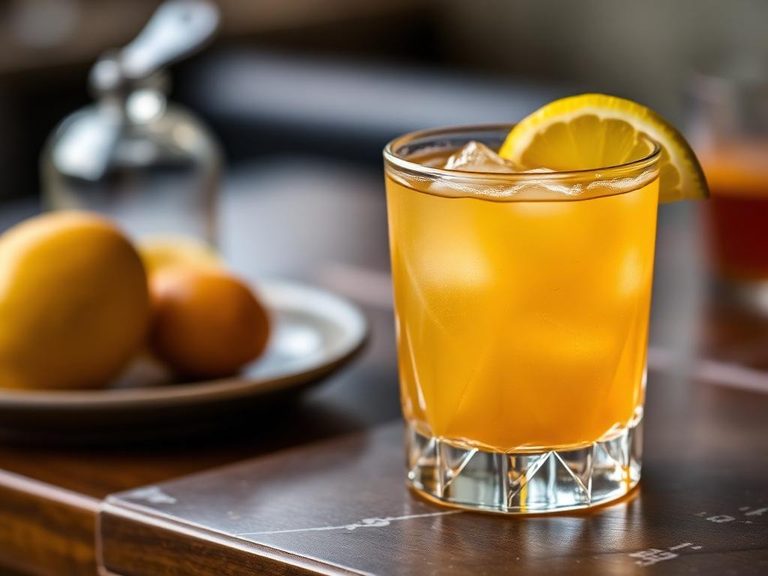
The whiskey sour is a classic cocktail that masterfully balances the robust, oaky warmth of whiskey with the sharp, bright tang of lemon juice, all rounded out by a touch of sweetener. Its texture is typically smooth and slightly frothy, especially when traditionally shaken with egg white, creating a luxurious mouthfeel. Nutritionally, it's a low-fat, low-protein drink, deriving its calories almost entirely from alcohol and the simple carbohydrates in its sweetening syrup.
Calorie split: 0% protein · 99% carbs · 1% fat
↓ Full nutrition💚 Why it's loved
People love the whiskey sour for its perfect equilibrium of sweet, sour, and spirited flavors, making it a refreshing yet complex sipper. It's a versatile template that can be customized with different whiskeys, sweeteners, or the addition of bitters, cementing its status as a timeless bar staple.
⚠️ Watch-outs & how to enjoy it better
The primary concern is the alcohol content, which can impair judgment and contribute empty calories; it's not suitable for those avoiding alcohol, pregnant individuals, or those with certain medical conditions. The citrus juice can also be harsh on sensitive teeth or stomachs. To mitigate, consume in moderation, sip slowly, and consider having it with a meal to slow alcohol absorption.
Key benefits
- Contains antioxidants from whiskey's grain base
- Lemon juice provides a dose of Vitamin C
- Can be a lower-sugar cocktail option when made with fresh juice
- May aid in social relaxation and stress relief
🍽️ Popular dishes
🌍 Where it's eaten
💡 Did you know?
The whiskey sour is one of the oldest cocktails, with its first known recipe published in Jerry Thomas's 1862 'How to Mix Drinks,' predating even the Old Fashioned.
Full nutrition (USDA data · scales with serving)
| Water | 72.6 g |
| Energy | 149 kcal |
| Energy | 623 kj |
| Protein | 0.00 g |
| Total lipid (fat) | 0.03 g |
| Ash | 0.10 g |
| Carbohydrate, by difference | 13.2 g |
| Fiber, total dietary | 0.00 g |
| Calcium, Ca | 1.0 mg |
| Iron, Fe | 0.08 mg |
| Magnesium, Mg | 1.0 mg |
| Phosphorus, P | 6.0 mg |
| Potassium, K | 5.0 mg |
| Sodium, Na | 20.0 mg |
| Zinc, Zn | 0.06 mg |
| Copper, Cu | 0.01 mg |
| Manganese, Mn | 0.01 mg |
| Selenium, Se | 0.10 ug |
| Vitamin C, total ascorbic acid | 1.6 mg |
| Thiamin | 0.01 mg |
| Riboflavin | 0.01 mg |
| Niacin | 0.02 mg |
| Pantothenic acid | 0.01 mg |
| Vitamin B-6 | 0.00 mg |
| Folate, total | 0.00 ug |
| Folic acid | 0.00 ug |
| Folate, food | 0.00 ug |
| Folate, DFE | 0.00 ug |
| Vitamin B-12 | 0.00 ug |
| Retinol | 0.00 ug |
| Vitamin A, IU | 13.0 iu |
| Alcohol, ethyl | 14.1 g |
Fat & fatty acid profile (per 100g)
| Fatty acids, total saturated | 0.01 g |
| SFA 4:0 | 0.00 g |
| SFA 6:0 | 0.00 g |
| SFA 8:0 | 0.00 g |
| SFA 10:0 | 0.00 g |
| SFA 12:0 | 0.00 g |
| SFA 14:0 | 0.00 g |
| SFA 16:0 | 0.01 g |
| SFA 18:0 | 0.00 g |
| Fatty acids, total monounsaturated | 0.00 g |
| MUFA 16:1 | 0.00 g |
| MUFA 18:1 | 0.00 g |
| MUFA 20:1 | 0.00 g |
| MUFA 22:1 | 0.00 g |
| Fatty acids, total polyunsaturated | 0.01 g |
| PUFA 18:2 | 0.01 g |
| PUFA 18:3 | 0.00 g |
| PUFA 18:4 | 0.00 g |
| PUFA 20:4 | 0.00 g |
| PUFA 20:5 n-3 (EPA) | 0.00 g |
| PUFA 22:5 n-3 (DPA) | 0.00 g |
| PUFA 22:6 n-3 (DHA) | 0.00 g |
| Fatty acids, total trans | 0.00 g |
| Cholesterol | 0.00 mg |
Amino acid profile (per 100g)
Estimated from Alcoholic beverage, distilled, vodka, 80 proof — USDA does not publish this profile for Alcoholic beverage.
| Tryptophan | 0.00 g |
| Threonine | 0.00 g |
| Isoleucine | 0.00 g |
| Leucine | 0.00 g |
| Lysine | 0.00 g |
| Methionine | 0.00 g |
| Cystine | 0.00 g |
| Phenylalanine | 0.00 g |
| Tyrosine | 0.00 g |
| Valine | 0.00 g |
| Arginine | 0.00 g |
| Histidine | 0.00 g |
| Alanine | 0.00 g |
| Aspartic acid | 0.00 g |
| Glutamic acid | 0.00 g |
| Glycine | 0.00 g |
| Proline | 0.00 g |
| Serine | 0.00 g |
FAQ
What's the difference between a whiskey sour and a Boston Sour?
A Boston Sour is simply a whiskey sour that includes egg white, which is shaken to create a rich, frothy texture and a milder, silkier flavor profile.
Can I make a whiskey sour without simple syrup?
Yes, you can substitute simple syrup with other sweeteners like honey syrup, maple syrup, or agave nectar, each adding a distinct flavor nuance to the drink.
Is a whiskey sour a strong drink?
It's moderately strong, typically containing about 2 ounces (60ml) of whiskey. Its perceived strength can vary based on the whiskey used, the balance of sour and sweet, and whether it's served on the rocks or straight up.
Nutrient density (calculated · NRF9.3)
Nutrient Rich Foods index: beneficial nutrients (protein, fiber, vitamins, minerals) minus saturated fat, added sugar & sodium, per 100 kcal.
NRF9.3 index — Fulgoni, Keast & Drewnowski, 2009. Computed from USDA nutrients.
Weight-loss friendliness (composite index)
Energy density 1.49 kcal/g · 0% calories from protein · 0.0 g fiber · 0.0 g sugar per 100 g.
Composite of energy density (Rolls et al., 1999), protein & fiber satiety, minus sugar. A calculated heuristic — ranks satiety-per-calorie, not a clinical measure.
Dietary load (calculated from USDA values)
Potential renal acid load. Positive = acid-forming, negative = alkaline-forming.
Sodium-to-potassium ratio: 4.00 (lower is better — aim for ≤ 1)
Sodium:potassium per WHO potassium guidance. Computed from USDA nutrients.