

Puddings, lemon, dry mix, instant, prepared with whole milk
Whole food · Sweets
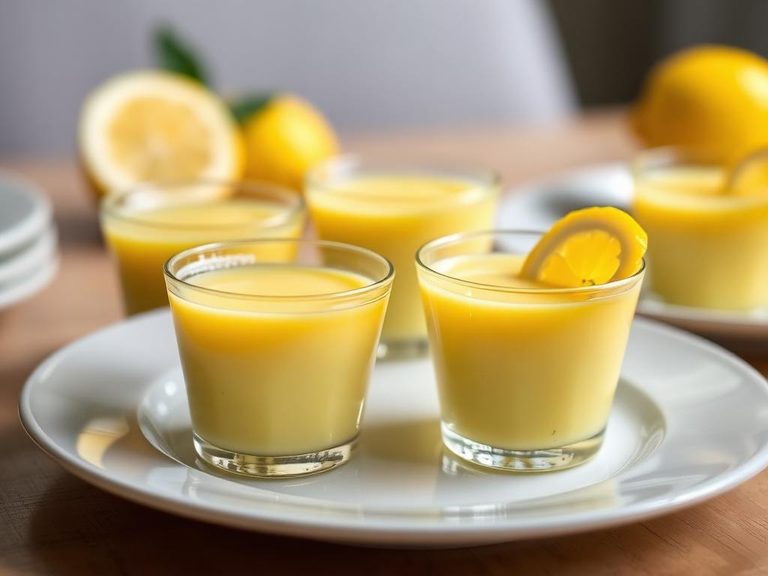
This is a quick-set, bright yellow pudding made from an instant dry mix and whole milk, delivering a smooth, creamy, and slightly jiggly texture with a distinct, tangy lemon flavor. It's a nostalgic, comforting dessert that's light yet satisfying, with a nutrition profile centered on quick-energy carbohydrates from its 20.1g per 100g content.
Calorie split: 9% protein · 69% carbs · 22% fat
↓ Full nutrition💚 Why it's loved
People adore its classic, nostalgic lemon flavor that balances sweet and tart, and its foolproof, creamy texture that requires no cooking. It's a beloved, simple comfort food that evokes childhood memories and pairs well with cookies or fruit.
⚠️ Watch-outs & how to enjoy it better
The primary downside is its high carbohydrate content from added sugars and starches, which can cause a rapid blood-sugar spike, making it less ideal for those managing diabetes. To counteract this, pair it with a source of protein or healthy fat (like nuts or a dollop of Greek yogurt) and practice portion control by sticking to a single serving.
Key benefits
- Provides quick energy from carbohydrates
- Contains calcium and protein from whole milk
- Low in fat compared to many desserts
- Convenient and fast to prepare
- Offers a portion-controlled treat
🍽️ Popular dishes




🌍 Where it's eaten
💡 Did you know?
The 'instant' setting power comes from modified food starch and tetrasodium pyrophosphate, which react with the calcium in milk to form a gel without requiring heat.
Full nutrition (USDA data · scales with serving)
| Water | 73.2 g |
| Energy | 115 kcal |
| Energy | 481 kj |
| Protein | 2.7 g |
| Total lipid (fat) | 2.9 g |
| Ash | 1.1 g |
| Carbohydrate, by difference | 20.1 g |
| Fiber, total dietary | 0.00 g |
| Calcium, Ca | 99.0 mg |
| Iron, Fe | 0.06 mg |
| Magnesium, Mg | 11.0 mg |
| Phosphorus, P | 205 mg |
| Potassium, K | 127 mg |
| Sodium, Na | 267 mg |
| Zinc, Zn | 0.32 mg |
| Copper, Cu | 0.01 mg |
| Manganese, Mn | 0.00 mg |
| Selenium, Se | 1.8 ug |
| Fluoride, F | 22.0 ug |
| Vitamin C, total ascorbic acid | 0.80 mg |
| Thiamin | 0.03 mg |
| Riboflavin | 0.14 mg |
| Niacin | 0.07 mg |
| Pantothenic acid | 0.26 mg |
| Vitamin B-6 | 0.04 mg |
| Folate, total | 4.0 ug |
| Folic acid | 0.00 ug |
| Folate, food | 4.0 ug |
| Folate, DFE | 4.0 ug |
| Vitamin B-12 | 0.30 ug |
| Vitamin A, RAE | 24.0 ug |
| Retinol | 23.0 ug |
| Carotene, beta | 15.0 ug |
| Vitamin A, IU | 105 iu |
Fat & fatty acid profile (per 100g)
| Fatty acids, total saturated | 1.7 g |
| SFA 4:0 | 0.09 g |
| SFA 6:0 | 0.05 g |
| SFA 8:0 | 0.03 g |
| SFA 10:0 | 0.07 g |
| SFA 12:0 | 0.08 g |
| SFA 14:0 | 0.29 g |
| SFA 16:0 | 0.77 g |
| SFA 18:0 | 0.36 g |
| Fatty acids, total monounsaturated | 0.85 g |
| MUFA 16:1 | 0.07 g |
| MUFA 18:1 | 0.78 g |
| Fatty acids, total polyunsaturated | 0.15 g |
| PUFA 18:2 | 0.10 g |
| PUFA 18:3 | 0.05 g |
| PUFA 20:4 | 0.00 g |
| Cholesterol | 11.0 mg |
| Phytosterols | 0.00 mg |
Amino acid profile (per 100g)
| Tryptophan | 0.04 g |
| Threonine | 0.12 g |
| Isoleucine | 0.16 g |
| Leucine | 0.26 g |
| Lysine | 0.21 g |
| Methionine | 0.07 g |
| Cystine | 0.02 g |
| Phenylalanine | 0.13 g |
| Tyrosine | 0.13 g |
| Valine | 0.17 g |
| Arginine | 0.09 g |
| Histidine | 0.07 g |
| Alanine | 0.09 g |
| Aspartic acid | 0.20 g |
| Glutamic acid | 0.55 g |
| Glycine | 0.06 g |
| Proline | 0.25 g |
| Serine | 0.14 g |
FAQ
Can I use a milk alternative like almond or soy milk?
It's not recommended. The instant mix relies on the specific proteins and calcium in dairy milk to set properly. Using a non-dairy milk will likely result in a thin, runny pudding that won't firm up.
Why is my pudding lumpy?
Lumps form if the dry mix isn't fully incorporated before adding all the milk. To prevent this, whisk the dry mix with just a few tablespoons of cold milk to form a smooth paste first, then gradually whisk in the remaining milk.
How long does prepared pudding last in the fridge?
When covered and refrigerated, it will maintain good quality and food safety for 3 to 4 days. The texture may become slightly firmer over time.
Nutrient density (calculated · NRF9.3)
Nutrient Rich Foods index: beneficial nutrients (protein, fiber, vitamins, minerals) minus saturated fat, added sugar & sodium, per 100 kcal.
NRF9.3 index — Fulgoni, Keast & Drewnowski, 2009. Computed from USDA nutrients.
Weight-loss friendliness (composite index)
Energy density 1.15 kcal/g · 9% calories from protein · 0.0 g fiber · 0.0 g sugar per 100 g.
Composite of energy density (Rolls et al., 1999), protein & fiber satiety, minus sugar. A calculated heuristic — ranks satiety-per-calorie, not a clinical measure.
Dietary load (calculated from USDA values)
Potential renal acid load. Positive = acid-forming, negative = alkaline-forming.
Sodium-to-potassium ratio: 2.10 (lower is better — aim for ≤ 1)
Sodium:potassium per WHO potassium guidance. Computed from USDA nutrients.