

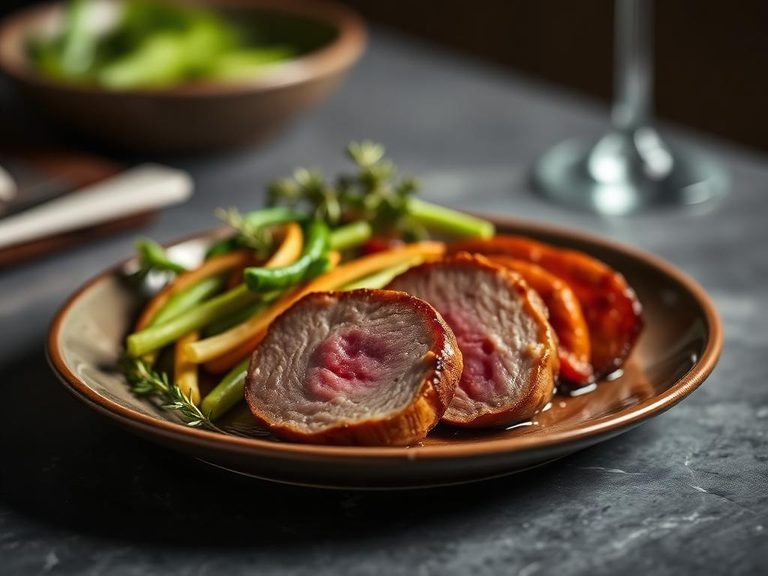
Pork, fresh, composite of trimmed retail cuts (loin and shoulder blade), separable lean only, cooked
Whole food · Pork Products

Photo: Wikipedia
This is lean pork from the loin and shoulder blade, cooked to a tender, juicy finish. It has a mild, savory flavor with a fine, firm texture that absorbs marinades and seasonings beautifully. Nutritionally, it's a powerhouse of complete protein with virtually no fat or carbohydrates.
Calorie split: 58% protein · 0% carbs · 42% fat
↓ Full nutrition💚 Why it's loved
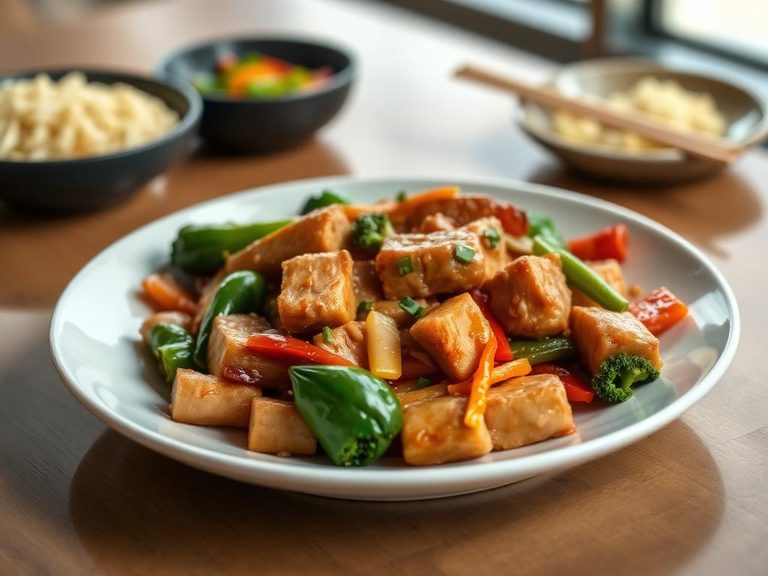
People love it for its clean, meaty flavor that serves as a perfect canvas for countless global cuisines, from Chinese stir-fries to American barbecue. Its versatility and lean profile make it a reliable staple for both quick weeknight meals and slow-cooked comfort food.
⚠️ Watch-outs & how to enjoy it better
As a very lean cut, it can become dry and tough if overcooked, requiring careful temperature control. Those monitoring sodium intake should be cautious with pre-marinated or processed versions. Counteract dryness by using moist-heat methods (braising, stewing) or brining before grilling.
Key benefits
- Excellent source of complete, high-quality protein
- Very low in carbohydrates and sugars
- Provides essential B vitamins like B1 (thiamine) and B6
- Rich in minerals such as selenium and phosphorus
- Lean cut supports muscle maintenance and satiety
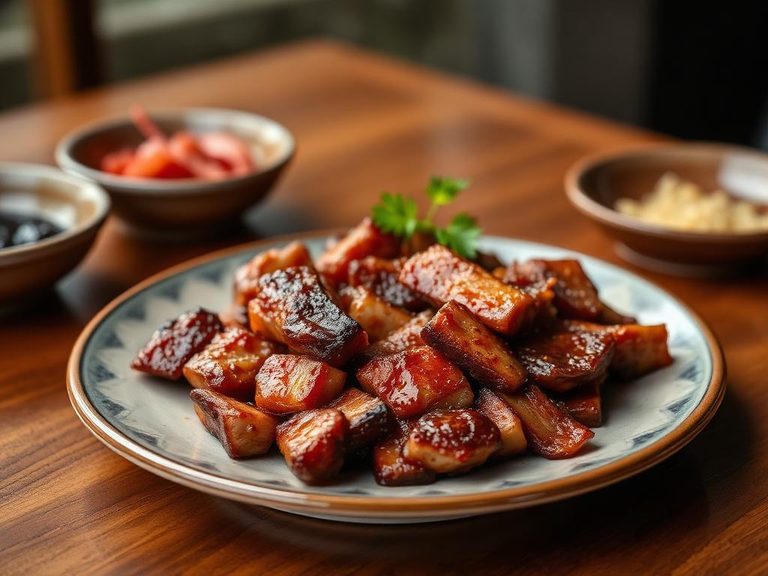
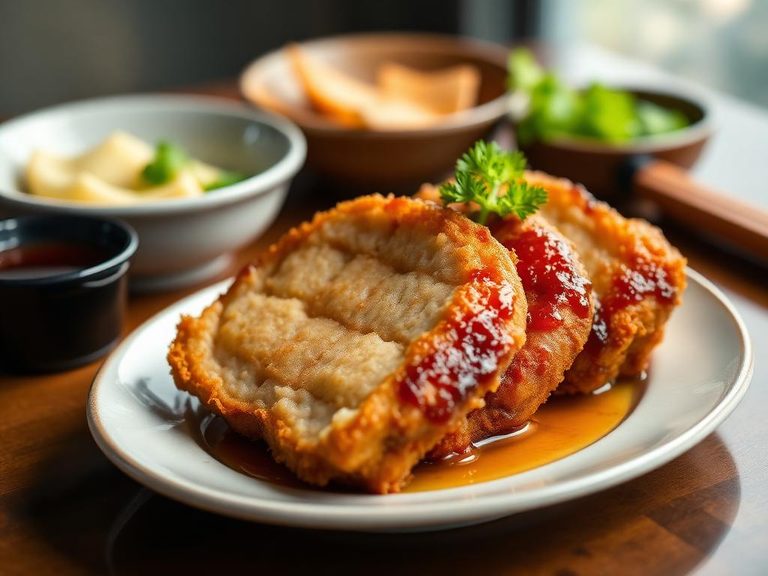
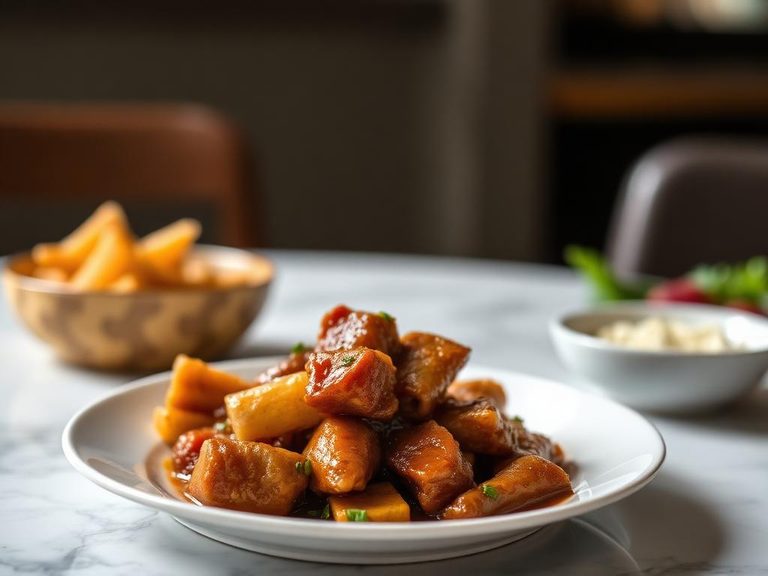
🍽️ Popular dishes

🌍 Where it's eaten
💡 Did you know?
Pork loin is so lean that it's often used as a dietary substitute for other red meats in clinical nutrition studies focused on heart health.
Full nutrition (USDA data · scales with serving)
| Water | 60.3 g |
| Energy | 211 kcal |
| Energy | 883 kj |
| Protein | 29.5 g |
| Total lipid (fat) | 9.4 g |
| Ash | 1.2 g |
| Carbohydrate, by difference | 0.00 g |
| Fiber, total dietary | 0.00 g |
| Calcium, Ca | 22.0 mg |
| Iron, Fe | 1.1 mg |
| Magnesium, Mg | 26.0 mg |
| Phosphorus, P | 234 mg |
| Potassium, K | 377 mg |
| Sodium, Na | 57.0 mg |
| Zinc, Zn | 2.9 mg |
| Copper, Cu | 0.05 mg |
| Manganese, Mn | 0.01 mg |
| Selenium, Se | 45.4 ug |
| Vitamin C, total ascorbic acid | 0.40 mg |
| Thiamin | 0.87 mg |
| Riboflavin | 0.34 mg |
| Niacin | 5.3 mg |
| Pantothenic acid | 0.69 mg |
| Vitamin B-6 | 0.43 mg |
| Folate, total | 6.0 ug |
| Folic acid | 0.00 ug |
| Folate, food | 6.0 ug |
| Folate, DFE | 6.0 ug |
| Vitamin B-12 | 0.75 ug |
| Vitamin A, RAE | 2.0 ug |
| Retinol | 2.0 ug |
| Vitamin A, IU | 7.0 iu |
Fat & fatty acid profile (per 100g)
| Fatty acids, total saturated | 3.3 g |
| SFA 10:0 | 0.01 g |
| SFA 12:0 | 0.01 g |
| SFA 14:0 | 0.12 g |
| SFA 16:0 | 2.1 g |
| SFA 18:0 | 1.1 g |
| Fatty acids, total monounsaturated | 4.2 g |
| MUFA 16:1 | 0.31 g |
| MUFA 18:1 | 3.8 g |
| MUFA 20:1 | 0.09 g |
| Fatty acids, total polyunsaturated | 0.71 g |
| PUFA 18:2 | 0.61 g |
| PUFA 18:3 | 0.02 g |
| PUFA 20:4 | 0.05 g |
| Cholesterol | 85.0 mg |
Amino acid profile (per 100g)
| Tryptophan | 0.37 g |
| Threonine | 1.3 g |
| Isoleucine | 1.4 g |
| Leucine | 2.4 g |
| Lysine | 2.6 g |
| Methionine | 0.78 g |
| Cystine | 0.38 g |
| Phenylalanine | 1.2 g |
| Tyrosine | 1.0 g |
| Valine | 1.6 g |
| Arginine | 1.8 g |
| Histidine | 1.2 g |
| Alanine | 1.7 g |
| Aspartic acid | 2.7 g |
| Glutamic acid | 4.6 g |
| Glycine | 1.4 g |
| Proline | 1.2 g |
| Serine | 1.2 g |
FAQ
How do I prevent lean pork from drying out?
Use a meat thermometer to cook to an internal temperature of 145°F (63°C), followed by a 3-minute rest. For added moisture, try brining in a saltwater solution for 1-2 hours before cooking.
Is this cut suitable for a low-fat diet?
Yes, it's one of the leanest red meat options available, with most of the fat being unsaturated. Trimming any visible fat before cooking further reduces the fat content.
What's the best way to add flavor without adding fat?
Use dry rubs with spices like paprika, garlic powder, and cumin, or marinate in acidic mixtures (citrus, vinegar) with herbs. Grilling or broiling can also create a flavorful crust without added fats.
Nutrient density (calculated · NRF9.3)
Nutrient Rich Foods index: beneficial nutrients (protein, fiber, vitamins, minerals) minus saturated fat, added sugar & sodium, per 100 kcal.
NRF9.3 index — Fulgoni, Keast & Drewnowski, 2009. Computed from USDA nutrients.
Weight-loss friendliness (composite index)
Energy density 2.11 kcal/g · 56% calories from protein · 0.0 g fiber · 0.0 g sugar per 100 g.
Composite of energy density (Rolls et al., 1999), protein & fiber satiety, minus sugar. A calculated heuristic — ranks satiety-per-calorie, not a clinical measure.
Dietary load (calculated from USDA values)
Potential renal acid load. Positive = acid-forming, negative = alkaline-forming.
Sodium-to-potassium ratio: 0.15 (lower is better — aim for ≤ 1)
Sodium:potassium per WHO potassium guidance. Computed from USDA nutrients.