

Pie, coconut custard, commercially prepared
Whole food · Baked Products
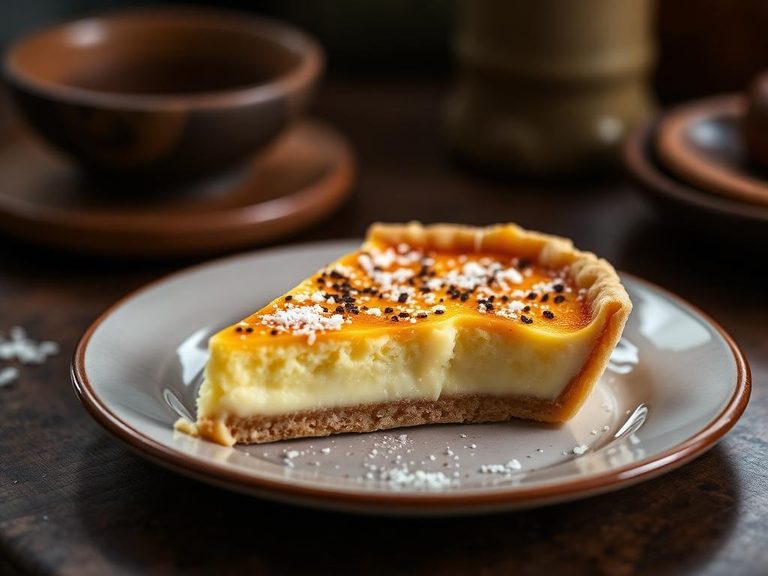
A classic dessert featuring a rich, creamy custard filling made with eggs and coconut, baked in a flaky pastry shell. The texture is smooth and velvety with a sweet, tropical coconut flavor that is both comforting and indulgent. Nutritionally, it provides a notable amount of fat and carbohydrates, making it a dense, energy-rich treat.
Calorie split: 9% protein · 46% carbs · 45% fat
↓ Full nutrition💚 Why it's loved
People love it for its decadent, creamy texture and the sweet, tropical aroma of coconut that evokes a sense of comfort and nostalgia. It's a versatile dessert that pairs well with coffee or tea and is often a staple at family gatherings and holiday meals.
⚠️ Watch-outs & how to enjoy it better
Its high fat and carbohydrate content can lead to blood sugar spikes, especially for those with insulin sensitivity. To counteract this, enjoy a small portion (like 1/8 of a pie) and pair it with a source of protein or fiber, such as a handful of nuts or a side of berries, to slow digestion and stabilize blood sugar.
Key benefits
- Good source of dietary fat for satiety.
- Provides a quick energy boost from carbohydrates.
- Contains some protein from eggs and coconut.
- Offers a comforting, nostalgic flavor profile.
🍽️ Popular dishes
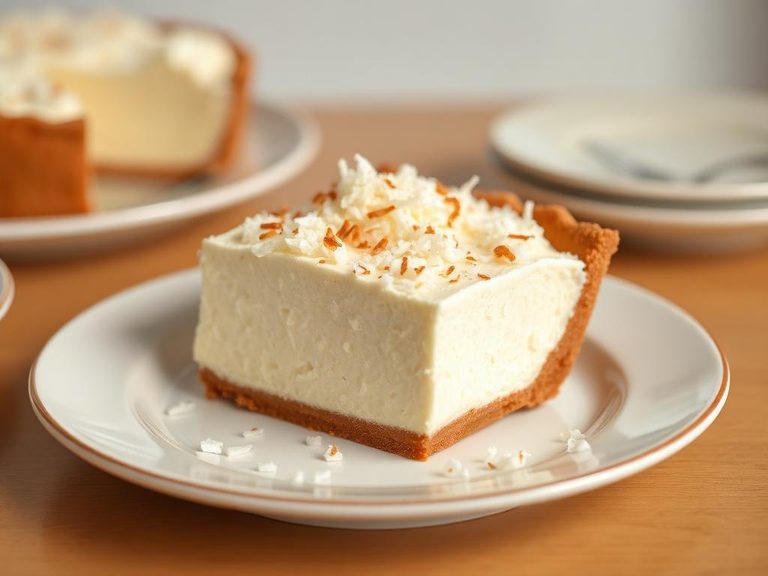
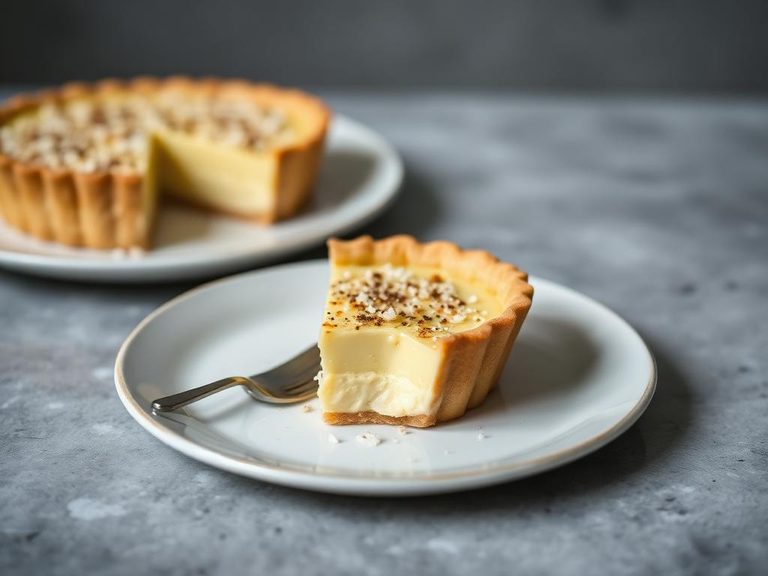
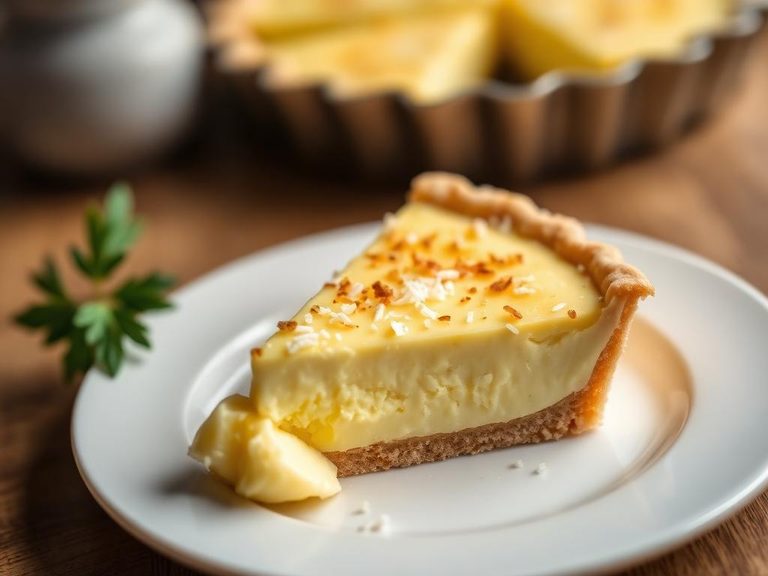
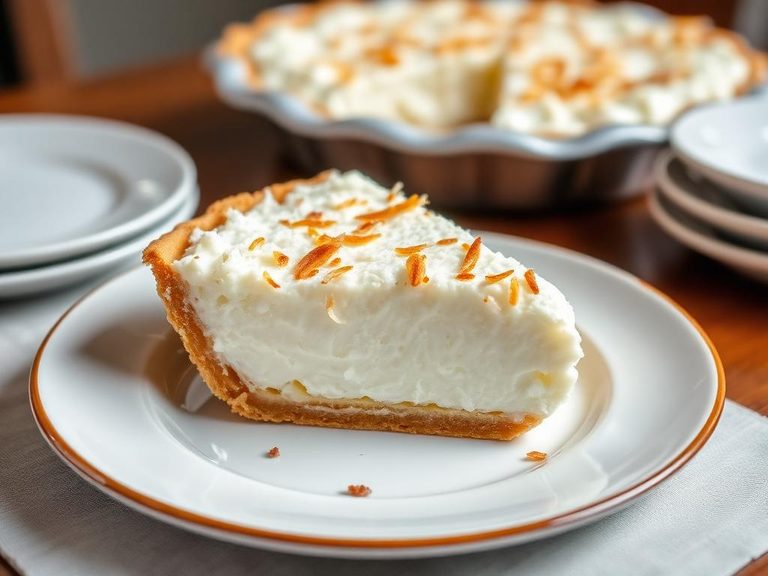

🌍 Where it's eaten
💡 Did you know?
The coconut custard pie is a descendant of the English custard tart, but it gained its distinct tropical identity in the American South and Caribbean after the widespread introduction of coconut in the 19th century.
Full nutrition (USDA data · scales with serving)
| Water | 49.2 g |
| Energy | 260 kcal |
| Energy | 1088 kj |
| Protein | 5.9 g |
| Total lipid (fat) | 13.2 g |
| Ash | 1.4 g |
| Carbohydrate, by difference | 30.2 g |
| Fiber, total dietary | 1.8 g |
| Calcium, Ca | 81.0 mg |
| Iron, Fe | 0.80 mg |
| Magnesium, Mg | 18.0 mg |
| Phosphorus, P | 122 mg |
| Potassium, K | 175 mg |
| Sodium, Na | 335 mg |
| Zinc, Zn | 0.68 mg |
| Copper, Cu | 0.06 mg |
| Manganese, Mn | 0.21 mg |
| Selenium, Se | 6.4 ug |
| Vitamin C, total ascorbic acid | 0.60 mg |
| Thiamin | 0.09 mg |
| Riboflavin | 0.15 mg |
| Niacin | 0.40 mg |
| Pantothenic acid | 0.24 mg |
| Vitamin B-6 | 0.01 mg |
| Folate, total | 13.0 ug |
| Folic acid | 9.0 ug |
| Folate, food | 4.0 ug |
| Folate, DFE | 19.0 ug |
| Vitamin B-12 | 0.09 ug |
| Vitamin A, RAE | 26.0 ug |
| Retinol | 24.0 ug |
| Vitamin A, IU | 110 iu |
Fat & fatty acid profile (per 100g)
| Fatty acids, total saturated | 5.9 g |
| SFA 4:0 | 0.05 g |
| SFA 6:0 | 0.05 g |
| SFA 8:0 | 0.23 g |
| SFA 10:0 | 0.21 g |
| SFA 12:0 | 1.4 g |
| SFA 14:0 | 0.73 g |
| SFA 16:0 | 1.8 g |
| SFA 18:0 | 1.4 g |
| Fatty acids, total monounsaturated | 5.5 g |
| MUFA 16:1 | 0.04 g |
| MUFA 18:1 | 5.4 g |
| MUFA 20:1 | 0.00 g |
| MUFA 22:1 | 0.00 g |
| Fatty acids, total polyunsaturated | 1.2 g |
| PUFA 18:2 | 1.1 g |
| PUFA 18:3 | 0.08 g |
| PUFA 18:4 | 0.00 g |
| PUFA 20:4 | 0.00 g |
| PUFA 20:5 n-3 (EPA) | 0.00 g |
| PUFA 22:5 n-3 (DPA) | 0.00 g |
| PUFA 22:6 n-3 (DHA) | 0.00 g |
| Cholesterol | 35.0 mg |
Amino acid profile (per 100g)
| Tryptophan | 0.08 g |
| Threonine | 0.22 g |
| Isoleucine | 0.29 g |
| Leucine | 0.48 g |
| Lysine | 0.34 g |
| Methionine | 0.12 g |
| Cystine | 0.09 g |
| Phenylalanine | 0.27 g |
| Tyrosine | 0.22 g |
| Valine | 0.33 g |
| Arginine | 0.28 g |
| Histidine | 0.14 g |
| Alanine | 0.20 g |
| Aspartic acid | 0.38 g |
| Glutamic acid | 1.4 g |
| Glycine | 0.16 g |
| Proline | 0.55 g |
| Serine | 0.30 g |
FAQ
Is coconut custard pie the same as coconut cream pie?
No. Coconut custard pie is baked with the coconut and custard together in the shell, resulting in a firmer, set texture. Coconut cream pie has a pre-baked shell filled with a cooked coconut cream pudding and is often topped with whipped cream.
Can I make coconut custard pie dairy-free?
Yes, by substituting the milk with coconut milk or a plant-based milk and using a dairy-free butter or margarine for the crust. The custard will still set from the eggs.
Why does my coconut custard pie crack on top?
Cracking usually happens from overbaking or too high an oven temperature. The custard continues to cook from residual heat after it's removed from the oven. Bake at a moderate temperature (325-350°F) and remove it when the center still has a slight jiggle.
Nutrient density (calculated · NRF9.3)
Nutrient Rich Foods index: beneficial nutrients (protein, fiber, vitamins, minerals) minus saturated fat, added sugar & sodium, per 100 kcal.
NRF9.3 index — Fulgoni, Keast & Drewnowski, 2009. Computed from USDA nutrients.
Weight-loss friendliness (composite index)
Energy density 2.60 kcal/g · 9% calories from protein · 1.8 g fiber · 0.0 g sugar per 100 g.
Composite of energy density (Rolls et al., 1999), protein & fiber satiety, minus sugar. A calculated heuristic — ranks satiety-per-calorie, not a clinical measure.
Dietary load (calculated from USDA values)
Potential renal acid load. Positive = acid-forming, negative = alkaline-forming.
Sodium-to-potassium ratio: 1.91 (lower is better — aim for ≤ 1)
Sodium:potassium per WHO potassium guidance. Computed from USDA nutrients.