

Bagels, egg
Whole food · Baked Products
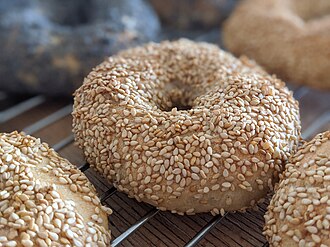
Photo: Wikipedia
An egg bagel is a rich, golden-hued variety of the classic ring-shaped bread, distinguished by the addition of whole eggs or egg yolks to the dough. This creates a tender, slightly sweet crumb with a chewy crust and a subtly buttery flavor that sets it apart from plain or water bagels. With 10.6g of protein and 2.3g of fiber per 100g, it offers a more substantial and satisfying base than many other bread options.
Calorie split: 16% protein · 78% carbs · 7% fat
↓ Full nutrition💚 Why it's loved
People love egg bagels for their uniquely rich, almost brioche-like flavor and tender, chewy texture that elevates a simple sandwich or toast. Their golden color and subtle sweetness make them a cultural staple in delis and breakfast spots, often considered the premium choice for a classic lox and cream cheese spread.
⚠️ Watch-outs & how to enjoy it better
The added eggs can make them slightly higher in fat and calories than plain bagels, which may concern those monitoring intake. Their dense, chewy texture can also be a challenge for some, and they are a common allergen due to eggs. To counteract, pair with lean protein like turkey or smoked salmon, or opt for a half-bagel portion to manage calories while still enjoying the flavor.
Key benefits
- Higher protein content than plain bagels due to egg enrichment.
- Provides a good source of complex carbohydrates for sustained energy.
- The added fat from eggs contributes to a more tender and moist texture.
- A versatile base for both sweet and savory toppings.
- Offers a more substantial and filling option for breakfast or brunch.
🍽️ Popular dishes





🌍 Where it's eaten
💡 Did you know?
The egg bagel's golden color and richer taste come from adding whole eggs or egg yolks to the dough, a variation that became popular in New York City delis in the mid-20th century.
Full nutrition (USDA data · scales with serving)
| Water | 32.7 g |
| Energy | 278 kcal |
| Energy | 1163 kj |
| Protein | 10.6 g |
| Total lipid (fat) | 2.1 g |
| Ash | 1.6 g |
| Carbohydrate, by difference | 53.0 g |
| Fiber, total dietary | 2.3 g |
| Calcium, Ca | 13.0 mg |
| Iron, Fe | 4.0 mg |
| Magnesium, Mg | 25.0 mg |
| Phosphorus, P | 84.0 mg |
| Potassium, K | 68.0 mg |
| Sodium, Na | 505 mg |
| Zinc, Zn | 0.77 mg |
| Copper, Cu | 0.09 mg |
| Manganese, Mn | 0.41 mg |
| Selenium, Se | 30.6 ug |
| Vitamin C, total ascorbic acid | 0.60 mg |
| Thiamin | 0.54 mg |
| Riboflavin | 0.23 mg |
| Niacin | 3.4 mg |
| Pantothenic acid | 0.67 mg |
| Vitamin B-6 | 0.09 mg |
| Folate, total | 88.0 ug |
| Folic acid | 66.0 ug |
| Folate, food | 22.0 ug |
| Folate, DFE | 134 ug |
| Vitamin B-12 | 0.16 ug |
| Vitamin A, RAE | 33.0 ug |
| Retinol | 33.0 ug |
| Vitamin A, IU | 109 iu |
Fat & fatty acid profile (per 100g)
| Fatty acids, total saturated | 0.42 g |
| SFA 8:0 | 0.00 g |
| SFA 10:0 | 0.00 g |
| SFA 12:0 | 0.00 g |
| SFA 14:0 | 0.00 g |
| SFA 16:0 | 0.34 g |
| SFA 18:0 | 0.08 g |
| Fatty acids, total monounsaturated | 0.42 g |
| MUFA 16:1 | 0.04 g |
| MUFA 18:1 | 0.38 g |
| MUFA 20:1 | 0.00 g |
| MUFA 22:1 | 0.00 g |
| Fatty acids, total polyunsaturated | 0.64 g |
| PUFA 18:2 | 0.60 g |
| PUFA 18:3 | 0.03 g |
| PUFA 20:4 | 0.01 g |
| PUFA 20:5 n-3 (EPA) | 0.00 g |
| PUFA 22:6 n-3 (DHA) | 0.00 g |
| Cholesterol | 24.0 mg |
Amino acid profile (per 100g)
| Tryptophan | 0.13 g |
| Threonine | 0.31 g |
| Isoleucine | 0.41 g |
| Leucine | 0.75 g |
| Lysine | 0.26 g |
| Methionine | 0.19 g |
| Cystine | 0.23 g |
| Phenylalanine | 0.52 g |
| Tyrosine | 0.31 g |
| Valine | 0.46 g |
| Arginine | 0.39 g |
| Histidine | 0.23 g |
| Alanine | 0.35 g |
| Aspartic acid | 0.48 g |
| Glutamic acid | 3.5 g |
| Glycine | 0.37 g |
| Proline | 1.2 g |
| Serine | 0.53 g |
FAQ
What makes an egg bagel different from a plain bagel?
An egg bagel includes whole eggs or egg yolks in the dough, giving it a richer flavor, a more tender crumb, and a golden color compared to the chewier, plainer variety.
Are egg bagels healthier than plain bagels?
They offer slightly more protein and fat due to the eggs, but they can also be higher in calories. Their nutritional value depends on portion size and toppings.
Can I make egg bagels at home?
Yes, egg bagels can be made at home by adding eggs to the dough, boiling the shaped rings, and baking them. Many recipes are available online for this classic variation.
Nutrient density (calculated · NRF9.3)
Nutrient Rich Foods index: beneficial nutrients (protein, fiber, vitamins, minerals) minus saturated fat, added sugar & sodium, per 100 kcal.
NRF9.3 index — Fulgoni, Keast & Drewnowski, 2009. Computed from USDA nutrients.
Weight-loss friendliness (composite index)
Energy density 2.78 kcal/g · 15% calories from protein · 2.3 g fiber · 0.0 g sugar per 100 g.
Composite of energy density (Rolls et al., 1999), protein & fiber satiety, minus sugar. A calculated heuristic — ranks satiety-per-calorie, not a clinical measure.
Dietary load (calculated from USDA values)
Potential renal acid load. Positive = acid-forming, negative = alkaline-forming.
Sodium-to-potassium ratio: 7.43 (lower is better — aim for ≤ 1)
Sodium:potassium per WHO potassium guidance. Computed from USDA nutrients.