

Babyfood, juice, orange and banana
Whole food · Baby Foods

Photo: Wikipedia
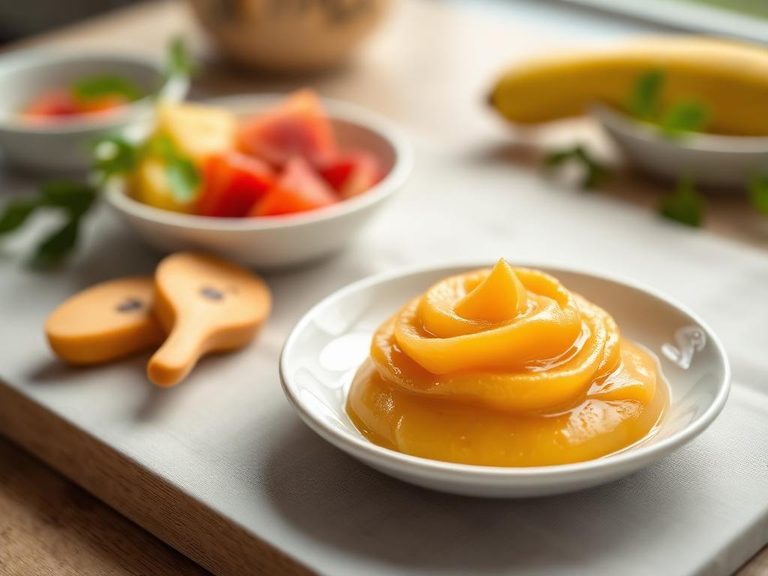
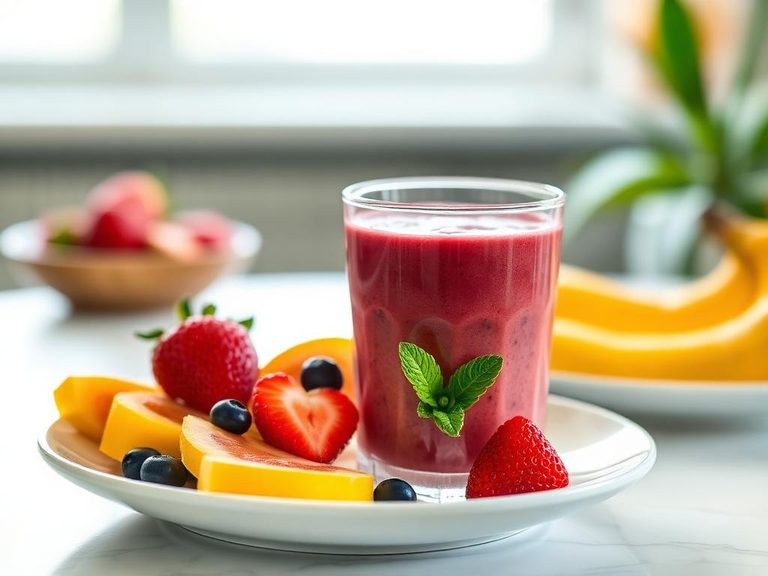
A smooth, pourable blend of orange and banana juices, this baby food offers a naturally sweet, tangy, and mildly creamy flavor profile. Its thin, easy-to-drink texture is designed for infants transitioning to solids, providing a gentle introduction to fruit flavors. Nutritionally, it is a low-calorie, carbohydrate-rich option that delivers a quick source of natural sugars for energy.
Calorie split: 5% protein · 93% carbs · 2% fat
↓ Full nutrition💚 Why it's loved
Parents and caregivers appreciate it for its familiar, comforting taste that combines the bright citrus of orange with the mellow sweetness of banana. Its simplicity and lack of added sugars make it a trusted, straightforward choice for introducing fruit to a baby's diet.
⚠️ Watch-outs & how to enjoy it better
The high natural sugar content, while not added, can contribute to blood-sugar spikes, especially if consumed frequently or in large amounts. To mitigate this, it's best offered in small portions and paired with a source of protein or healthy fat (like a tiny bit of yogurt or avocado) to slow sugar absorption. Individuals with a known allergy to bananas or citrus should avoid it.
Key benefits
- Provides a quick source of natural energy from carbohydrates
- Naturally low in fat and cholesterol
- Smooth, easy-to-digest texture suitable for early weaning
- Offers a mild introduction to fruit flavors without added sugars
- Convenient, ready-to-serve format for busy caregivers
🍽️ Popular dishes
🌍 Where it's eaten
💡 Did you know?
The combination of orange and banana is a classic pairing in baby food because the banana's natural pectin helps thicken the juice slightly, making it easier for infants to swallow without a choking hazard.
Full nutrition (USDA data · scales with serving)
| Water | 86.9 g |
| Energy | 50.0 kcal |
| Energy | 209 kj |
| Protein | 0.70 g |
| Total lipid (fat) | 0.10 g |
| Ash | 0.40 g |
| Carbohydrate, by difference | 11.9 g |
| Calcium, Ca | 17.0 mg |
| Iron, Fe | 0.11 mg |
| Magnesium, Mg | 14.0 mg |
| Phosphorus, P | 13.0 mg |
| Potassium, K | 200 mg |
| Sodium, Na | 3.0 mg |
| Zinc, Zn | 0.09 mg |
| Copper, Cu | 0.04 mg |
| Selenium, Se | 0.10 ug |
| Vitamin C, total ascorbic acid | 34.0 mg |
| Thiamin | 0.05 mg |
| Riboflavin | 0.04 mg |
| Niacin | 0.18 mg |
| Pantothenic acid | 0.15 mg |
| Vitamin B-6 | 0.05 mg |
| Folate, total | 24.0 ug |
| Folic acid | 0.00 ug |
| Folate, food | 24.0 ug |
| Folate, DFE | 24.0 ug |
| Vitamin B-12 | 0.00 ug |
| Vitamin A, RAE | 2.0 ug |
| Retinol | 0.00 ug |
| Vitamin A, IU | 46.0 iu |
Fat & fatty acid profile (per 100g)
Estimated from Babyfood, grape juice, no sugar, canned — USDA does not publish this profile for Babyfood.
| Fatty acids, total saturated | 0.00 g |
| SFA 4:0 | 0.00 g |
| SFA 6:0 | 0.00 g |
| SFA 8:0 | 0.00 g |
| SFA 10:0 | 0.00 g |
| SFA 12:0 | 0.00 g |
| SFA 14:0 | 0.00 g |
| SFA 16:0 | 0.00 g |
| SFA 18:0 | 0.00 g |
| Fatty acids, total monounsaturated | 0.00 g |
| MUFA 16:1 | 0.00 g |
| MUFA 18:1 | 0.00 g |
| MUFA 20:1 | 0.00 g |
| MUFA 22:1 | 0.00 g |
| Fatty acids, total polyunsaturated | 0.00 g |
| PUFA 18:2 | 0.00 g |
| PUFA 18:3 | 0.00 g |
| PUFA 18:4 | 0.00 g |
| PUFA 20:4 | 0.00 g |
| PUFA 20:5 n-3 (EPA) | 0.00 g |
| PUFA 22:5 n-3 (DPA) | 0.00 g |
| PUFA 22:6 n-3 (DHA) | 0.00 g |
| Cholesterol | 0.00 mg |
Amino acid profile (per 100g)
Estimated from Babyfood, grape juice, no sugar, canned — USDA does not publish this profile for Babyfood.
| Threonine | 0.02 g |
| Isoleucine | 0.01 g |
| Leucine | 0.02 g |
| Lysine | 0.02 g |
| Methionine | 0.03 g |
| Cystine | 0.01 g |
| Phenylalanine | 0.02 g |
| Tyrosine | 0.02 g |
| Valine | 0.02 g |
| Arginine | 0.06 g |
| Histidine | 0.03 g |
| Alanine | 0.04 g |
| Aspartic acid | 0.10 g |
| Glutamic acid | 0.18 g |
| Glycine | 0.03 g |
| Proline | 0.03 g |
| Serine | 0.04 g |
FAQ
Is this baby food juice high in sugar?
It contains natural sugars from the fruit (11.9g per 100g), but no added sugars. The sugar is part of the fruit's natural composition and is accompanied by some vitamins, though it's still a concentrated source of carbohydrates.
Can I give this to a baby with a banana allergy?
No, this product contains banana and should be avoided if your baby has a known allergy to bananas or latex (latex-fruit syndrome). Always consult a pediatrician for guidance on introducing new foods.
How does this compare to whole fruit?
This juice blend lacks the fiber found in whole oranges and bananas, which helps with digestion and feeling full. It's a more concentrated source of sugars and calories, so it should be offered in moderation as part of a balanced diet.
Nutrient density (calculated · NRF9.3)
Nutrient Rich Foods index: beneficial nutrients (protein, fiber, vitamins, minerals) minus saturated fat, added sugar & sodium, per 100 kcal.
NRF9.3 index — Fulgoni, Keast & Drewnowski, 2009. Computed from USDA nutrients.
Weight-loss friendliness (composite index)
Energy density 0.50 kcal/g · 6% calories from protein · 0.0 g fiber · 0.0 g sugar per 100 g.
Composite of energy density (Rolls et al., 1999), protein & fiber satiety, minus sugar. A calculated heuristic — ranks satiety-per-calorie, not a clinical measure.
Dietary load (calculated from USDA values)
Potential renal acid load. Positive = acid-forming, negative = alkaline-forming.
Sodium-to-potassium ratio: 0.01 (lower is better — aim for ≤ 1)
Sodium:potassium per WHO potassium guidance. Computed from USDA nutrients.