

Artichokes, (globe or french), raw
Whole food · Vegetables and Vegetable Products

Photo: Wikipedia
The globe artichoke is a large, edible thistle bud with tightly packed, tender leaves surrounding a fuzzy, inedible 'choke' and a prized heart. Its flavor is distinctly nutty, earthy, and subtly sweet, with a pleasant, slightly crisp texture when raw. Nutritionally, it's a low-calorie powerhouse of dietary fiber, which supports digestive health.
Calorie split: 23% protein · 74% carbs · 2% fat
↓ Full nutrition💚 Why it's loved
People love artichokes for their unique, sophisticated flavor that pairs beautifully with lemon, garlic, and butter, and for the interactive, communal ritual of peeling and eating the leaves. They are a celebrated centerpiece in Mediterranean cuisine, symbolizing both rustic charm and gourmet elegance.
⚠️ Watch-outs & how to enjoy it better
The raw leaves can be tough and the choke is inedible, requiring preparation knowledge. Some individuals may experience digestive discomfort like bloating due to the high fiber and prebiotic inulin content. Tip: Start with small portions, and cooking (steaming, boiling, or roasting) softens the fibers and makes the nutrients more digestible.
Key benefits
- Excellent source of dietary fiber (5.4g per 100g)
- Very low in fat and calories
- Provides plant-based protein
- Rich in antioxidants like cynarin and silymarin
- Contains prebiotic inulin fiber
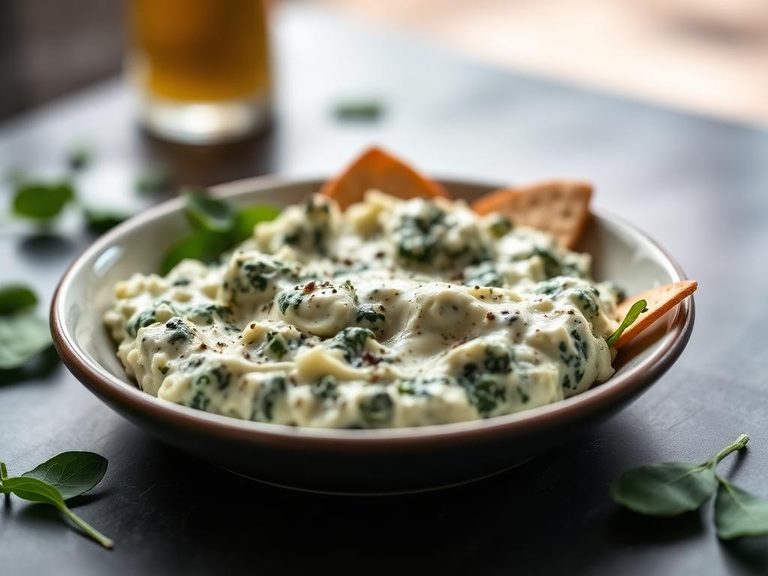
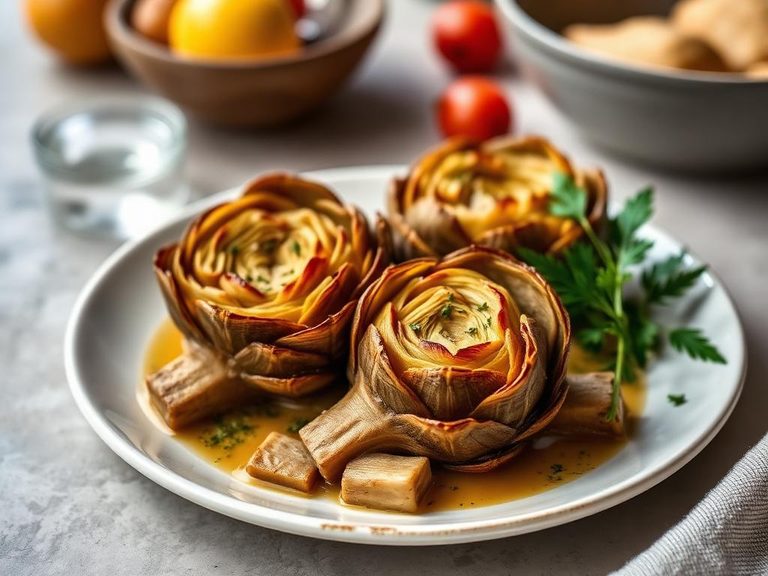
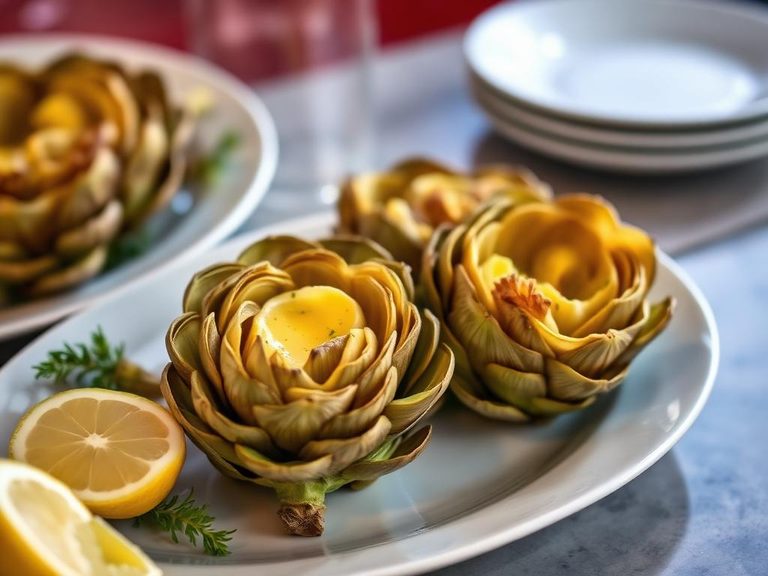
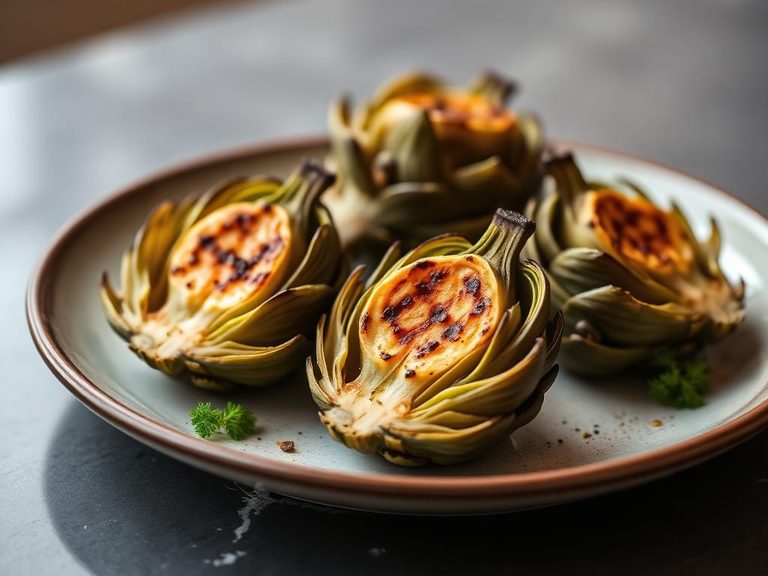
🍽️ Popular dishes
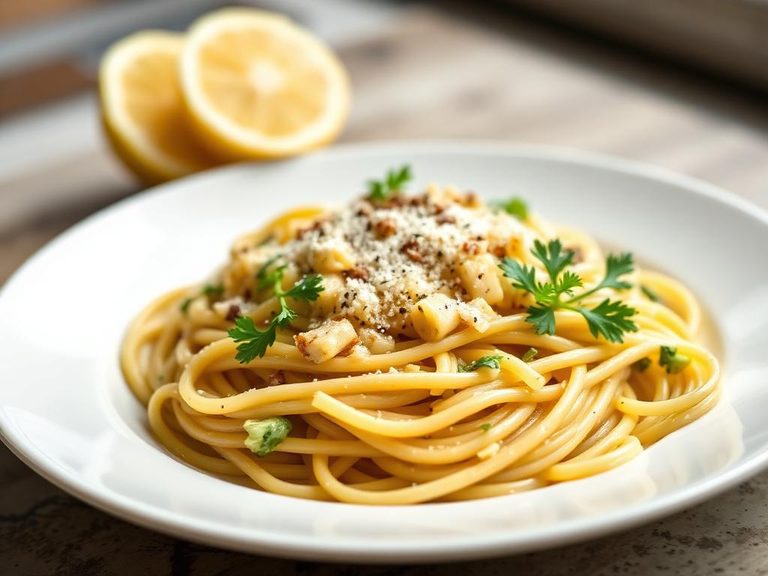
🌍 Where it's eaten
💡 Did you know?
The artichoke is the flower bud of a thistle plant, and if left unharvested, it blooms into a stunning, large purple flower.
Full nutrition (USDA data · scales with serving)
| Water | 84.9 g |
| Energy | 47.0 kcal |
| Energy | 197 kj |
| Protein | 3.3 g |
| Total lipid (fat) | 0.15 g |
| Ash | 1.1 g |
| Carbohydrate, by difference | 10.5 g |
| Fiber, total dietary | 5.4 g |
| Total Sugars | 0.99 g |
| Calcium, Ca | 44.0 mg |
| Iron, Fe | 1.3 mg |
| Magnesium, Mg | 60.0 mg |
| Phosphorus, P | 90.0 mg |
| Potassium, K | 370 mg |
| Sodium, Na | 94.0 mg |
| Zinc, Zn | 0.49 mg |
| Copper, Cu | 0.23 mg |
| Manganese, Mn | 0.26 mg |
| Selenium, Se | 0.20 ug |
| Vitamin C, total ascorbic acid | 11.7 mg |
| Thiamin | 0.07 mg |
| Riboflavin | 0.07 mg |
| Niacin | 1.0 mg |
| Pantothenic acid | 0.34 mg |
| Vitamin B-6 | 0.12 mg |
| Folate, total | 68.0 ug |
| Folic acid | 0.00 ug |
| Folate, food | 68.0 ug |
| Folate, DFE | 68.0 ug |
| Choline, total | 34.4 mg |
| Betaine | 0.20 mg |
| Vitamin B-12 | 0.00 ug |
| Vitamin A, RAE | 1.0 ug |
| Retinol | 0.00 ug |
| Carotene, beta | 8.0 ug |
| Carotene, alpha | 0.00 ug |
| Cryptoxanthin, beta | 0.00 ug |
| Vitamin A, IU | 13.0 iu |
| Lycopene | 0.00 ug |
| Lutein + zeaxanthin | 464 ug |
| Vitamin E (alpha-tocopherol) | 0.19 mg |
| Vitamin D (D2 + D3), International Units | 0.00 iu |
| Vitamin D (D2 + D3) | 0.00 ug |
| Vitamin K (phylloquinone) | 14.8 ug |
| Alcohol, ethyl | 0.00 g |
Fat & fatty acid profile (per 100g)
| Fatty acids, total saturated | 0.04 g |
| SFA 4:0 | 0.00 g |
| SFA 6:0 | 0.00 g |
| SFA 8:0 | 0.00 g |
| SFA 10:0 | 0.00 g |
| SFA 12:0 | 0.00 g |
| SFA 14:0 | 0.00 g |
| SFA 16:0 | 0.03 g |
| SFA 18:0 | 0.00 g |
| Fatty acids, total monounsaturated | 0.01 g |
| MUFA 16:1 | 0.00 g |
| MUFA 18:1 | 0.01 g |
| MUFA 20:1 | 0.00 g |
| MUFA 22:1 | 0.00 g |
| Fatty acids, total polyunsaturated | 0.06 g |
| PUFA 18:2 | 0.05 g |
| PUFA 18:3 | 0.02 g |
| PUFA 18:4 | 0.00 g |
| PUFA 20:4 | 0.00 g |
| PUFA 20:5 n-3 (EPA) | 0.00 g |
| PUFA 22:5 n-3 (DPA) | 0.00 g |
| PUFA 22:6 n-3 (DHA) | 0.00 g |
| Fatty acids, total trans | 0.00 g |
| Cholesterol | 0.00 mg |
FAQ
How do you prepare a raw artichoke for eating?
Trim the stem, cut off the top inch of the leaves, snip the sharp tips off remaining leaves, and rub with lemon to prevent browning. To eat, pull off leaves one by one, scrape the tender flesh at the base with your teeth, and discard the rest. Once you reach the center, scoop out and discard the fuzzy choke to reveal the edible heart.
Why do artichokes make water taste sweet?
This is due to a compound called cynarin, an antioxidant found in artichokes. It temporarily inhibits your taste receptors for sweetness, and when you drink water afterward, those receptors rebound, creating a sweet sensation.
Are canned or frozen artichoke hearts as nutritious as fresh?
They retain most of their fiber and minerals but can be higher in sodium due to brine. Frozen hearts are often a great, convenient alternative with minimal nutrient loss. Always check labels and rinse canned hearts to reduce sodium.
Nutrient density (calculated · NRF9.3)
Nutrient Rich Foods index: beneficial nutrients (protein, fiber, vitamins, minerals) minus saturated fat, added sugar & sodium, per 100 kcal.
NRF9.3 index — Fulgoni, Keast & Drewnowski, 2009. Computed from USDA nutrients.
Weight-loss friendliness (composite index)
Energy density 0.47 kcal/g · 28% calories from protein · 5.4 g fiber · 1.0 g sugar per 100 g.
Composite of energy density (Rolls et al., 1999), protein & fiber satiety, minus sugar. A calculated heuristic — ranks satiety-per-calorie, not a clinical measure.
Dietary load (calculated from USDA values)
Potential renal acid load. Positive = acid-forming, negative = alkaline-forming.
Sodium-to-potassium ratio: 0.25 (lower is better — aim for ≤ 1)
Sodium:potassium per WHO potassium guidance. Computed from USDA nutrients.