

Soup, shark fin, restaurant-prepared
Whole food · Soups, Sauces, and Gravies

Photo: Wikipedia
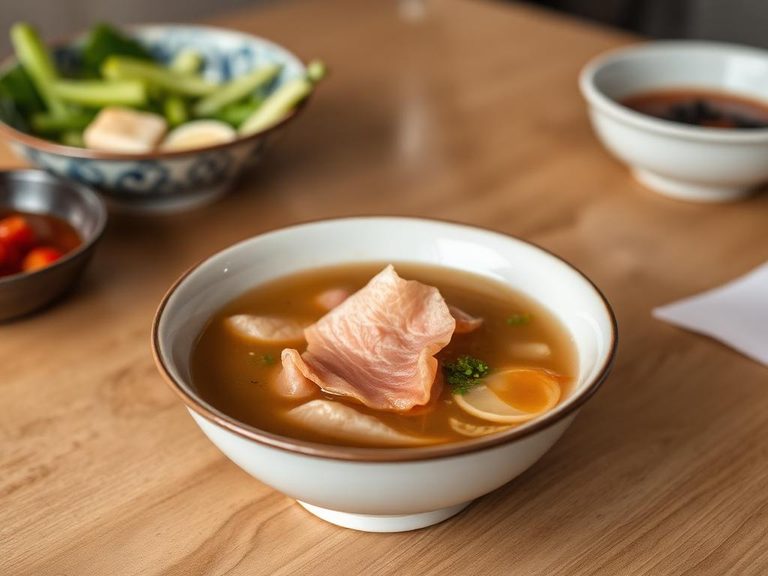
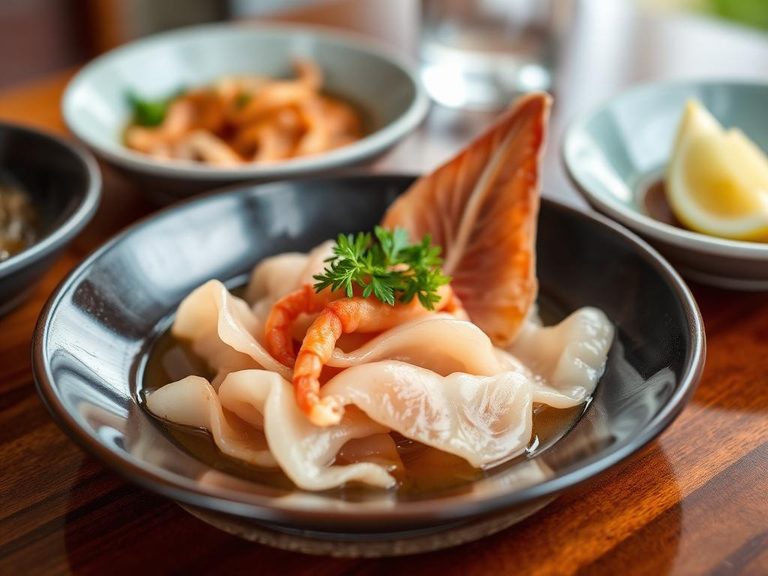
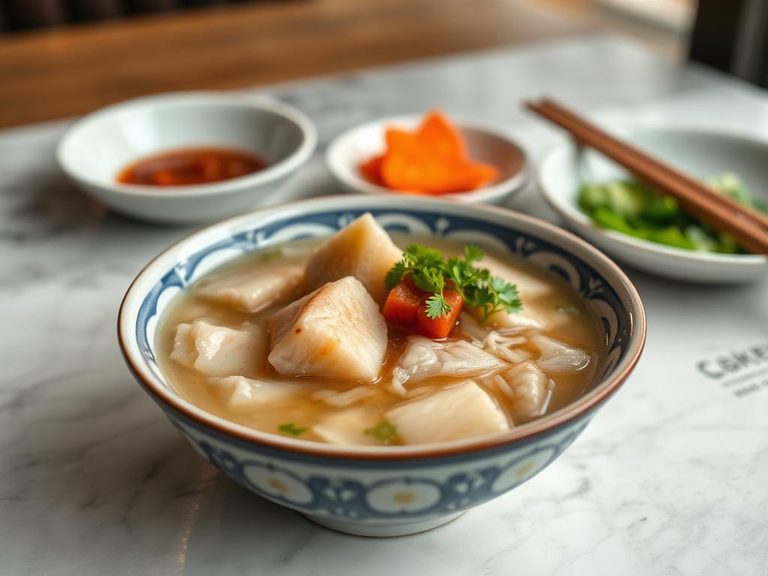
A clear, delicate broth featuring translucent, gelatinous strands of shark fin, prized for its unique, springy texture that absorbs the savory, umami-rich flavors of the soup. Nutritionally, it is a very low-calorie, low-protein dish, functioning more as a luxurious textural element than a significant nutrient source.
Calorie split: 28% protein · 33% carbs · 39% fat
↓ Full nutrition💚 Why it's loved
People love it for its unparalleled, luxurious mouthfeel and its deep cultural significance as a centerpiece of celebration and respect in many Asian cuisines.
⚠️ Watch-outs & how to enjoy it better
The primary downsides are the severe environmental and ethical concerns of shark finning, and the dish's potential high sodium content from its broth. For health, it offers minimal nutritional benefit for its cost. To mitigate sodium, request a lighter broth or pair it with low-sodium sides.
Key benefits
- Very low in calories and fat
- Source of collagen-like protein
- High in umami flavor
- Traditional symbol of prestige
- Often served as a celebratory course
🍽️ Popular dishes
🌍 Where it's eaten
💡 Did you know?
The fin itself is tasteless and odorless; it is entirely valued for its unique gelatinous texture, which acts as a sponge for the rich, savory broth it's cooked in.
Full nutrition (USDA data · scales with serving)
| Water | 90.1 g |
| Energy | 46.0 kcal |
| Energy | 192 kj |
| Protein | 3.2 g |
| Total lipid (fat) | 2.0 g |
| Ash | 0.87 g |
| Carbohydrate, by difference | 3.8 g |
| Fiber, total dietary | 0.00 g |
| Calcium, Ca | 10.0 mg |
| Iron, Fe | 0.94 mg |
| Magnesium, Mg | 7.0 mg |
| Phosphorus, P | 21.0 mg |
| Potassium, K | 53.0 mg |
| Sodium, Na | 501 mg |
| Zinc, Zn | 0.82 mg |
| Copper, Cu | 0.11 mg |
| Manganese, Mn | 0.02 mg |
| Vitamin C, total ascorbic acid | 0.10 mg |
| Thiamin | 0.03 mg |
| Riboflavin | 0.04 mg |
| Niacin | 0.49 mg |
| Pantothenic acid | 0.13 mg |
| Vitamin B-6 | 0.03 mg |
| Folate, total | 9.0 ug |
| Folic acid | 0.00 ug |
| Folate, food | 9.0 ug |
| Folate, DFE | 9.0 ug |
| Vitamin B-12 | 0.19 ug |
| Vitamin A, RAE | 0.00 ug |
| Retinol | 0.00 ug |
| Vitamin A, IU | 0.00 iu |
| Alcohol, ethyl | 0.00 g |
Fat & fatty acid profile (per 100g)
| Fatty acids, total saturated | 0.50 g |
| SFA 4:0 | 0.00 g |
| SFA 6:0 | 0.00 g |
| SFA 8:0 | 0.00 g |
| SFA 10:0 | 0.00 g |
| SFA 12:0 | 0.00 g |
| SFA 14:0 | 0.04 g |
| SFA 16:0 | 0.34 g |
| SFA 18:0 | 0.09 g |
| Fatty acids, total monounsaturated | 0.58 g |
| MUFA 16:1 | 0.18 g |
| MUFA 18:1 | 0.36 g |
| MUFA 20:1 | 0.01 g |
| MUFA 22:1 | 0.00 g |
| Fatty acids, total polyunsaturated | 0.34 g |
| PUFA 18:2 | 0.02 g |
| PUFA 18:3 | 0.01 g |
| PUFA 18:4 | 0.01 g |
| PUFA 20:4 | 0.03 g |
| PUFA 20:5 n-3 (EPA) | 0.09 g |
| PUFA 22:5 n-3 (DPA) | 0.04 g |
| PUFA 22:6 n-3 (DHA) | 0.12 g |
| Cholesterol | 2.0 mg |
Amino acid profile (per 100g)
Estimated from Soup, bean with pork, canned, condensed — USDA does not publish this profile for Soup.
| Tryptophan | 0.06 g |
| Threonine | 0.24 g |
| Isoleucine | 0.29 g |
| Leucine | 0.48 g |
| Lysine | 0.40 g |
| Methionine | 0.07 g |
| Cystine | 0.07 g |
| Phenylalanine | 0.33 g |
| Tyrosine | 0.18 g |
| Valine | 0.32 g |
| Arginine | 0.31 g |
| Histidine | 0.15 g |
| Alanine | 0.29 g |
| Aspartic acid | 0.66 g |
| Glutamic acid | 1.1 g |
| Glycine | 0.28 g |
| Proline | 0.27 g |
| Serine | 0.29 g |
FAQ
What does shark fin actually taste like?
The fin strands are largely tasteless. The dish's flavor comes entirely from the rich, savory broth they are cooked in, while the fin contributes a unique, slightly crunchy yet gelatinous texture.
Is shark fin soup high in protein?
No. Despite its reputation, it contains relatively little protein (about 3.2g per 100g). The collagen-like strands are not a complete protein source.
Why is it considered a delicacy?
Historically, shark fins were rare and difficult to obtain, making them a symbol of wealth, status, and respect. Their unique texture and the elaborate preparation of the soup cemented this luxury status in Chinese banquet culture.
Nutrient density (calculated · NRF9.3)
Nutrient Rich Foods index: beneficial nutrients (protein, fiber, vitamins, minerals) minus saturated fat, added sugar & sodium, per 100 kcal.
NRF9.3 index — Fulgoni, Keast & Drewnowski, 2009. Computed from USDA nutrients.
Weight-loss friendliness (composite index)
Energy density 0.46 kcal/g · 28% calories from protein · 0.0 g fiber · 0.0 g sugar per 100 g.
Composite of energy density (Rolls et al., 1999), protein & fiber satiety, minus sugar. A calculated heuristic — ranks satiety-per-calorie, not a clinical measure.
Dietary load (calculated from USDA values)
Potential renal acid load. Positive = acid-forming, negative = alkaline-forming.
Sodium-to-potassium ratio: 9.45 (lower is better — aim for ≤ 1)
Sodium:potassium per WHO potassium guidance. Computed from USDA nutrients.