

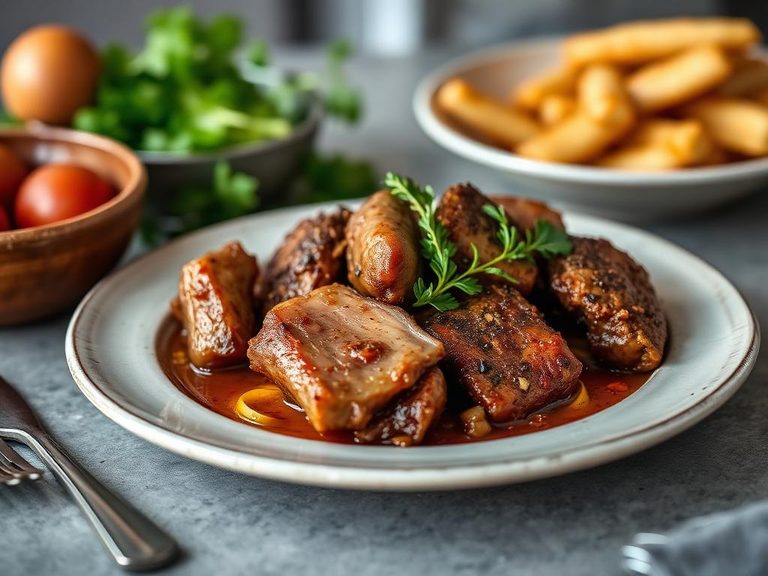
Lamb, shoulder, blade, separable lean and fat, trimmed to 1/8" fat, choice, cooked, braised
Whole food · Lamb, Veal, and Game Products
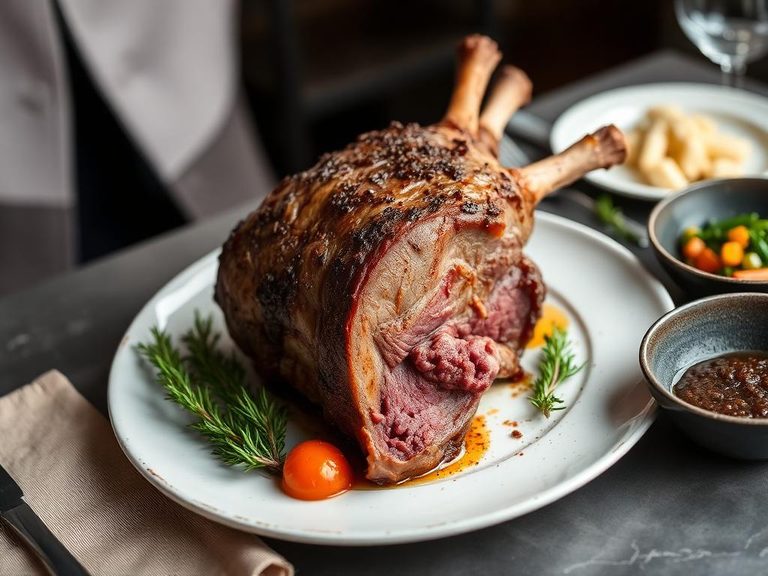
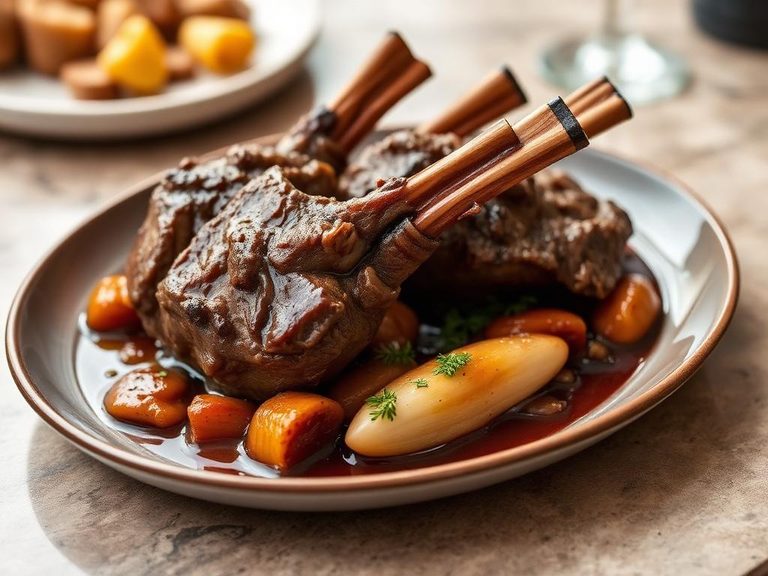
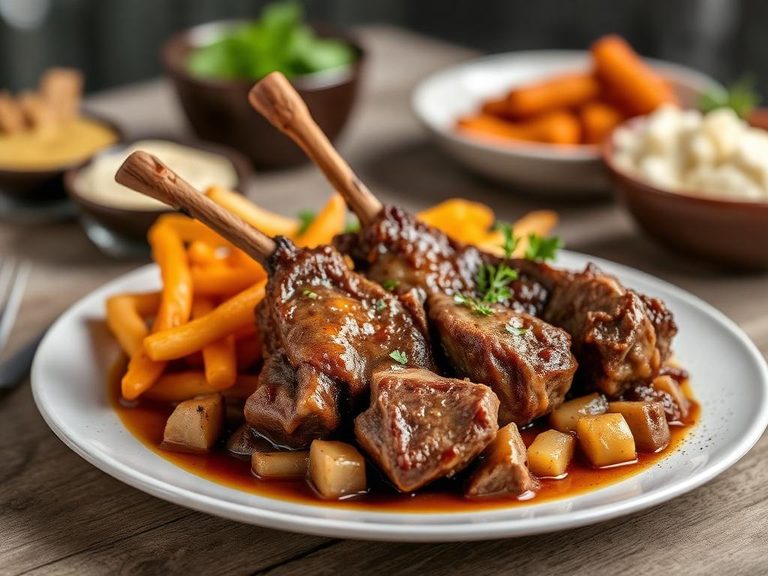
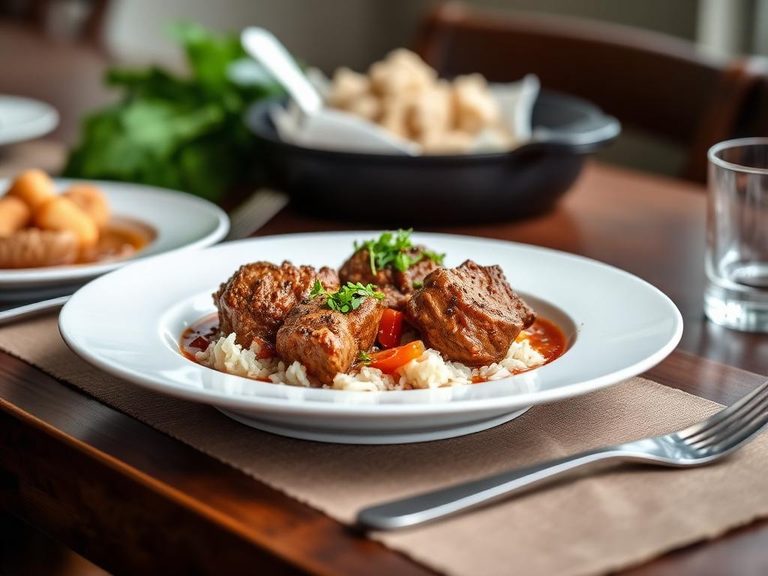
This is a succulent cut from the shoulder of the lamb, featuring a balanced marbling of lean meat and fat that becomes incredibly tender and rich when braised. The slow-cooking process breaks down connective tissue, resulting in a deeply savory, melt-in-your-mouth texture with a robust, slightly gamey flavor. Nutritionally, it's a powerhouse of high-quality protein and essential fats, providing significant energy and satiety.
Calorie split: 35% protein · 0% carbs · 65% fat
↓ Full nutrition💚 Why it's loved
People cherish it for its profound, savory depth of flavor and the luxurious, fork-tender texture achieved through slow braising. It's a centerpiece of comfort food and celebratory meals across many cultures, offering a satisfying and hearty eating experience.
⚠️ Watch-outs & how to enjoy it better
Its high fat content means it is calorie-dense, which may require portion awareness for those managing energy intake. Individuals with specific dietary restrictions related to saturated fat or cholesterol should consume it mindfully. To balance, pair it with fiber-rich vegetables like roasted root vegetables or a fresh salad, and consider skimming excess fat from the braising liquid before serving.
Key benefits
- Excellent source of complete protein for muscle maintenance and repair.
- Rich in bioavailable iron and zinc, crucial for immune function and oxygen transport.
- Provides B vitamins, particularly B12, essential for nerve function and red blood cell formation.
- Contains conjugated linoleic acid (CLA), a fatty acid studied for potential metabolic benefits.
- Offers high caloric density, making it effective for meeting energy needs.
🍽️ Popular dishes
🌍 Where it's eaten
💡 Did you know?
The term 'blade' refers to the flat, blade-like bone (the scapula) that runs through this cut, which helps conduct heat during cooking and adds flavor to the braising liquid.
Full nutrition (USDA data · scales with serving)
| Water | 45.6 g |
| Energy | 339 kcal |
| Energy | 1418 kj |
| Protein | 28.9 g |
| Total lipid (fat) | 23.9 g |
| Ash | 1.6 g |
| Carbohydrate, by difference | 0.00 g |
| Fiber, total dietary | 0.00 g |
| Calcium, Ca | 27.0 mg |
| Iron, Fe | 2.4 mg |
| Magnesium, Mg | 24.0 mg |
| Phosphorus, P | 187 mg |
| Potassium, K | 244 mg |
| Sodium, Na | 75.0 mg |
| Zinc, Zn | 7.0 mg |
| Copper, Cu | 0.12 mg |
| Manganese, Mn | 0.03 mg |
| Selenium, Se | 33.5 ug |
| Vitamin C, total ascorbic acid | 0.00 mg |
| Thiamin | 0.06 mg |
| Riboflavin | 0.21 mg |
| Niacin | 6.0 mg |
| Pantothenic acid | 0.61 mg |
| Vitamin B-6 | 0.11 mg |
| Folate, total | 18.0 ug |
| Folic acid | 0.00 ug |
| Folate, food | 18.0 ug |
| Folate, DFE | 18.0 ug |
| Vitamin B-12 | 2.8 ug |
| Vitamin A, RAE | 0.00 ug |
| Retinol | 0.00 ug |
| Vitamin A, IU | 0.00 iu |
Fat & fatty acid profile (per 100g)
| Fatty acids, total saturated | 9.9 g |
| SFA 10:0 | 0.05 g |
| SFA 12:0 | 0.09 g |
| SFA 14:0 | 0.86 g |
| SFA 16:0 | 5.1 g |
| SFA 18:0 | 3.2 g |
| Fatty acids, total monounsaturated | 9.7 g |
| MUFA 16:1 | 0.70 g |
| MUFA 18:1 | 8.8 g |
| MUFA 20:1 | 0.00 g |
| Fatty acids, total polyunsaturated | 2.0 g |
| PUFA 18:2 | 1.4 g |
| PUFA 18:3 | 0.40 g |
| PUFA 20:4 | 0.12 g |
| Cholesterol | 116 mg |
Amino acid profile (per 100g)
| Tryptophan | 0.34 g |
| Threonine | 1.2 g |
| Isoleucine | 1.4 g |
| Leucine | 2.2 g |
| Lysine | 2.6 g |
| Methionine | 0.74 g |
| Cystine | 0.34 g |
| Phenylalanine | 1.2 g |
| Tyrosine | 0.97 g |
| Valine | 1.6 g |
| Arginine | 1.7 g |
| Histidine | 0.92 g |
| Alanine | 1.7 g |
| Aspartic acid | 2.5 g |
| Glutamic acid | 4.2 g |
| Glycine | 1.4 g |
| Proline | 1.2 g |
| Serine | 1.1 g |
FAQ
What's the best cooking method for this cut?
Braising (slow cooking in liquid) is ideal. It transforms the tough connective tissue into gelatin, making the meat exceptionally tender and flavorful. Roasting at a lower temperature for a longer time also works well.
Is the fat content something to worry about?
The fat contributes significantly to flavor and moisture. In a balanced diet, it can be enjoyed. For a leaner dish, you can trim excess visible fat before cooking or refrigerate the braising liquid and skim off the solidified fat layer before reheating.
How does it differ from lamb leg?
Lamb shoulder (including blade) has more fat and connective tissue, making it more flavorful but requiring slow, moist cooking. Lamb leg is leaner and more uniform, suitable for quicker roasting or grilling.
Nutrient density (calculated · NRF9.3)
Nutrient Rich Foods index: beneficial nutrients (protein, fiber, vitamins, minerals) minus saturated fat, added sugar & sodium, per 100 kcal.
NRF9.3 index — Fulgoni, Keast & Drewnowski, 2009. Computed from USDA nutrients.
Weight-loss friendliness (composite index)
Energy density 3.39 kcal/g · 34% calories from protein · 0.0 g fiber · 0.0 g sugar per 100 g.
Composite of energy density (Rolls et al., 1999), protein & fiber satiety, minus sugar. A calculated heuristic — ranks satiety-per-calorie, not a clinical measure.
Dietary load (calculated from USDA values)
Potential renal acid load. Positive = acid-forming, negative = alkaline-forming.
Sodium-to-potassium ratio: 0.31 (lower is better — aim for ≤ 1)
Sodium:potassium per WHO potassium guidance. Computed from USDA nutrients.