

Horseradish, prepared
Whole food · Spices and Herbs

Photo: Wikipedia
Prepared horseradish is a pungent, grated root condiment made by mixing fresh horseradish with vinegar and salt. Its fiery, sinus-clearing heat is immediate and sharp, with a crisp, fibrous texture. Nutritionally, it's very low in calories (48 kcal/100g) and provides a notable 3.3g of dietary fiber.
Calorie split: 8% protein · 81% carbs · 11% fat
↓ Full nutrition💚 Why it's loved
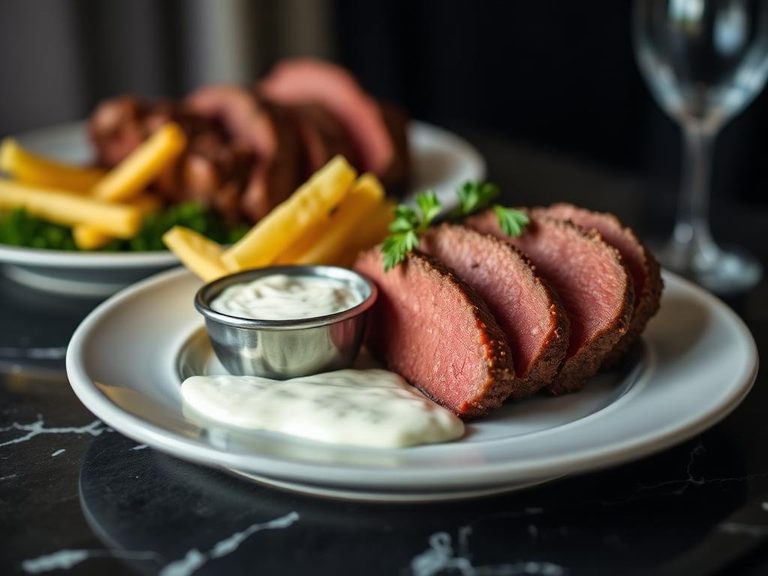
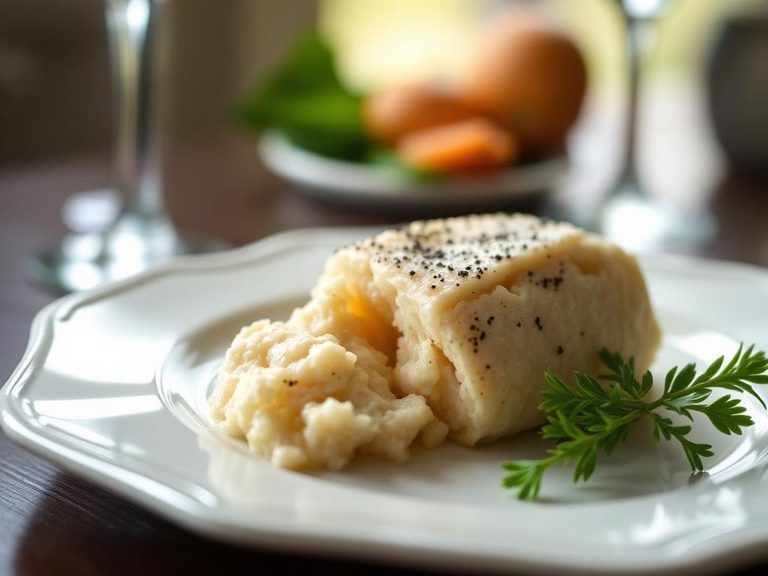
People love it for its exhilarating, wasabi-like heat that instantly cuts through rich, fatty foods like roast beef or gefilte fish. It's a versatile flavor booster that can elevate sauces, dips, and marinades with just a tiny amount.
⚠️ Watch-outs & how to enjoy it better
Its intense pungency can be overwhelming for some and may irritate sensitive digestive systems. The vinegar and salt used in preparation mean it can be high in sodium, which is a consideration for those monitoring salt intake. **Tip:** Use it sparingly as a condiment rather than a main ingredient, and pair it with milder foods to balance its intensity.
Key benefits
- Low in calories and fat.
- Good source of dietary fiber.
- Contains glucosinolates, sulfur compounds found in cruciferous vegetables.
- Adds intense flavor without added sugars or fats.
🍽️ Popular dishes

🌍 Where it's eaten
💡 Did you know?
The volatile compound that gives horseradish its kick, allyl isothiocyanate, is only released when the root's cells are crushed or grated; a whole, unpeeled root has almost no smell.
Full nutrition (USDA data · scales with serving)
| Water | 85.1 g |
| Energy | 48.0 kcal |
| Energy | 201 kj |
| Protein | 1.2 g |
| Total lipid (fat) | 0.69 g |
| Ash | 1.8 g |
| Carbohydrate, by difference | 11.3 g |
| Fiber, total dietary | 3.3 g |
| Total Sugars | 8.0 g |
| Starch | 0.00 g |
| Calcium, Ca | 56.0 mg |
| Iron, Fe | 0.42 mg |
| Magnesium, Mg | 27.0 mg |
| Phosphorus, P | 31.0 mg |
| Potassium, K | 246 mg |
| Sodium, Na | 420 mg |
| Zinc, Zn | 0.83 mg |
| Copper, Cu | 0.06 mg |
| Manganese, Mn | 0.13 mg |
| Selenium, Se | 2.8 ug |
| Vitamin C, total ascorbic acid | 24.9 mg |
| Thiamin | 0.01 mg |
| Riboflavin | 0.02 mg |
| Niacin | 0.39 mg |
| Pantothenic acid | 0.09 mg |
| Vitamin B-6 | 0.07 mg |
| Folate, total | 57.0 ug |
| Folic acid | 0.00 ug |
| Folate, food | 57.0 ug |
| Folate, DFE | 57.0 ug |
| Choline, total | 6.5 mg |
| Vitamin B-12 | 0.00 ug |
| Vitamin B-12, added | 0.00 ug |
| Vitamin A, RAE | 0.00 ug |
| Retinol | 0.00 ug |
| Carotene, beta | 1.0 ug |
| Carotene, alpha | 0.00 ug |
| Cryptoxanthin, beta | 0.00 ug |
| Vitamin A, IU | 2.0 iu |
| Lycopene | 0.00 ug |
| Lutein + zeaxanthin | 10.0 ug |
| Vitamin E (alpha-tocopherol) | 0.01 mg |
| Vitamin E, added | 0.00 mg |
| Vitamin D (D2 + D3), International Units | 0.00 iu |
| Vitamin D (D2 + D3) | 0.00 ug |
| Vitamin K (phylloquinone) | 1.3 ug |
| Alcohol, ethyl | 0.00 g |
| Caffeine | 0.00 mg |
| Theobromine | 0.00 mg |
Fat & fatty acid profile (per 100g)
| Fatty acids, total saturated | 0.09 g |
| SFA 4:0 | 0.00 g |
| SFA 6:0 | 0.00 g |
| SFA 8:0 | 0.00 g |
| SFA 10:0 | 0.00 g |
| SFA 12:0 | 0.00 g |
| SFA 14:0 | 0.00 g |
| SFA 16:0 | 0.06 g |
| SFA 18:0 | 0.02 g |
| Fatty acids, total monounsaturated | 0.13 g |
| MUFA 16:1 | 0.00 g |
| MUFA 18:1 | 0.13 g |
| MUFA 20:1 | 0.00 g |
| MUFA 22:1 | 0.00 g |
| Fatty acids, total polyunsaturated | 0.34 g |
| PUFA 18:2 | 0.28 g |
| PUFA 18:3 | 0.05 g |
| PUFA 18:4 | 0.00 g |
| PUFA 20:4 | 0.00 g |
| PUFA 20:5 n-3 (EPA) | 0.00 g |
| PUFA 22:5 n-3 (DPA) | 0.00 g |
| PUFA 22:6 n-3 (DHA) | 0.00 g |
| Fatty acids, total trans | 0.00 g |
| Cholesterol | 0.00 mg |
| Phytosterols | 9.0 mg |
FAQ
Is prepared horseradish the same as wasabi?
No. Most 'wasabi' served in restaurants is actually horseradish dyed green. True wasabi is a different plant with a more complex, less harsh flavor, and is much rarer and more expensive.
How should I store opened prepared horseradish?
Keep it tightly sealed in the refrigerator. The vinegar helps preserve it, but its pungency will fade over time, typically within a few months.
Can I make it less spicy?
You can mellow its heat by mixing it with sour cream, mayonnaise, or Greek yogurt to create a creamy sauce. Heating it also diminishes its pungency.
Nutrient density (calculated · NRF9.3)
Nutrient Rich Foods index: beneficial nutrients (protein, fiber, vitamins, minerals) minus saturated fat, added sugar & sodium, per 100 kcal.
NRF9.3 index — Fulgoni, Keast & Drewnowski, 2009. Computed from USDA nutrients.
Weight-loss friendliness (composite index)
Energy density 0.48 kcal/g · 10% calories from protein · 3.3 g fiber · 8.0 g sugar per 100 g.
Composite of energy density (Rolls et al., 1999), protein & fiber satiety, minus sugar. A calculated heuristic — ranks satiety-per-calorie, not a clinical measure.
Dietary load (calculated from USDA values)
Potential renal acid load. Positive = acid-forming, negative = alkaline-forming.
Sodium-to-potassium ratio: 1.71 (lower is better — aim for ≤ 1)
Sodium:potassium per WHO potassium guidance. Computed from USDA nutrients.