

Cheese, gjetost
Whole food · Dairy and Egg Products

Photo: Wikipedia
Gjetost is a Norwegian brown cheese made by slowly simmering whey, milk, and cream until the sugars caramelize, creating a dense, fudge-like block with a rich, sweet-savory flavor reminiscent of dulce de leche and goat cheese. Its striking amber color and smooth, sliceable texture make it instantly recognizable. Nutritionally, it's a calorie-dense source of energy, providing significant fat and carbohydrates with a modest protein boost.
Calorie split: 8% protein · 36% carbs · 56% fat
↓ Full nutrition💚 Why it's loved
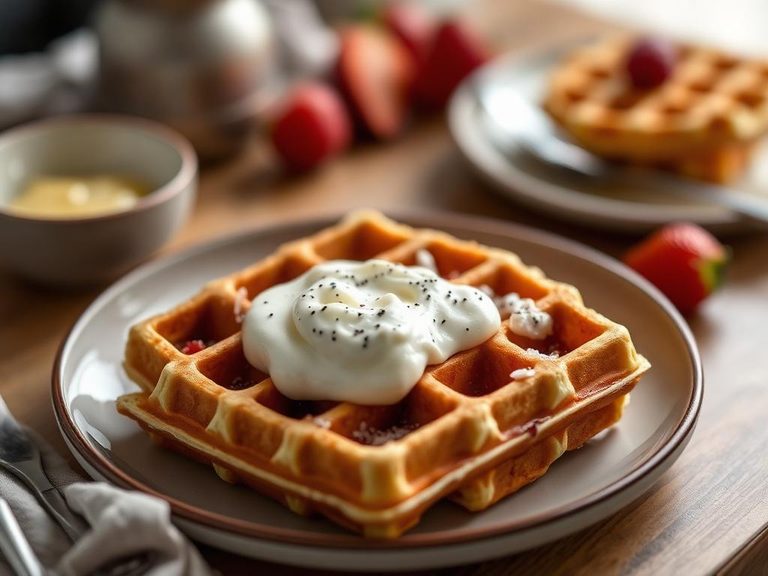
People adore gjetost for its unique, addictive flavor that bridges sweet and savory, making it a versatile topping for waffles, toast, and fruit. It's a beloved cultural staple in Norway, often enjoyed as a simple, comforting snack that evokes tradition.
⚠️ Watch-outs & how to enjoy it better
Its high fat and carbohydrate content (29.5g and 42.7g per 100g) can contribute to significant calorie intake, which may be a concern for those monitoring weight or blood sugar. To enjoy mindfully, practice strict portion control—serving it in thin shavings—and pair it with protein-rich foods like whole-grain bread or nuts to balance the meal.
Key benefits
- High-calorie, energy-dense food for sustained fuel
- Source of calcium and vitamin A from milk solids
- Naturally lactose-free due to the caramelization process
- Provides conjugated linoleic acid (CLA) from ruminant milk fat
- No added sugars; sweetness comes from lactose caramelization
🍽️ Popular dishes


🌍 Where it's eaten
💡 Did you know?
Gjetost translates literally to 'goat cheese,' but the most common version, 'Ekte Gjetost' (True Goat Cheese), is actually made from a blend of cow's milk and goat's milk whey.
Full nutrition (USDA data · scales with serving)
| Water | 13.4 g |
| Energy | 466 kcal |
| Energy | 1948 kj |
| Protein | 9.7 g |
| Total lipid (fat) | 29.5 g |
| Ash | 4.8 g |
| Carbohydrate, by difference | 42.6 g |
| Fiber, total dietary | 0.00 g |
| Calcium, Ca | 400 mg |
| Iron, Fe | 0.52 mg |
| Magnesium, Mg | 70.0 mg |
| Phosphorus, P | 444 mg |
| Potassium, K | 1409 mg |
| Sodium, Na | 600 mg |
| Zinc, Zn | 1.1 mg |
| Copper, Cu | 0.08 mg |
| Manganese, Mn | 0.04 mg |
| Selenium, Se | 14.5 ug |
| Vitamin C, total ascorbic acid | 0.00 mg |
| Thiamin | 0.32 mg |
| Riboflavin | 1.4 mg |
| Niacin | 0.81 mg |
| Pantothenic acid | 3.4 mg |
| Vitamin B-6 | 0.27 mg |
| Folate, total | 5.0 ug |
| Folic acid | 0.00 ug |
| Folate, food | 5.0 ug |
| Folate, DFE | 5.0 ug |
| Vitamin B-12 | 2.4 ug |
| Vitamin A, RAE | 334 ug |
| Retinol | 334 ug |
| Vitamin A, IU | 1113 iu |
Fat & fatty acid profile (per 100g)
| Fatty acids, total saturated | 19.2 g |
| SFA 4:0 | 0.96 g |
| SFA 6:0 | 0.57 g |
| SFA 8:0 | 0.33 g |
| SFA 10:0 | 0.58 g |
| SFA 12:0 | 0.83 g |
| SFA 14:0 | 3.3 g |
| SFA 16:0 | 8.7 g |
| SFA 18:0 | 3.5 g |
| Fatty acids, total monounsaturated | 7.9 g |
| MUFA 16:1 | 0.53 g |
| MUFA 18:1 | 7.0 g |
| Fatty acids, total polyunsaturated | 0.94 g |
| PUFA 18:2 | 0.51 g |
| PUFA 18:3 | 0.43 g |
| PUFA 20:4 | 0.00 g |
| Cholesterol | 94.0 mg |
Amino acid profile (per 100g)
| Tryptophan | 0.14 g |
| Threonine | 0.39 g |
| Isoleucine | 0.52 g |
| Leucine | 0.99 g |
| Lysine | 0.81 g |
| Methionine | 0.32 g |
| Cystine | 0.06 g |
| Phenylalanine | 0.54 g |
| Tyrosine | 0.54 g |
| Valine | 0.77 g |
| Arginine | 0.33 g |
| Histidine | 0.29 g |
| Alanine | 0.33 g |
| Aspartic acid | 0.71 g |
| Glutamic acid | 2.0 g |
| Glycine | 0.19 g |
| Proline | 1.2 g |
| Serine | 0.47 g |
FAQ
Is gjetost the same as goat cheese?
Not exactly. While 'gjetost' means 'goet cheese' in Norwegian, the most common variety is a blend of cow's and goat's milk whey. Pure goat's milk versions exist but are less common.
Why is gjetost brown and sweet?
The brown color and caramel sweetness come from slowly boiling down the whey, which concentrates the natural milk sugars (lactose) and causes them to caramelize, similar to making dulce de leche.
How should I store and serve gjetost?
Keep it wrapped in its original packaging or wax paper in the refrigerator, where it will last for months. For serving, use a cheese plane or sharp knife to shave off thin, curling slices—it's too sticky to cube easily.
Nutrient density (calculated · NRF9.3)
Nutrient Rich Foods index: beneficial nutrients (protein, fiber, vitamins, minerals) minus saturated fat, added sugar & sodium, per 100 kcal.
NRF9.3 index — Fulgoni, Keast & Drewnowski, 2009. Computed from USDA nutrients.
Weight-loss friendliness (composite index)
Energy density 4.66 kcal/g · 8% calories from protein · 0.0 g fiber · 0.0 g sugar per 100 g.
Composite of energy density (Rolls et al., 1999), protein & fiber satiety, minus sugar. A calculated heuristic — ranks satiety-per-calorie, not a clinical measure.
Dietary load (calculated from USDA values)
Potential renal acid load. Positive = acid-forming, negative = alkaline-forming.
Sodium-to-potassium ratio: 0.43 (lower is better — aim for ≤ 1)
Sodium:potassium per WHO potassium guidance. Computed from USDA nutrients.