

Cheese food, cold pack, American
Whole food · Dairy and Egg Products

Photo: Wikipedia
Cold pack American cheese is a smooth, mild, and creamy processed cheese product, known for its exceptional meltability and consistent texture. It's a staple in American diners and home kitchens, prized for its salty, savory flavor that enhances a wide range of dishes. Nutritionally, it's a dense source of protein and fat, providing significant calories in a small serving.
Calorie split: 24% protein · 10% carbs · 66% fat
↓ Full nutrition💚 Why it's loved
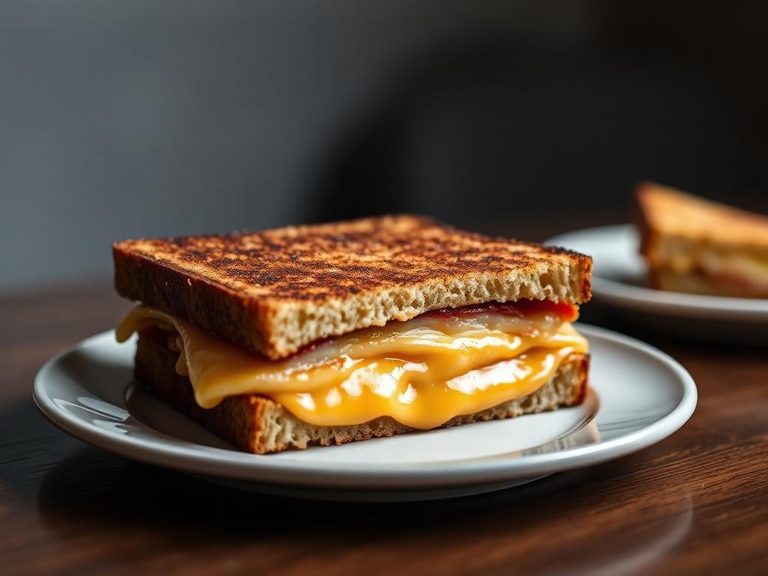
People love it for its unmatched convenience and reliable, crowd-pleasing flavor that instantly elevates comfort foods. Its cultural significance as the quintessential cheese for a perfect grilled cheese or a juicy cheeseburger makes it a nostalgic favorite.
⚠️ Watch-outs & how to enjoy it better
It is typically high in sodium and saturated fat, which may concern those monitoring heart health or blood pressure. To mitigate, use it as a flavorful accent rather than the main event—pair it with fiber-rich vegetables like tomatoes or spinach in a sandwich, and control portion size to about one slice (28g).
Key benefits
- Excellent source of high-quality protein
- Provides calcium for bone health
- Melts smoothly without separating
- Long shelf life when refrigerated
- Consistent flavor and texture batch-to-batch
🍽️ Popular dishes

🌍 Where it's eaten
💡 Did you know?
Cold pack cheese is made by blending natural cheese with emulsifying salts, which prevent the fat and protein from separating when heated, giving it that signature smooth melt.
Full nutrition (USDA data · scales with serving)
| Water | 43.1 g |
| Energy | 331 kcal |
| Energy | 1386 kj |
| Protein | 19.7 g |
| Total lipid (fat) | 24.5 g |
| Ash | 4.4 g |
| Carbohydrate, by difference | 8.3 g |
| Fiber, total dietary | 0.00 g |
| Calcium, Ca | 497 mg |
| Iron, Fe | 0.84 mg |
| Magnesium, Mg | 30.0 mg |
| Phosphorus, P | 400 mg |
| Potassium, K | 363 mg |
| Sodium, Na | 966 mg |
| Zinc, Zn | 3.0 mg |
| Copper, Cu | 0.03 mg |
| Manganese, Mn | 0.01 mg |
| Selenium, Se | 16.2 ug |
| Vitamin C, total ascorbic acid | 0.00 mg |
| Thiamin | 0.03 mg |
| Riboflavin | 0.45 mg |
| Niacin | 0.07 mg |
| Pantothenic acid | 0.98 mg |
| Vitamin B-6 | 0.14 mg |
| Folate, total | 5.0 ug |
| Folic acid | 0.00 ug |
| Folate, food | 5.0 ug |
| Folate, DFE | 5.0 ug |
| Vitamin B-12 | 1.3 ug |
| Vitamin A, IU | 705 iu |
Fat & fatty acid profile (per 100g)
| Fatty acids, total saturated | 15.4 g |
| SFA 4:0 | 0.79 g |
| SFA 6:0 | 0.47 g |
| SFA 8:0 | 0.36 g |
| SFA 10:0 | 0.59 g |
| SFA 12:0 | 0.73 g |
| SFA 14:0 | 2.5 g |
| SFA 16:0 | 6.8 g |
| SFA 18:0 | 2.8 g |
| Fatty acids, total monounsaturated | 7.2 g |
| MUFA 16:1 | 0.65 g |
| MUFA 18:1 | 6.0 g |
| Fatty acids, total polyunsaturated | 0.72 g |
| PUFA 18:2 | 0.46 g |
| PUFA 18:3 | 0.26 g |
| PUFA 20:4 | 0.00 g |
| Cholesterol | 64.0 mg |
Amino acid profile (per 100g)
| Tryptophan | 0.29 g |
| Threonine | 0.64 g |
| Isoleucine | 0.91 g |
| Leucine | 1.7 g |
| Lysine | 2.0 g |
| Methionine | 0.51 g |
| Cystine | 0.13 g |
| Phenylalanine | 1.00 g |
| Tyrosine | 1.1 g |
| Valine | 1.2 g |
| Arginine | 0.82 g |
| Histidine | 0.80 g |
| Alanine | 0.49 g |
| Aspartic acid | 1.2 g |
| Glutamic acid | 4.1 g |
| Glycine | 0.32 g |
| Proline | 2.0 g |
| Serine | 0.95 g |
FAQ
What's the difference between cold pack and regular American cheese?
Cold pack (or club) cheese is made by blending fresh cheese curds with other cheeses and emulsifiers, then packing it cold. It's often creamier and milder than standard American cheese slices, which are typically made from a cooked blend of cheese, milk, and emulsifiers.
Is it real cheese?
It's classified as a 'cheese product' because it contains additives like emulsifying salts to improve texture and melt. However, its primary ingredient is still real cheese.
Why does it melt so perfectly?
The emulsifying salts (like sodium citrate) bind the proteins and fats, preventing them from separating into an oily mess. This creates a smooth, creamy melt ideal for sauces and sandwiches.
Nutrient density (calculated · NRF9.3)
Nutrient Rich Foods index: beneficial nutrients (protein, fiber, vitamins, minerals) minus saturated fat, added sugar & sodium, per 100 kcal.
NRF9.3 index — Fulgoni, Keast & Drewnowski, 2009. Computed from USDA nutrients.
Weight-loss friendliness (composite index)
Energy density 3.31 kcal/g · 24% calories from protein · 0.0 g fiber · 0.0 g sugar per 100 g.
Composite of energy density (Rolls et al., 1999), protein & fiber satiety, minus sugar. A calculated heuristic — ranks satiety-per-calorie, not a clinical measure.
Dietary load (calculated from USDA values)
Potential renal acid load. Positive = acid-forming, negative = alkaline-forming.
Sodium-to-potassium ratio: 2.66 (lower is better — aim for ≤ 1)
Sodium:potassium per WHO potassium guidance. Computed from USDA nutrients.