

Cake, coffeecake, cheese
Whole food · Baked Products
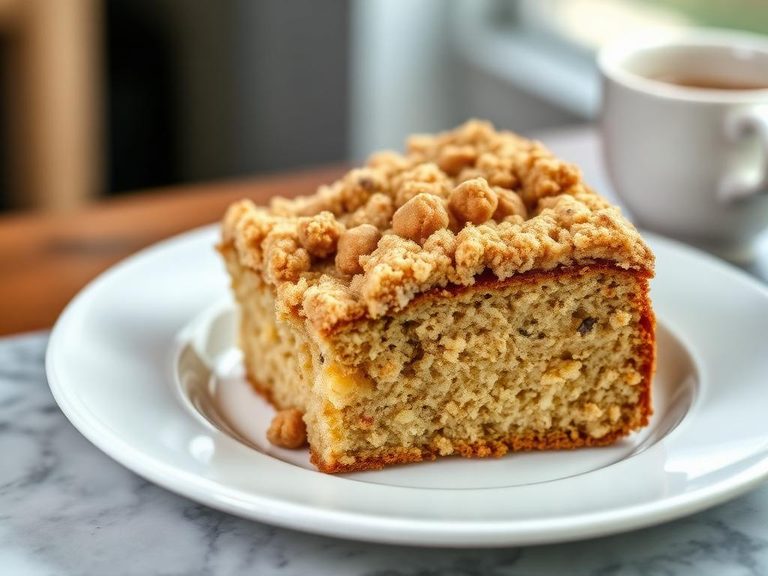
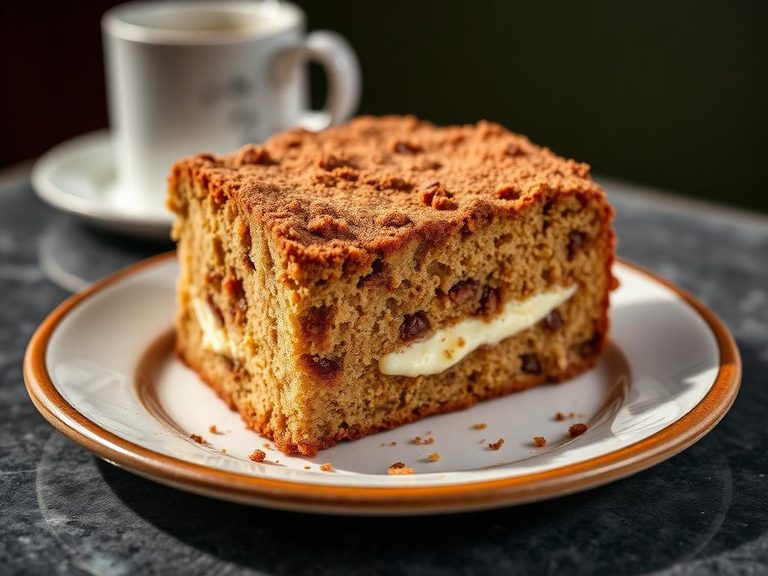
A moist, tender cake featuring a rich, tangy cream cheese swirl or filling, offering a delightful contrast between the sweet, buttery crumb and the smooth, slightly tart cheese layer. Nutritionally, it's an energy-dense treat, providing a substantial 339 kcal per 100g, primarily from carbohydrates and fats.
Calorie split: 8% protein · 52% carbs · 40% fat
↓ Full nutrition💚 Why it's loved
People love it for the luxurious, creamy texture of the cheese layer that perfectly balances the sweet cake base, making it a versatile choice for breakfast, brunch, or dessert.
⚠️ Watch-outs & how to enjoy it better
Its high calorie and refined carbohydrate content can cause rapid blood sugar spikes, making it less suitable for those managing blood sugar or seeking low-calorie options. To counteract this, enjoy a small portion (e.g., 1/6 of a standard cake) alongside a source of protein (like Greek yogurt) or healthy fat (like nuts) to slow digestion and increase satiety.
Key benefits
- Provides quick energy from carbohydrates
- Contains calcium from the cream cheese component
- Offers a satisfying blend of sweet and tangy flavors
- Can serve as a comforting, indulgent snack or dessert
🍽️ Popular dishes


🌍 Where it's eaten
💡 Did you know?
The 'cheese' in cheesecake or cheese coffeecake is typically not a hard cheese, but a soft, fresh cheese like cream cheese, quark, or farmer's cheese, which gives it that characteristic smooth, dense texture.
Full nutrition (USDA data · scales with serving)
| Water | 32.2 g |
| Energy | 339 kcal |
| Energy | 1418 kj |
| Protein | 7.0 g |
| Total lipid (fat) | 15.2 g |
| Ash | 1.2 g |
| Carbohydrate, by difference | 44.3 g |
| Fiber, total dietary | 1.0 g |
| Calcium, Ca | 59.0 mg |
| Iron, Fe | 0.64 mg |
| Magnesium, Mg | 15.0 mg |
| Phosphorus, P | 101 mg |
| Potassium, K | 289 mg |
| Sodium, Na | 339 mg |
| Zinc, Zn | 0.59 mg |
| Copper, Cu | 0.05 mg |
| Manganese, Mn | 0.17 mg |
| Selenium, Se | 13.3 ug |
| Vitamin C, total ascorbic acid | 0.10 mg |
| Thiamin | 0.10 mg |
| Riboflavin | 0.13 mg |
| Niacin | 0.68 mg |
| Pantothenic acid | 0.40 mg |
| Vitamin B-6 | 0.06 mg |
| Folate, total | 39.0 ug |
| Folic acid | 20.0 ug |
| Folate, food | 19.0 ug |
| Folate, DFE | 53.0 ug |
| Vitamin B-12 | 0.34 ug |
| Vitamin A, RAE | 86.0 ug |
| Retinol | 86.0 ug |
| Vitamin A, IU | 287 iu |
| Alcohol, ethyl | 0.00 g |
Fat & fatty acid profile (per 100g)
| Fatty acids, total saturated | 5.4 g |
| SFA 4:0 | 0.11 g |
| SFA 6:0 | 0.03 g |
| SFA 8:0 | 0.04 g |
| SFA 10:0 | 0.07 g |
| SFA 12:0 | 0.05 g |
| SFA 14:0 | 0.45 g |
| SFA 16:0 | 2.8 g |
| SFA 18:0 | 1.7 g |
| Fatty acids, total monounsaturated | 7.1 g |
| MUFA 16:1 | 0.17 g |
| MUFA 18:1 | 6.9 g |
| MUFA 20:1 | 0.01 g |
| MUFA 22:1 | 0.00 g |
| Fatty acids, total polyunsaturated | 1.6 g |
| PUFA 18:2 | 1.5 g |
| PUFA 18:3 | 0.13 g |
| PUFA 18:4 | 0.00 g |
| PUFA 20:4 | 0.03 g |
| PUFA 20:5 n-3 (EPA) | 0.00 g |
| PUFA 22:5 n-3 (DPA) | 0.00 g |
| PUFA 22:6 n-3 (DHA) | 0.01 g |
| Cholesterol | 85.0 mg |
Amino acid profile (per 100g)
| Tryptophan | 0.08 g |
| Threonine | 0.26 g |
| Isoleucine | 0.33 g |
| Leucine | 0.57 g |
| Lysine | 0.40 g |
| Methionine | 0.14 g |
| Cystine | 0.11 g |
| Phenylalanine | 0.35 g |
| Tyrosine | 0.26 g |
| Valine | 0.36 g |
| Arginine | 0.30 g |
| Histidine | 0.19 g |
| Alanine | 0.26 g |
| Aspartic acid | 0.47 g |
| Glutamic acid | 1.8 g |
| Glycine | 0.21 g |
| Proline | 0.63 g |
| Serine | 0.37 g |
FAQ
Is the cheese in coffee cake the same as in cheesecake?
Often, yes. Both typically use cream cheese for a tangy, creamy element. However, some coffee cakes might use a lighter farmer's cheese or a sweetened ricotta mixture.
Can I make a lower-sugar version?
You can reduce the sugar in the cake batter and use a less sweetened cream cheese filling. Using applesauce or mashed banana in the batter can also add moisture and natural sweetness with less refined sugar.
Why is my cream cheese filling sinking or cracking?
This often happens if the filling is too liquid or the cake is overbaked. Ensure your cream cheese is fully softened but not warm, mix gently to avoid incorporating too much air, and bake just until the center is set but still slightly jiggly.
Nutrient density (calculated · NRF9.3)
Nutrient Rich Foods index: beneficial nutrients (protein, fiber, vitamins, minerals) minus saturated fat, added sugar & sodium, per 100 kcal.
NRF9.3 index — Fulgoni, Keast & Drewnowski, 2009. Computed from USDA nutrients.
Weight-loss friendliness (composite index)
Energy density 3.39 kcal/g · 8% calories from protein · 1.0 g fiber · 0.0 g sugar per 100 g.
Composite of energy density (Rolls et al., 1999), protein & fiber satiety, minus sugar. A calculated heuristic — ranks satiety-per-calorie, not a clinical measure.
Dietary load (calculated from USDA values)
Potential renal acid load. Positive = acid-forming, negative = alkaline-forming.
Sodium-to-potassium ratio: 1.17 (lower is better — aim for ≤ 1)
Sodium:potassium per WHO potassium guidance. Computed from USDA nutrients.