

Beef, rib, small end (ribs 10-12), separable lean and fat, trimmed to 1/8" fat, prime, cooked, roasted
Whole food · Beef Products

Photo: Wikipedia
This is the prized, well-marbled cut from the small end of the beef rib, specifically ribs 10-12, roasted to a perfect medium-rare or medium. It delivers a robust, beefy flavor with a tender, juicy texture where the lean meat and the thin, rendered fat cap melt together beautifully. Nutritionally, it's a powerhouse of high-quality protein and energy-dense fat, with virtually no carbohydrates.
Calorie split: 22% protein · 0% carbs · 78% fat
↓ Full nutrition💚 Why it's loved
People adore it for the intense, savory beef flavor and the luxurious mouthfeel that comes from the intramuscular fat (marbling). It's a celebratory centerpiece, often associated with Sunday roasts, holiday feasts, and steakhouse indulgence.
⚠️ Watch-outs & how to enjoy it better
The high saturated fat and calorie content means it should be enjoyed in moderation, especially by those managing heart health or calorie intake. To counteract this, practice strict portion control (see below) and pair it with large servings of non-starchy vegetables like roasted broccoli or a crisp salad to add volume and fiber without significant carbs.
Key benefits
- Excellent source of complete, high-quality protein for muscle maintenance.
- Rich in heme iron, which is highly absorbable and vital for energy.
- Provides essential B vitamins, especially B12, crucial for nerve function.
- Contains zinc, which supports immune system health.
- A calorie-dense food useful for meeting high energy needs.
🍽️ Popular dishes
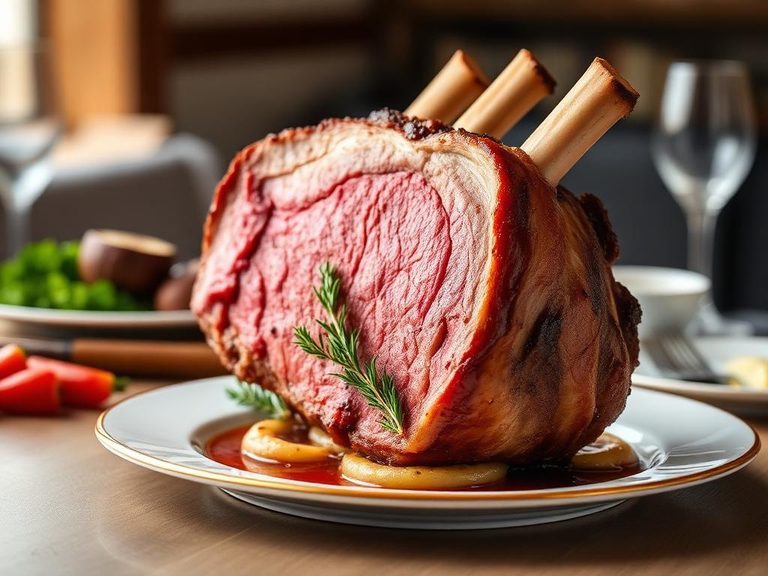
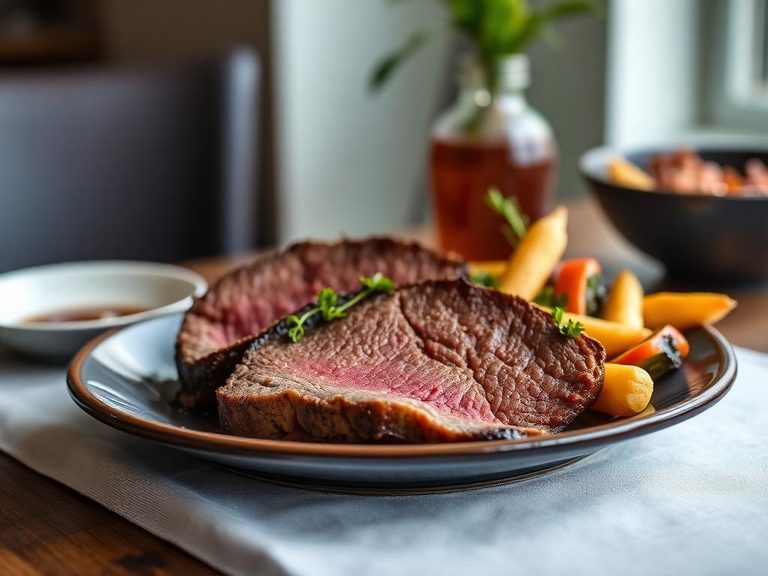
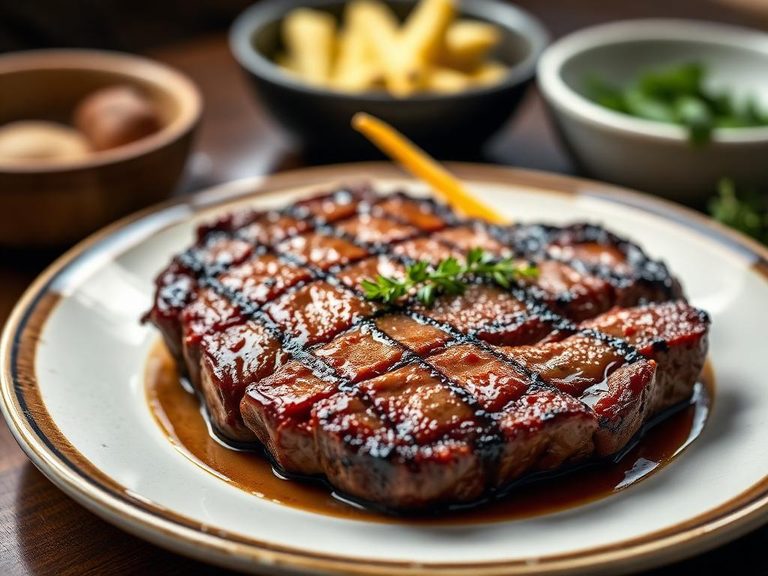

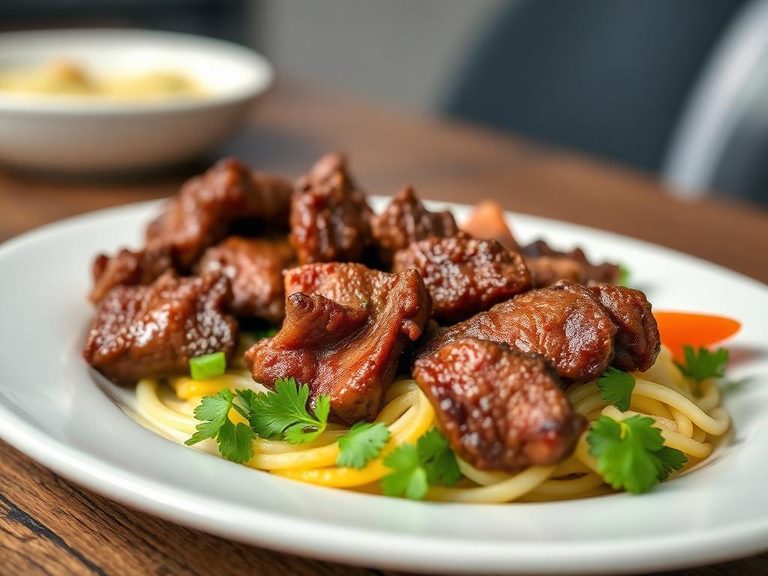
🌍 Where it's eaten
💡 Did you know?
The 'small end' (ribs 10-12) is often considered more tender and evenly shaped than the 'large end' (ribs 6-9), making it the preferred cut for a classic, picture-perfect Standing Rib Roast.
Full nutrition (USDA data · scales with serving)
| Water | 41.8 g |
| Energy | 411 kcal |
| Energy | 1720 kj |
| Protein | 22.1 g |
| Total lipid (fat) | 35.1 g |
| Ash | 0.91 g |
| Carbohydrate, by difference | 0.00 g |
| Fiber, total dietary | 0.00 g |
| Calcium, Ca | 13.0 mg |
| Iron, Fe | 1.9 mg |
| Magnesium, Mg | 20.0 mg |
| Phosphorus, P | 178 mg |
| Potassium, K | 323 mg |
| Sodium, Na | 65.0 mg |
| Zinc, Zn | 4.8 mg |
| Copper, Cu | 0.08 mg |
| Manganese, Mn | 0.01 mg |
| Selenium, Se | 22.3 ug |
| Vitamin C, total ascorbic acid | 0.00 mg |
| Thiamin | 0.06 mg |
| Riboflavin | 0.17 mg |
| Niacin | 3.0 mg |
| Pantothenic acid | 0.36 mg |
| Vitamin B-6 | 0.30 mg |
| Folate, total | 7.0 ug |
| Folic acid | 0.00 ug |
| Folate, food | 7.0 ug |
| Folate, DFE | 7.0 ug |
| Vitamin B-12 | 2.9 ug |
| Vitamin A, RAE | 0.00 ug |
| Retinol | 0.00 ug |
| Vitamin A, IU | 0.00 iu |
Fat & fatty acid profile (per 100g)
| Fatty acids, total saturated | 14.5 g |
| SFA 10:0 | 0.08 g |
| SFA 12:0 | 0.08 g |
| SFA 14:0 | 1.1 g |
| SFA 16:0 | 8.7 g |
| SFA 18:0 | 4.2 g |
| Fatty acids, total monounsaturated | 15.3 g |
| MUFA 16:1 | 1.4 g |
| MUFA 18:1 | 13.6 g |
| MUFA 20:1 | 0.06 g |
| Fatty acids, total polyunsaturated | 1.2 g |
| PUFA 18:2 | 0.82 g |
| PUFA 18:3 | 0.33 g |
| PUFA 20:4 | 0.04 g |
| Cholesterol | 84.0 mg |
Amino acid profile (per 100g)
| Tryptophan | 0.25 g |
| Threonine | 0.97 g |
| Isoleucine | 1.00 g |
| Leucine | 1.8 g |
| Lysine | 1.8 g |
| Methionine | 0.57 g |
| Cystine | 0.25 g |
| Phenylalanine | 0.86 g |
| Tyrosine | 0.74 g |
| Valine | 1.1 g |
| Arginine | 1.4 g |
| Histidine | 0.76 g |
| Alanine | 1.3 g |
| Aspartic acid | 2.0 g |
| Glutamic acid | 3.3 g |
| Glycine | 1.2 g |
| Proline | 0.98 g |
| Serine | 0.85 g |
FAQ
What's the difference between 'separable lean and fat' and just 'lean'?
'Separable lean and fat' means the nutrition data includes both the meat you eat and the fat layer you can easily separate with a knife. A 'lean' cut would have most of that external fat trimmed away, resulting in lower calories and fat per gram.
Is 'prime' the highest quality grade?
Yes, in the USDA grading system, Prime is the top grade, awarded to beef with abundant marbling (intramuscular fat). This marbling is what gives it exceptional tenderness, juiciness, and flavor.
How do I cook this cut to keep it tender?
For roasting, use a high-heat sear first to develop a crust, then finish at a lower temperature. The key is to use a meat thermometer and pull it from the oven about 5-10°F below your target final temperature, as it will continue to cook while resting. This prevents overcooking and drying out the lean muscle.
Nutrient density (calculated · NRF9.3)
Nutrient Rich Foods index: beneficial nutrients (protein, fiber, vitamins, minerals) minus saturated fat, added sugar & sodium, per 100 kcal.
NRF9.3 index — Fulgoni, Keast & Drewnowski, 2009. Computed from USDA nutrients.
Weight-loss friendliness (composite index)
Energy density 4.11 kcal/g · 22% calories from protein · 0.0 g fiber · 0.0 g sugar per 100 g.
Composite of energy density (Rolls et al., 1999), protein & fiber satiety, minus sugar. A calculated heuristic — ranks satiety-per-calorie, not a clinical measure.
Dietary load (calculated from USDA values)
Potential renal acid load. Positive = acid-forming, negative = alkaline-forming.
Sodium-to-potassium ratio: 0.20 (lower is better — aim for ≤ 1)
Sodium:potassium per WHO potassium guidance. Computed from USDA nutrients.