

Soup, cream of celery, canned, prepared with equal volume milk
Whole food · Soups, Sauces, and Gravies
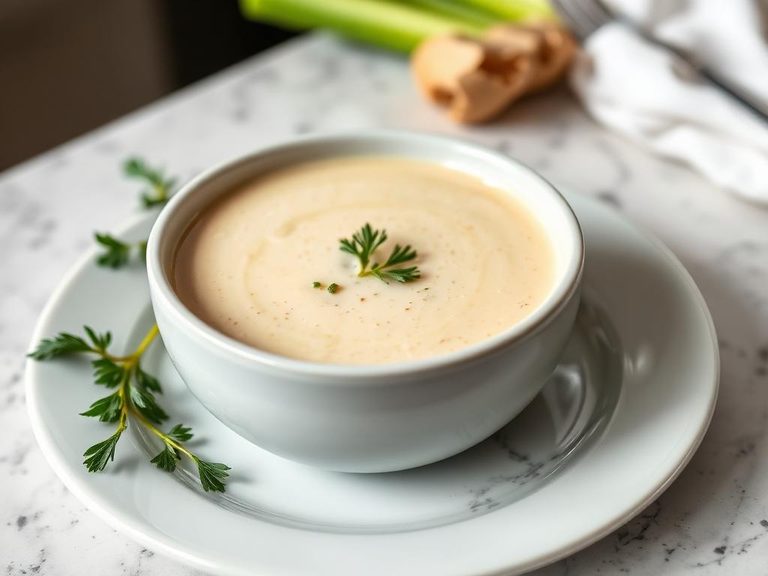
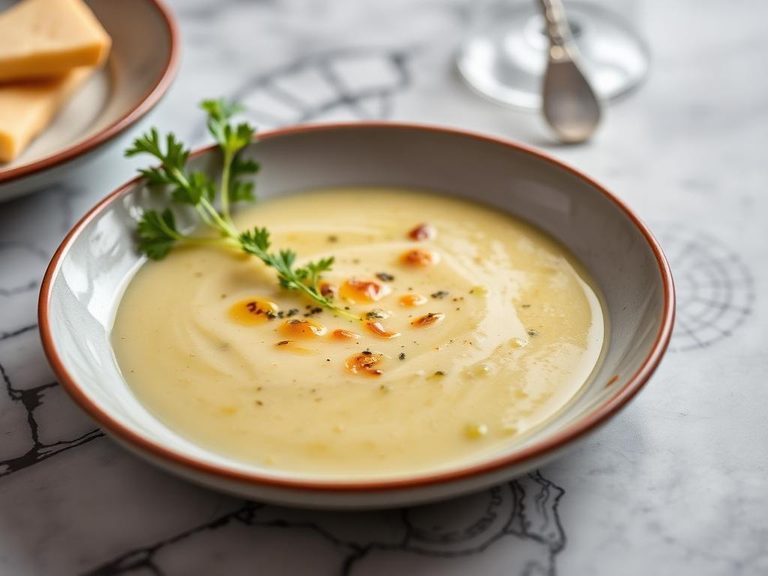
This is a classic, comforting canned soup base, transformed into a creamy, savory bowl by simply adding an equal volume of milk. The result is a velvety, smooth texture with a distinct, earthy celery flavor that is both familiar and satisfying. Nutritionally, it's a light yet creamy option, providing a balanced mix of protein and fat from the milk addition, with a moderate calorie count.
Calorie split: 14% protein · 35% carbs · 52% fat
↓ Full nutrition💚 Why it's loved
People love it for its nostalgic, comforting flavor and effortless preparation, turning a can into a warm meal in minutes. Its mild, savory profile makes it a versatile base that pairs wonderfully with a grilled cheese sandwich or a simple side salad.
⚠️ Watch-outs & how to enjoy it better
Canned soups are often high in sodium, which can be a concern for those monitoring blood pressure or fluid retention. To counteract this, look for 'low sodium' versions or rinse the concentrated soup base lightly before mixing. Additionally, while low in sugar, the carbohydrate content can contribute to blood-sugar spikes if not balanced; pairing it with a protein-rich side like chicken or whole-grain bread helps mitigate this.
Key benefits
- Quick and convenient meal or starter
- Good source of protein when prepared with milk
- Provides a creamy texture without heavy cream
- Low in sugar
- Contains dietary fiber from celery
🍽️ Popular dishes
🌍 Where it's eaten
💡 Did you know?
The 'cream of' style of canned soup was popularized in the early 20th century by companies like Campbell's, which marketed it as a modern, convenient way to create a 'homemade' taste.
Full nutrition (USDA data · scales with serving)
| Water | 86.5 g |
| Energy | 66.0 kcal |
| Energy | 276 kj |
| Protein | 2.3 g |
| Total lipid (fat) | 3.9 g |
| Ash | 1.5 g |
| Carbohydrate, by difference | 5.9 g |
| Fiber, total dietary | 0.30 g |
| Calcium, Ca | 75.0 mg |
| Iron, Fe | 0.28 mg |
| Magnesium, Mg | 9.0 mg |
| Phosphorus, P | 61.0 mg |
| Potassium, K | 125 mg |
| Sodium, Na | 272 mg |
| Zinc, Zn | 0.08 mg |
| Copper, Cu | 0.06 mg |
| Manganese, Mn | 0.10 mg |
| Selenium, Se | 1.9 ug |
| Vitamin C, total ascorbic acid | 0.60 mg |
| Thiamin | 0.03 mg |
| Riboflavin | 0.10 mg |
| Niacin | 0.18 mg |
| Pantothenic acid | 0.61 mg |
| Vitamin B-6 | 0.03 mg |
| Folate, total | 3.0 ug |
| Folic acid | 0.00 ug |
| Folate, food | 3.0 ug |
| Folate, DFE | 3.0 ug |
| Vitamin B-12 | 0.20 ug |
| Vitamin A, IU | 186 iu |
| Alcohol, ethyl | 0.00 g |
Fat & fatty acid profile (per 100g)
| Fatty acids, total saturated | 1.6 g |
| SFA 4:0 | 0.08 g |
| SFA 6:0 | 0.05 g |
| SFA 8:0 | 0.03 g |
| SFA 10:0 | 0.06 g |
| SFA 12:0 | 0.07 g |
| SFA 14:0 | 0.25 g |
| SFA 16:0 | 0.67 g |
| SFA 18:0 | 0.31 g |
| Fatty acids, total monounsaturated | 0.99 g |
| MUFA 16:1 | 0.06 g |
| MUFA 18:1 | 0.90 g |
| MUFA 20:1 | 0.00 g |
| MUFA 22:1 | 0.00 g |
| Fatty acids, total polyunsaturated | 1.1 g |
| PUFA 18:2 | 1.0 g |
| PUFA 18:3 | 0.05 g |
| PUFA 18:4 | 0.00 g |
| PUFA 20:4 | 0.00 g |
| PUFA 20:5 n-3 (EPA) | 0.00 g |
| PUFA 22:5 n-3 (DPA) | 0.00 g |
| PUFA 22:6 n-3 (DHA) | 0.00 g |
| Cholesterol | 13.0 mg |
Amino acid profile (per 100g)
| Tryptophan | 0.03 g |
| Threonine | 0.10 g |
| Isoleucine | 0.13 g |
| Leucine | 0.21 g |
| Lysine | 0.16 g |
| Methionine | 0.05 g |
| Cystine | 0.02 g |
| Phenylalanine | 0.11 g |
| Tyrosine | 0.10 g |
| Valine | 0.14 g |
| Arginine | 0.08 g |
| Histidine | 0.06 g |
| Alanine | 0.08 g |
| Aspartic acid | 0.17 g |
| Glutamic acid | 0.49 g |
| Glycine | 0.06 g |
| Proline | 0.21 g |
| Serine | 0.12 g |
FAQ
Can I use water instead of milk to prepare it?
Yes, you can use water, but the soup will be thinner and less creamy, with a more pronounced, less-rounded celery flavor. Using milk (dairy or a fortified plant-based alternative) is key to achieving the intended rich texture and taste.
Is this soup gluten-free?
The base canned soup may contain wheat flour as a thickener. Always check the specific product label. If gluten-free, it can be a safe option when prepared with a compatible milk.
How can I enhance the flavor of this simple soup?
Stir in a pinch of nutmeg or black pepper, a squeeze of lemon juice to brighten it, or some fresh herbs like parsley or thyme. Sautéed mushrooms or a handful of cooked rice can also add texture and depth.
Nutrient density (calculated · NRF9.3)
Nutrient Rich Foods index: beneficial nutrients (protein, fiber, vitamins, minerals) minus saturated fat, added sugar & sodium, per 100 kcal.
NRF9.3 index — Fulgoni, Keast & Drewnowski, 2009. Computed from USDA nutrients.
Weight-loss friendliness (composite index)
Energy density 0.66 kcal/g · 14% calories from protein · 0.3 g fiber · 0.0 g sugar per 100 g.
Composite of energy density (Rolls et al., 1999), protein & fiber satiety, minus sugar. A calculated heuristic — ranks satiety-per-calorie, not a clinical measure.
Dietary load (calculated from USDA values)
Potential renal acid load. Positive = acid-forming, negative = alkaline-forming.
Sodium-to-potassium ratio: 2.18 (lower is better — aim for ≤ 1)
Sodium:potassium per WHO potassium guidance. Computed from USDA nutrients.