Figs, dried, uncooked
Whole food · Fruits and Fruit Juices
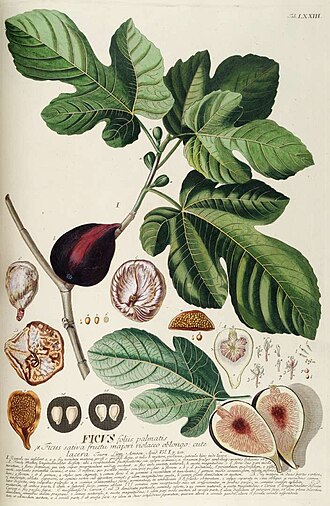
Photo: Wikipedia
Dried figs are sun-kissed fruits, shriveled into a chewy, jammy state with a honeyed sweetness and a satisfying crunch from their tiny seeds. Nutritionally, they are a standout source of dietary fiber and a surprising plant-based source of minerals like potassium and calcium.
💚 Why it's loved
People adore dried figs for their intense, honey-like sweetness and uniquely satisfying texture that's both chewy and crunchy. They are cherished across cultures as a natural sweetener in baking, a luxurious addition to cheese boards, and a symbol of hospitality and abundance.
⚠️ Watch-outs & how to enjoy it better
Due to their concentrated natural sugars and carbohydrates, they can cause a rapid rise in blood sugar if eaten in large quantities alone. To mitigate this, pair them with a source of protein or healthy fat (like nuts or cheese) and practice portion control. Their sticky texture can also promote dental plaque, so rinsing with water after eating is a good tip.
Key benefits
- Excellent source of dietary fiber for digestive health.
- Rich in essential minerals like potassium and calcium.
- Provides quick, natural energy from carbohydrates.
- Contains antioxidants like polyphenols.
- A convenient, shelf-stable whole-food snack.
🍽️ Popular dishes




🌍 Where it's eaten
💡 Did you know?
Figs are not actually fruits in the botanical sense; they are inverted flowers (a syconium) that are pollinated internally by tiny wasps.
Full nutrition (scales with serving)
| Water | 30.0 g |
| Energy (Atwater General Factors) | 277 kcal |
| Energy (Atwater Specific Factors) | 249 kcal |
| Energy | 249 kcal |
| Energy | 1040 kj |
| Nitrogen | 0.53 g |
| Protein | 3.3 g |
| Total lipid (fat) | 0.92 g |
| Ash | 1.9 g |
| Carbohydrate, by difference | 63.9 g |
| Carbohydrate, by summation | 62.8 g |
| Fiber, total dietary | 9.8 g |
| Fiber, soluble | 1.5 g |
| Fiber, insoluble | 8.3 g |
| Sugars, Total | 47.9 g |
| Sucrose | 0.07 g |
| Glucose | 24.8 g |
| Fructose | 22.9 g |
| Lactose | 0.00 g |
| Maltose | 0.00 g |
| Galactose | 0.13 g |
| Starch | 5.1 g |
| Calcium, Ca | 162 mg |
| Iron, Fe | 2.0 mg |
| Magnesium, Mg | 67.6 mg |
| Phosphorus, P | 67.0 mg |
| Potassium, K | 680 mg |
| Sodium, Na | 10.0 mg |
| Zinc, Zn | 0.66 mg |
| Copper, Cu | 0.29 mg |
| Manganese, Mn | 0.51 mg |
| Selenium, Se | 0.60 ug |
| Vitamin C, total ascorbic acid | 1.2 mg |
| Thiamin | 0.09 mg |
| Riboflavin | 0.08 mg |
| Niacin | 0.62 mg |
| Pantothenic acid | 0.43 mg |
| Vitamin B-6 | 0.11 mg |
| Folate, total | 9.0 ug |
| Vitamin A, RAE | 0.00 ug |
| Carotene, beta | 6.0 ug |
| Carotene, alpha | 0.00 ug |
| Cryptoxanthin, beta | 0.00 ug |
| Lycopene | 0.00 ug |
| Lutein + zeaxanthin | 32.0 ug |
| Vitamin E (alpha-tocopherol) | 0.36 mg |
| Tocopherol, beta | 0.01 mg |
| Tocopherol, gamma | 0.37 mg |
| Tocopherol, delta | 0.01 mg |
| Tocotrienol, alpha | 0.02 mg |
| Tocotrienol, beta | 0.00 mg |
| Tocotrienol, gamma | 0.00 mg |
| Tocotrienol, delta | 0.00 mg |
| Vitamin K (phylloquinone) | 15.6 ug |
| Vitamin K (Dihydrophylloquinone) | 0.00 ug |
| Tryptophan | 0.02 g |
| Threonine | 0.08 g |
| Isoleucine | 0.08 g |
| Leucine | 0.12 g |
| Lysine | 0.08 g |
| Methionine | 0.03 g |
| Cystine | 0.03 g |
| Phenylalanine | 0.07 g |
| Tyrosine | 0.04 g |
| Valine | 0.11 g |
| Arginine | 0.07 g |
| Histidine | 0.03 g |
| Alanine | 0.12 g |
| Aspartic acid | 0.62 g |
| Glutamic acid | 0.27 g |
| Glycine | 0.10 g |
| Proline | 0.56 g |
| Serine | 0.12 g |
FAQ
Why do dried figs sometimes have a white, powdery coating?
This is often a natural sugar bloom, where the fruit's sugars crystallize on the surface. It's perfectly safe to eat. If the figs are very old or stored poorly, it could also be mold, so inspect them closely.
How should I store dried figs to keep them fresh?
For short-term use, keep them in an airtight container in a cool, dark pantry. For longer storage (up to a year), place them in a sealed container in the refrigerator or freezer to prevent them from drying out further or becoming infested.
Are dried figs a good source of calcium?
Yes, surprisingly so. Dried figs contain more calcium per weight than many fresh fruits and can be a meaningful contributor to your daily intake, especially for those on a plant-based diet.