

Chewing gum, sugarless
Whole food · Sweets
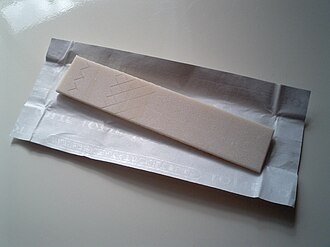
Photo: Wikipedia
Sugarless chewing gum is a resilient, rubbery base designed to be chewed without swallowing, delivering a burst of artificial or natural sweetness without the calories of sugar. Its texture is pliant and elastic, offering a satisfying resistance that softens over time as flavor is extracted. Nutritionally, it's a near-pure carbohydrate source, with its 94.8g of carbs per 100g primarily from sugar alcohols like sorbitol or xylitol, which provide sweetness with minimal caloric impact.
Calorie split: 0% protein · 99% carbs · 1% fat
↓ Full nutrition💚 Why it's loved
People love it for the long-lasting, intense flavor bursts that can freshen breath instantly and provide a sensory distraction. It's a versatile, pocket-sized habit for focus, stress relief, or simply enjoying a favorite taste without consuming food.
⚠️ Watch-outs & how to enjoy it better
Excessive consumption of sugar alcohols (like sorbitol) can have a laxative effect, causing bloating and digestive discomfort. Individuals with irritable bowel syndrome (IBS) or sensitive digestion should be cautious. To counteract this, practice portion control—stick to a few pieces at a time—and check labels for the specific sugar alcohol used, as xylitol is generally better tolerated than sorbitol.
Key benefits
- Promotes saliva production, which can help neutralize mouth acids after meals.
- Provides a calorie-free or very low-calorie flavor experience.
- Sugar alcohols like xylitol are not metabolized by cavity-causing bacteria.
- Can serve as a temporary appetite suppressant or oral fixation aid.
- Offers a convenient, portable, and mess-free flavor boost.
🍽️ Popular dishes



🌍 Where it's eaten
💡 Did you know?
The first commercially successful modern chewing gum, 'Adams New York Gum,' was invented in 1871 by Thomas Adams, who was trying to create a rubber substitute from chicle—a tree sap he acquired from a Mexican general.
Full nutrition (USDA data · scales with serving)
| Water | 3.5 g |
| Energy | 268 kcal |
| Energy | 1121 kj |
| Protein | 0.00 g |
| Total lipid (fat) | 0.40 g |
| Ash | 1.3 g |
| Carbohydrate, by difference | 94.8 g |
| Fiber, total dietary | 2.4 g |
| Total Sugars | 0.00 g |
| Calcium, Ca | 20.0 mg |
| Iron, Fe | 0.00 mg |
| Magnesium, Mg | 0.00 mg |
| Phosphorus, P | 0.00 mg |
| Potassium, K | 0.00 mg |
| Sodium, Na | 7.0 mg |
| Zinc, Zn | 0.00 mg |
| Copper, Cu | 0.00 mg |
| Selenium, Se | 0.50 ug |
| Vitamin C, total ascorbic acid | 0.00 mg |
| Thiamin | 0.00 mg |
| Riboflavin | 0.00 mg |
| Niacin | 0.00 mg |
| Vitamin B-6 | 0.00 mg |
| Folate, total | 0.00 ug |
| Folic acid | 0.00 ug |
| Folate, food | 0.00 ug |
| Folate, DFE | 0.00 ug |
| Choline, total | 0.00 mg |
| Vitamin B-12 | 0.00 ug |
| Vitamin B-12, added | 0.00 ug |
| Vitamin A, RAE | 0.00 ug |
| Retinol | 0.00 ug |
| Carotene, beta | 0.00 ug |
| Carotene, alpha | 0.00 ug |
| Cryptoxanthin, beta | 0.00 ug |
| Vitamin A, IU | 0.00 iu |
| Lycopene | 0.00 ug |
| Lutein + zeaxanthin | 0.00 ug |
| Vitamin E (alpha-tocopherol) | 0.00 mg |
| Vitamin E, added | 0.00 mg |
| Vitamin D (D2 + D3), International Units | 0.00 iu |
| Vitamin D (D2 + D3) | 0.00 ug |
| Vitamin K (phylloquinone) | 0.00 ug |
| Alcohol, ethyl | 0.00 g |
| Caffeine | 0.00 mg |
| Theobromine | 0.00 mg |
Fat & fatty acid profile (per 100g)
| Fatty acids, total saturated | 0.06 g |
| SFA 4:0 | 0.00 g |
| SFA 6:0 | 0.00 g |
| SFA 8:0 | 0.00 g |
| SFA 10:0 | 0.00 g |
| SFA 12:0 | 0.00 g |
| SFA 14:0 | 0.00 g |
| SFA 16:0 | 0.04 g |
| SFA 18:0 | 0.01 g |
| Fatty acids, total monounsaturated | 0.09 g |
| MUFA 16:1 | 0.00 g |
| MUFA 18:1 | 0.09 g |
| MUFA 20:1 | 0.00 g |
| MUFA 22:1 | 0.00 g |
| Fatty acids, total polyunsaturated | 0.23 g |
| PUFA 18:2 | 0.20 g |
| PUFA 18:3 | 0.03 g |
| PUFA 18:4 | 0.00 g |
| PUFA 20:4 | 0.00 g |
| PUFA 20:5 n-3 (EPA) | 0.00 g |
| PUFA 22:5 n-3 (DPA) | 0.00 g |
| PUFA 22:6 n-3 (DHA) | 0.00 g |
| Cholesterol | 0.00 mg |
FAQ
Does sugarless gum have any calories?
Yes, but very few. The calories come from the sugar alcohols (like sorbitol or xylitol) used for sweetness. A typical piece has about 2-5 calories, compared to 10-15 calories for a sugar-sweetened piece.
Is chewing gum bad for your teeth?
Sugarless gum is actually beneficial for dental health. The act of chewing stimulates saliva flow, which helps wash away food particles and neutralize harmful acids. Gums sweetened with xylitol may further reduce cavity-causing bacteria.
Why does sugarless gum sometimes cause stomach issues?
Sugar alcohols are not fully absorbed by the body. When consumed in large amounts, they can draw water into the intestines and be fermented by gut bacteria, leading to gas, bloating, and a laxative effect. This is dose-dependent.
Nutrient density (calculated · NRF9.3)
Nutrient Rich Foods index: beneficial nutrients (protein, fiber, vitamins, minerals) minus saturated fat, added sugar & sodium, per 100 kcal.
NRF9.3 index — Fulgoni, Keast & Drewnowski, 2009. Computed from USDA nutrients.
Weight-loss friendliness (composite index)
Energy density 2.68 kcal/g · 0% calories from protein · 2.4 g fiber · 0.0 g sugar per 100 g.
Composite of energy density (Rolls et al., 1999), protein & fiber satiety, minus sugar. A calculated heuristic — ranks satiety-per-calorie, not a clinical measure.
Dietary load (calculated from USDA values)
Potential renal acid load. Positive = acid-forming, negative = alkaline-forming.
Sodium:potassium per WHO potassium guidance. Computed from USDA nutrients.