

Chewing gum
Whole food · Sweets
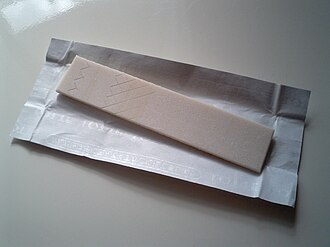
Photo: Wikipedia
Chewing gum is a soft, chewy substance designed to be chewed but not swallowed, typically offering a burst of sweet or minty flavor. Its texture is uniquely elastic and resilient, providing a satisfying, repetitive chew. Nutritionally, it is almost entirely composed of carbohydrates, specifically sugars, with negligible protein or fat.
Calorie split: 0% protein · 99% carbs · 1% fat
↓ Full nutrition💚 Why it's loved
People love chewing gum for its immediate, intense burst of flavor and the satisfying, stress-relieving rhythm of chewing. It's a versatile, portable habit that can be a cultural staple, from classic American bubblegum to sophisticated European mints.
⚠️ Watch-outs & how to enjoy it better
The primary downside is its high sugar content (over 66g per 100g), which can contribute to tooth decay and blood-sugar spikes. To counteract this, always opt for sugar-free varieties sweetened with xylitol or sorbitol, and practice good oral hygiene by brushing or rinsing after chewing.
Key benefits
- May improve focus and concentration during tasks
- Can stimulate saliva production, aiding in oral hygiene
- Often used as a breath freshener
- Provides a sugar-free option for a sweet craving
- A common tool for managing mild stress or anxiety
🍽️ Popular dishes


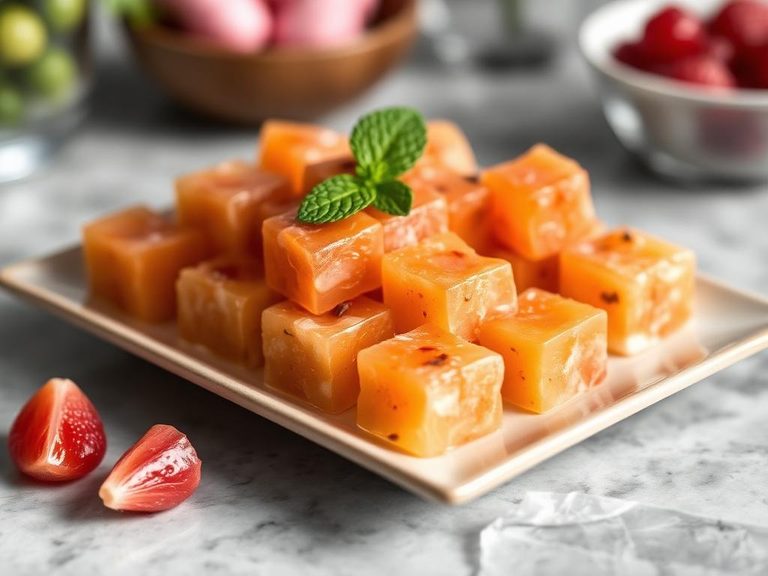
🌍 Where it's eaten
💡 Did you know?
The world's largest bubblegum bubble ever blown measured over 50 cm (20 inches) in diameter, a sticky feat of physics and lung power.
Full nutrition (USDA data · scales with serving)
| Water | 2.6 g |
| Energy | 360 kcal |
| Energy | 1507 kj |
| Protein | 0.00 g |
| Total lipid (fat) | 0.30 g |
| Ash | 0.40 g |
| Carbohydrate, by difference | 96.7 g |
| Fiber, total dietary | 2.4 g |
| Total Sugars | 66.1 g |
| Calcium, Ca | 0.00 mg |
| Iron, Fe | 0.00 mg |
| Magnesium, Mg | 0.00 mg |
| Phosphorus, P | 0.00 mg |
| Potassium, K | 2.0 mg |
| Sodium, Na | 1.0 mg |
| Zinc, Zn | 0.00 mg |
| Copper, Cu | 0.00 mg |
| Manganese, Mn | 0.00 mg |
| Selenium, Se | 0.60 ug |
| Fluoride, F | 5.0 ug |
| Vitamin C, total ascorbic acid | 0.00 mg |
| Thiamin | 0.00 mg |
| Riboflavin | 0.00 mg |
| Niacin | 0.00 mg |
| Pantothenic acid | 0.00 mg |
| Vitamin B-6 | 0.00 mg |
| Folate, total | 0.00 ug |
| Folic acid | 0.00 ug |
| Folate, food | 0.00 ug |
| Folate, DFE | 0.00 ug |
| Choline, total | 0.00 mg |
| Vitamin B-12 | 0.00 ug |
| Vitamin B-12, added | 0.00 ug |
| Vitamin A, RAE | 0.00 ug |
| Retinol | 0.00 ug |
| Carotene, beta | 0.00 ug |
| Carotene, alpha | 0.00 ug |
| Cryptoxanthin, beta | 0.00 ug |
| Vitamin A, IU | 0.00 iu |
| Lycopene | 0.00 ug |
| Lutein + zeaxanthin | 0.00 ug |
| Vitamin E (alpha-tocopherol) | 0.00 mg |
| Vitamin E, added | 0.00 mg |
| Vitamin D (D2 + D3), International Units | 0.00 iu |
| Vitamin D (D2 + D3) | 0.00 ug |
| Vitamin K (phylloquinone) | 0.00 ug |
| Alcohol, ethyl | 0.00 g |
| Caffeine | 0.00 mg |
| Theobromine | 0.00 mg |
Fat & fatty acid profile (per 100g)
| Fatty acids, total saturated | 0.04 g |
| SFA 4:0 | 0.00 g |
| SFA 6:0 | 0.00 g |
| SFA 8:0 | 0.00 g |
| SFA 10:0 | 0.00 g |
| SFA 12:0 | 0.00 g |
| SFA 14:0 | 0.00 g |
| SFA 16:0 | 0.04 g |
| SFA 18:0 | 0.01 g |
| Fatty acids, total monounsaturated | 0.08 g |
| MUFA 16:1 | 0.00 g |
| MUFA 18:1 | 0.08 g |
| MUFA 20:1 | 0.00 g |
| MUFA 22:1 | 0.00 g |
| Fatty acids, total polyunsaturated | 0.14 g |
| PUFA 18:2 | 0.13 g |
| PUFA 18:3 | 0.00 g |
| PUFA 18:4 | 0.00 g |
| PUFA 20:4 | 0.00 g |
| PUFA 20:5 n-3 (EPA) | 0.00 g |
| PUFA 22:5 n-3 (DPA) | 0.00 g |
| PUFA 22:6 n-3 (DHA) | 0.00 g |
| Cholesterol | 0.00 mg |
FAQ
Is chewing gum digestible?
No. The gum base is synthetic and indigestible. While the flavor and sweeteners are absorbed, the base passes through the digestive system intact.
Does chewing gum help with weight loss?
It may help curb snack cravings temporarily by keeping your mouth busy, but it's not a significant calorie burner. Its main benefit is as a behavioral tool, not a metabolic one.
Why is sugar-free gum often recommended for teeth?
Sugar-free gum, especially those sweetened with xylitol, does not feed cavity-causing bacteria. The act of chewing also increases saliva flow, which helps neutralize acids and remineralize tooth enamel.
Nutrient density (calculated · NRF9.3)
Nutrient Rich Foods index: beneficial nutrients (protein, fiber, vitamins, minerals) minus saturated fat, added sugar & sodium, per 100 kcal.
NRF9.3 index — Fulgoni, Keast & Drewnowski, 2009. Computed from USDA nutrients.
Weight-loss friendliness (composite index)
Energy density 3.60 kcal/g · 0% calories from protein · 2.4 g fiber · 66.1 g sugar per 100 g.
Composite of energy density (Rolls et al., 1999), protein & fiber satiety, minus sugar. A calculated heuristic — ranks satiety-per-calorie, not a clinical measure.
Dietary load (calculated from USDA values)
Potential renal acid load. Positive = acid-forming, negative = alkaline-forming.
Sodium-to-potassium ratio: 0.50 (lower is better — aim for ≤ 1)
Sodium:potassium per WHO potassium guidance. Computed from USDA nutrients.