

Candied fruit
Whole food · Fruits and Fruit Juices

Photo: Wikipedia
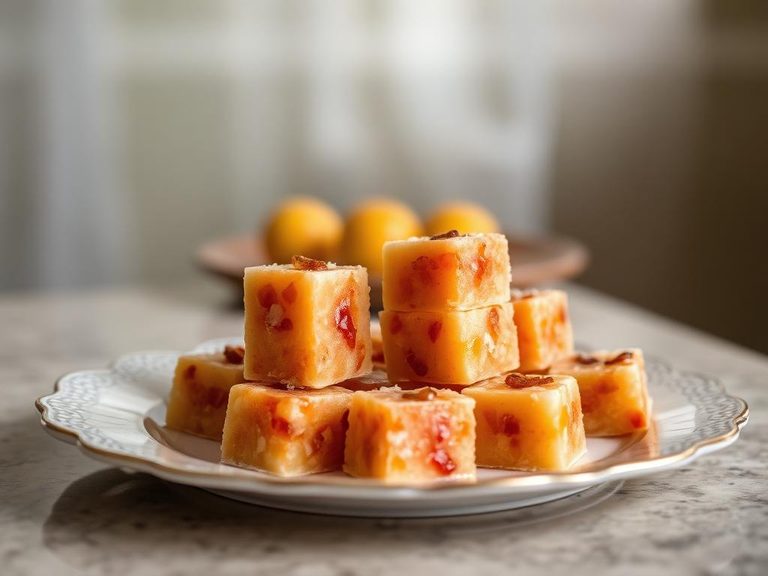
Candied fruit, or crystallized fruit, is fresh fruit that has been preserved by slowly replacing its water content with sugar syrup, then often coated in additional granulated sugar. The result is a jewel-like, chewy, and intensely sweet confection with a texture that can range from tender to slightly firm, depending on the fruit and preparation. Nutritionally, it is a concentrated source of carbohydrates, primarily from sugar, with minimal protein or fat.
Calorie split: 0% protein · 99% carbs · 0% fat
↓ Full nutrition💚 Why it's loved
People love candied fruit for its intense, concentrated sweetness and unique chewy texture that transforms ordinary fruit into a decadent treat. It is cherished in many cultures as a festive ingredient, adding color and flavor to holiday cakes, pastries, and confections.
⚠️ Watch-outs & how to enjoy it better
The extremely high sugar content (over 80g per 100g) can cause rapid blood-sugar spikes, making it unsuitable for those with diabetes or insulin resistance. To mitigate this, consume it in very small portions (a few pieces) and pair it with a source of protein or fat (like nuts or cheese) to slow sugar absorption. It is also calorie-dense, so portion control is key for weight management.
Key benefits
- Provides a quick source of energy from simple carbohydrates.
- Acts as a long-lasting, shelf-stable fruit preserve without refrigeration.
- Adds concentrated flavor and decorative appeal to baked goods and desserts.
- Can be a way to preserve seasonal fruits for year-round use.
🍽️ Popular dishes



🌍 Where it's eaten
💡 Did you know?
The process of making candied fruit, called 'candying' or 'crystallizing,' can take several weeks, as the fruit is gradually soaked in increasingly concentrated sugar syrups to prevent it from shriveling and to ensure the sugar fully permeates the flesh.
Full nutrition (USDA data · scales with serving)
| Water | 16.7 g |
| Energy | 322 kcal |
| Energy | 1345 kj |
| Protein | 0.34 g |
| Total lipid (fat) | 0.07 g |
| Ash | 0.14 g |
| Carbohydrate, by difference | 82.7 g |
| Fiber, total dietary | 1.6 g |
| Total Sugars | 80.7 g |
| Calcium, Ca | 18.0 mg |
| Iron, Fe | 0.17 mg |
| Magnesium, Mg | 4.0 mg |
| Phosphorus, P | 5.0 mg |
| Potassium, K | 56.0 mg |
| Sodium, Na | 98.0 mg |
| Zinc, Zn | 0.05 mg |
| Copper, Cu | 0.03 mg |
| Manganese, Mn | 0.11 mg |
| Selenium, Se | 0.60 ug |
| Vitamin C, total ascorbic acid | 0.00 mg |
| Thiamin | 0.00 mg |
| Riboflavin | 0.00 mg |
| Niacin | 0.00 mg |
| Vitamin B-6 | 0.00 mg |
| Folate, total | 0.00 ug |
| Folic acid | 0.00 ug |
| Folate, food | 0.00 ug |
| Folate, DFE | 0.00 ug |
| Choline, total | 2.2 mg |
| Vitamin B-12 | 0.00 ug |
| Vitamin B-12, added | 0.00 ug |
| Vitamin A, RAE | 1.0 ug |
| Retinol | 0.00 ug |
| Carotene, beta | 9.0 ug |
| Carotene, alpha | 0.00 ug |
| Cryptoxanthin, beta | 5.0 ug |
| Vitamin A, IU | 19.0 iu |
| Lycopene | 0.00 ug |
| Lutein + zeaxanthin | 11.0 ug |
| Vitamin E (alpha-tocopherol) | 0.04 mg |
| Vitamin E, added | 0.00 mg |
| Vitamin D (D2 + D3), International Units | 0.00 iu |
| Vitamin D (D2 + D3) | 0.00 ug |
| Vitamin K (phylloquinone) | 0.30 ug |
| Alcohol, ethyl | 0.00 g |
| Caffeine | 0.00 mg |
| Theobromine | 0.00 mg |
Fat & fatty acid profile (per 100g)
| Fatty acids, total saturated | 0.01 g |
| SFA 4:0 | 0.00 g |
| SFA 6:0 | 0.00 g |
| SFA 8:0 | 0.00 g |
| SFA 10:0 | 0.00 g |
| SFA 12:0 | 0.00 g |
| SFA 14:0 | 0.00 g |
| SFA 16:0 | 0.01 g |
| SFA 18:0 | 0.00 g |
| Fatty acids, total monounsaturated | 0.01 g |
| MUFA 16:1 | 0.00 g |
| MUFA 18:1 | 0.01 g |
| MUFA 20:1 | 0.00 g |
| MUFA 22:1 | 0.00 g |
| Fatty acids, total polyunsaturated | 0.02 g |
| PUFA 18:2 | 0.01 g |
| PUFA 18:3 | 0.01 g |
| PUFA 18:4 | 0.00 g |
| PUFA 20:4 | 0.00 g |
| PUFA 20:5 n-3 (EPA) | 0.00 g |
| PUFA 22:5 n-3 (DPA) | 0.00 g |
| PUFA 22:6 n-3 (DHA) | 0.00 g |
| Fatty acids, total trans | 0.00 g |
| Cholesterol | 0.00 mg |
FAQ
Is candied fruit the same as dried fruit?
No. Dried fruit is simply dehydrated, while candied fruit is preserved in sugar syrup, making it much sweeter, moister, and more calorie-dense per gram.
Can I make candied fruit at home?
Yes, but it requires patience. The fruit must be slowly simmered in sugar syrup over several days, with the syrup concentration increased gradually, to achieve the right texture without making the fruit mushy.
What fruits are commonly candied?
Citrus peels (orange, lemon, grapefruit), cherries, pineapple, ginger, and melon are popular choices. The process works best with fruits that have a firm structure.
Nutrient density (calculated · NRF9.3)
Nutrient Rich Foods index: beneficial nutrients (protein, fiber, vitamins, minerals) minus saturated fat, added sugar & sodium, per 100 kcal.
NRF9.3 index — Fulgoni, Keast & Drewnowski, 2009. Computed from USDA nutrients.
Weight-loss friendliness (composite index)
Energy density 3.22 kcal/g · 0% calories from protein · 1.6 g fiber · 80.7 g sugar per 100 g.
Composite of energy density (Rolls et al., 1999), protein & fiber satiety, minus sugar. A calculated heuristic — ranks satiety-per-calorie, not a clinical measure.
Dietary load (calculated from USDA values)
Potential renal acid load. Positive = acid-forming, negative = alkaline-forming.
Sodium-to-potassium ratio: 1.75 (lower is better — aim for ≤ 1)
Sodium:potassium per WHO potassium guidance. Computed from USDA nutrients.