

Acerola juice, raw
Whole food · Fruits and Fruit Juices

Photo: Wikipedia
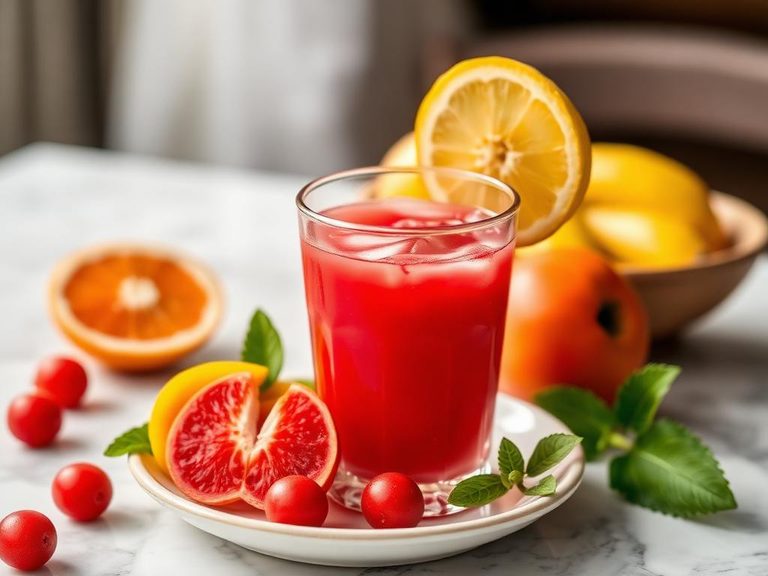
Acerola juice, raw, is a vibrant, tart liquid pressed from the cherry-like fruit of the Malpighia emarginata bush. Its flavor is intensely sour and refreshing, reminiscent of a sharp cranberry or sour cherry, with a thin, watery texture. This juice is a nutritional powerhouse, celebrated for its extraordinarily high natural vitamin C content, far surpassing that of oranges.
Calorie split: 7% protein · 82% carbs · 11% fat
↓ Full nutrition💚 Why it's loved
People love acerola juice for its electrifying, mouth-puckering tartness that makes it a refreshing base for cocktails, smoothies, and health shots. In its native regions, it's a cherished cultural staple, often enjoyed fresh from the fruit or as a popular, tangy commercial beverage.
⚠️ Watch-outs & how to enjoy it better
The intense sourness can be overwhelming for some palates, and its high natural sugar content (though low in absolute grams) can contribute to blood sugar spikes if consumed in large quantities. To counteract this, pair it with a source of protein or healthy fat (like a handful of nuts or yogurt), or dilute it with water and consume it with a meal to blunt the glycemic response.
Key benefits
- Exceptionally rich source of natural vitamin C
- Provides antioxidants like anthocyanins and carotenoids
- Low in calories and contains no fat
- May support immune function due to vitamin C
- Contains small amounts of potassium and B vitamins
🍽️ Popular dishes

🌍 Where it's eaten
💡 Did you know?
A single acerola cherry contains about 80 mg of vitamin C, which is more than the recommended daily intake for an adult and roughly 30-50 times more than an orange by weight.
Full nutrition (USDA data · scales with serving)
| Water | 94.3 g |
| Energy | 23.0 kcal |
| Energy | 96.0 kj |
| Protein | 0.40 g |
| Total lipid (fat) | 0.30 g |
| Ash | 0.20 g |
| Carbohydrate, by difference | 4.8 g |
| Fiber, total dietary | 0.30 g |
| Total Sugars | 4.5 g |
| Calcium, Ca | 10.0 mg |
| Iron, Fe | 0.50 mg |
| Magnesium, Mg | 12.0 mg |
| Phosphorus, P | 9.0 mg |
| Potassium, K | 97.0 mg |
| Sodium, Na | 3.0 mg |
| Zinc, Zn | 0.10 mg |
| Copper, Cu | 0.09 mg |
| Selenium, Se | 0.10 ug |
| Vitamin C, total ascorbic acid | 1600 mg |
| Thiamin | 0.02 mg |
| Riboflavin | 0.06 mg |
| Niacin | 0.40 mg |
| Pantothenic acid | 0.20 mg |
| Vitamin B-6 | 0.00 mg |
| Folate, total | 14.0 ug |
| Folic acid | 0.00 ug |
| Folate, food | 14.0 ug |
| Folate, DFE | 14.0 ug |
| Vitamin B-12 | 0.00 ug |
| Vitamin B-12, added | 0.00 ug |
| Vitamin A, RAE | 25.0 ug |
| Retinol | 0.00 ug |
| Carotene, beta | 305 ug |
| Carotene, alpha | 0.00 ug |
| Cryptoxanthin, beta | 0.00 ug |
| Vitamin A, IU | 509 iu |
| Lycopene | 0.00 ug |
| Lutein + zeaxanthin | 17.0 ug |
| Vitamin E (alpha-tocopherol) | 0.18 mg |
| Vitamin E, added | 0.00 mg |
| Vitamin K (phylloquinone) | 1.4 ug |
| Alcohol, ethyl | 0.00 g |
| Caffeine | 0.00 mg |
| Theobromine | 0.00 mg |
Fat & fatty acid profile (per 100g)
| Fatty acids, total saturated | 0.07 g |
| SFA 4:0 | 0.00 g |
| SFA 6:0 | 0.00 g |
| SFA 8:0 | 0.00 g |
| SFA 10:0 | 0.00 g |
| SFA 12:0 | 0.00 g |
| SFA 14:0 | 0.00 g |
| SFA 16:0 | 0.05 g |
| SFA 18:0 | 0.02 g |
| Fatty acids, total monounsaturated | 0.08 g |
| MUFA 16:1 | 0.00 g |
| MUFA 18:1 | 0.08 g |
| MUFA 20:1 | 0.00 g |
| MUFA 22:1 | 0.00 g |
| Fatty acids, total polyunsaturated | 0.09 g |
| PUFA 18:2 | 0.05 g |
| PUFA 18:3 | 0.04 g |
| PUFA 18:4 | 0.00 g |
| PUFA 20:4 | 0.00 g |
| PUFA 20:5 n-3 (EPA) | 0.00 g |
| PUFA 22:5 n-3 (DPA) | 0.00 g |
| PUFA 22:6 n-3 (DHA) | 0.00 g |
| Fatty acids, total trans | 0.00 g |
| Cholesterol | 0.00 mg |
FAQ
Is acerola juice the same as cherry juice?
No. Acerola (Malpighia emarginata) is a different fruit from a different plant family than common cherries (Prunus). They share a superficial resemblance and tartness, but acerola is famed for its extreme vitamin C content.
Can I drink acerola juice every day?
In moderation, yes. Its high vitamin C is beneficial, but its natural sugars mean it's best enjoyed as part of a varied diet. Diluting it or having it with meals is a good practice.
How does raw acerola juice differ from commercial acerola juice?
Raw, freshly pressed juice retains the full spectrum of heat-sensitive nutrients like vitamin C. Commercial versions are often pasteurized and may contain added water, sweeteners, or preservatives, which can reduce the nutrient density.
Nutrient density (calculated · NRF9.3)
Nutrient Rich Foods index: beneficial nutrients (protein, fiber, vitamins, minerals) minus saturated fat, added sugar & sodium, per 100 kcal.
NRF9.3 index — Fulgoni, Keast & Drewnowski, 2009. Computed from USDA nutrients.
Weight-loss friendliness (composite index)
Energy density 0.23 kcal/g · 7% calories from protein · 0.3 g fiber · 4.5 g sugar per 100 g.
Composite of energy density (Rolls et al., 1999), protein & fiber satiety, minus sugar. A calculated heuristic — ranks satiety-per-calorie, not a clinical measure.
Dietary load (calculated from USDA values)
Potential renal acid load. Positive = acid-forming, negative = alkaline-forming.
Sodium-to-potassium ratio: 0.03 (lower is better — aim for ≤ 1)
Sodium:potassium per WHO potassium guidance. Computed from USDA nutrients.