

Thuringer, cervelat, summer sausage, beef, pork
Whole food · Sausages and Luncheon Meats
A trio of classic European-style cured sausages—Thuringer, cervelat, and summer sausage—crafted from a savory blend of beef and pork. They offer a firm, dense texture with a rich, slightly tangy, and spiced flavor profile, often with notes of garlic, mustard seed, and paprika. Nutritionally, they are a high-fat, high-protein food with minimal carbohydrates, making them a calorie-dense option.
Calorie split: 20% protein · 4% carbs · 77% fat
↓ Full nutrition💚 Why it's loved
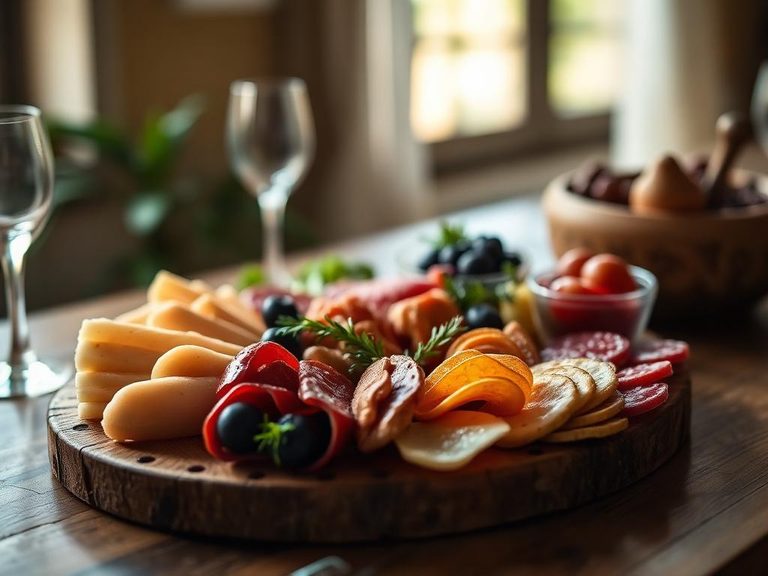
People adore these sausages for their robust, savory depth and satisfying, chewy texture, which makes them a staple for charcuterie boards and hearty snacks. Their cultural heritage and versatility in both casual and formal settings contribute to their enduring appeal.
⚠️ Watch-outs & how to enjoy it better
Due to their high sodium and saturated fat content, they should be consumed in moderation, especially by those managing blood pressure or heart health. To counteract, pair them with fiber-rich vegetables or whole-grain crackers, and practice strict portion control to avoid excessive intake.
Key benefits
- High-quality complete protein for muscle maintenance
- Provides essential B vitamins, especially B12
- Convenient, shelf-stable, and requires no cooking
- Source of minerals like iron and zinc
- Low in carbohydrates and sugar
🍽️ Popular dishes
🌍 Where it's eaten
💡 Did you know?
Thuringer sausage is protected by a geographical indication in the EU, requiring it to be produced in the German state of Thuringia with specific ingredients and methods.
Full nutrition (USDA data · scales with serving)
| Water | 45.2 g |
| Energy | 362 kcal |
| Energy | 1514 kj |
| Protein | 17.4 g |
| Total lipid (fat) | 30.4 g |
| Ash | 3.6 g |
| Carbohydrate, by difference | 3.3 g |
| Fiber, total dietary | 0.00 g |
| Total Sugars | 0.85 g |
| Calcium, Ca | 9.0 mg |
| Iron, Fe | 2.0 mg |
| Magnesium, Mg | 14.0 mg |
| Phosphorus, P | 111 mg |
| Potassium, K | 260 mg |
| Sodium, Na | 1300 mg |
| Zinc, Zn | 2.6 mg |
| Copper, Cu | 0.15 mg |
| Selenium, Se | 20.3 ug |
| Vitamin C, total ascorbic acid | 16.6 mg |
| Thiamin | 0.15 mg |
| Riboflavin | 0.33 mg |
| Niacin | 4.3 mg |
| Vitamin B-6 | 0.26 mg |
| Folate, total | 2.0 ug |
| Folic acid | 0.00 ug |
| Folate, food | 2.0 ug |
| Folate, DFE | 2.0 ug |
| Choline, total | 78.9 mg |
| Betaine | 3.4 mg |
| Vitamin B-12 | 5.5 ug |
| Vitamin B-12, added | 0.00 ug |
| Vitamin A, RAE | 0.00 ug |
| Retinol | 0.00 ug |
| Carotene, beta | 0.00 ug |
| Carotene, alpha | 0.00 ug |
| Cryptoxanthin, beta | 0.00 ug |
| Vitamin A, IU | 0.00 iu |
| Lycopene | 0.00 ug |
| Lutein + zeaxanthin | 0.00 ug |
| Vitamin E (alpha-tocopherol) | 0.22 mg |
| Vitamin E, added | 0.00 mg |
| Vitamin D (D2 + D3), International Units | 44.0 iu |
| Vitamin D (D2 + D3) | 1.1 ug |
| Vitamin K (phylloquinone) | 1.3 ug |
| Alcohol, ethyl | 0.00 g |
| Caffeine | 0.00 mg |
| Theobromine | 0.00 mg |
Fat & fatty acid profile (per 100g)
| Fatty acids, total saturated | 11.5 g |
| SFA 4:0 | 0.00 g |
| SFA 6:0 | 0.00 g |
| SFA 8:0 | 0.00 g |
| SFA 10:0 | 0.11 g |
| SFA 12:0 | 0.08 g |
| SFA 14:0 | 0.80 g |
| SFA 16:0 | 6.3 g |
| SFA 18:0 | 4.2 g |
| Fatty acids, total monounsaturated | 13.0 g |
| MUFA 16:1 | 1.8 g |
| MUFA 18:1 | 11.2 g |
| MUFA 20:1 | 0.00 g |
| MUFA 22:1 | 0.00 g |
| Fatty acids, total polyunsaturated | 1.2 g |
| PUFA 18:2 | 0.99 g |
| PUFA 18:3 | 0.21 g |
| PUFA 18:4 | 0.00 g |
| PUFA 20:4 | 0.00 g |
| PUFA 20:5 n-3 (EPA) | 0.00 g |
| PUFA 22:5 n-3 (DPA) | 0.00 g |
| PUFA 22:6 n-3 (DHA) | 0.00 g |
| Cholesterol | 74.0 mg |
FAQ
What is the difference between Thuringer, cervelat, and summer sausage?
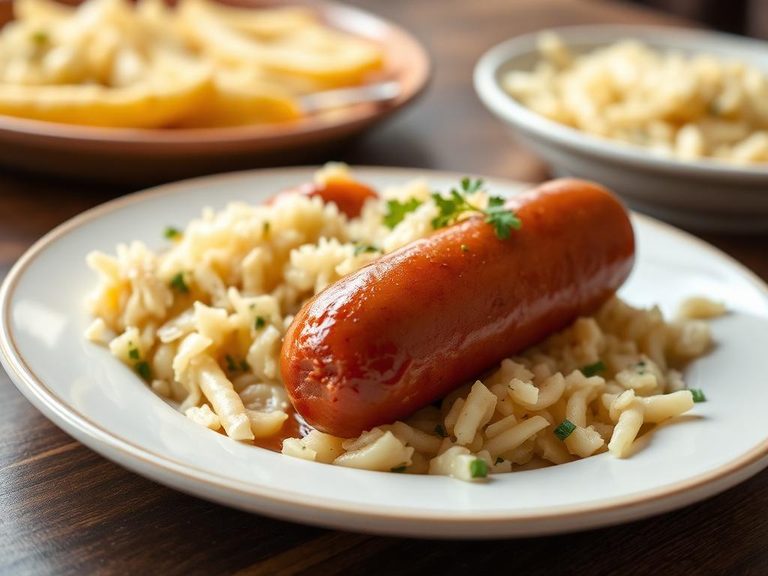
Thuringer is a German bratwurst-style sausage, often grilled; cervelat is a Swiss/German smoked sausage, sometimes with a distinctive red casing; summer sausage is a general term for cured, fermented sausages meant to be kept without refrigeration, typically milder in flavor.
Is this sausage gluten-free?
It depends on the specific recipe. Some may contain fillers or binders with gluten, so always check the label for ingredients like wheat or barley.
How should I store it?
Unopened, it can be stored in a cool, dry place. Once opened, keep it refrigerated in an airtight container and consume within a week.
Can it be eaten raw?
These are cured and cooked sausages, so they are safe to eat without further cooking, though they are often grilled or pan-fried for enhanced flavor.
Nutrient density (calculated · NRF9.3)
Nutrient Rich Foods index: beneficial nutrients (protein, fiber, vitamins, minerals) minus saturated fat, added sugar & sodium, per 100 kcal.
NRF9.3 index — Fulgoni, Keast & Drewnowski, 2009. Computed from USDA nutrients.
Weight-loss friendliness (composite index)
Energy density 3.62 kcal/g · 19% calories from protein · 0.0 g fiber · 0.8 g sugar per 100 g.
Composite of energy density (Rolls et al., 1999), protein & fiber satiety, minus sugar. A calculated heuristic — ranks satiety-per-calorie, not a clinical measure.
Dietary load (calculated from USDA values)
Potential renal acid load. Positive = acid-forming, negative = alkaline-forming.
Sodium-to-potassium ratio: 5.00 (lower is better — aim for ≤ 1)
Sodium:potassium per WHO potassium guidance. Computed from USDA nutrients.