

Snacks, KELLOGG, KELLOGG'S Low Fat Granola Bar, Crunchy Almond/Brown Sugar
Whole food · Snacks

Photo: Wikipedia
A crunchy, chewy snack bar made with rolled oats, almonds, and a brown sugar glaze, delivering a satisfying texture and a sweet, nutty flavor profile. It's a convenient, portion-controlled source of carbohydrates and fiber for a quick energy boost. Notably, it provides a decent 8 grams of protein per 100 grams, supporting satiety between meals.
Calorie split: 8% protein · 76% carbs · 16% fat
↓ Full nutrition💚 Why it's loved
People love it for the satisfying crunch and the comforting, classic combination of toasted oats, nutty almonds, and caramel-like brown sugar. It's a nostalgic, reliable snack that fits easily into a lunchbox or a busy day.
⚠️ Watch-outs & how to enjoy it better
With 78g of carbohydrates per 100g, it can cause a rapid rise in blood sugar, especially without balancing nutrients. It also contains common allergens like almonds and may have added sodium. To counteract this, pair it with a source of protein or fat (like Greek yogurt or cheese) and practice portion control by enjoying a single bar (approx. 39g) rather than multiple servings.
Key benefits
- Good source of dietary fiber (6.2g per 100g)
- Provides plant-based protein from oats and almonds
- Convenient, portable energy source
- Low in fat compared to many snack bars
- Contains no added sugar per the provided data
🍽️ Popular dishes
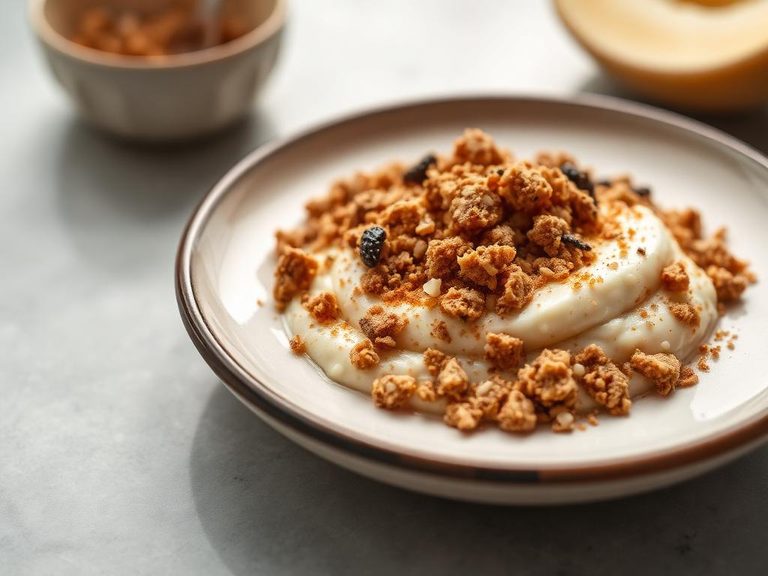

🌍 Where it's eaten
💡 Did you know?
The 'low fat' designation on such bars often means they have less fat than a standard granola bar, but they can still contain 7.4g of fat per 100g, primarily from the almonds and any added oils.
Full nutrition (USDA data · scales with serving)
| Water | 5.0 g |
| Energy | 390 kcal |
| Energy | 1632 kj |
| Protein | 8.0 g |
| Total lipid (fat) | 7.4 g |
| Ash | 1.6 g |
| Carbohydrate, by difference | 78.0 g |
| Fiber, total dietary | 6.2 g |
| Calcium, Ca | 35.0 mg |
| Iron, Fe | 8.6 mg |
| Magnesium, Mg | 87.0 mg |
| Phosphorus, P | 248 mg |
| Potassium, K | 249 mg |
| Sodium, Na | 291 mg |
| Zinc, Zn | 2.2 mg |
| Copper, Cu | 0.70 mg |
| Manganese, Mn | 1.8 mg |
| Vitamin C, total ascorbic acid | 0.00 mg |
| Thiamin | 0.70 mg |
| Riboflavin | 0.80 mg |
| Niacin | 9.5 mg |
| Pantothenic acid | 0.67 mg |
| Vitamin B-6 | 1.0 mg |
| Folate, total | 0.00 ug |
| Folic acid | 0.00 ug |
| Folate, food | 0.00 ug |
| Folate, DFE | 0.00 ug |
| Vitamin B-12 | 0.00 ug |
| Vitamin A, RAE | 713 ug |
| Retinol | 713 ug |
| Vitamin A, IU | 2381 iu |
Fat & fatty acid profile (per 100g)
| Fatty acids, total saturated | 1.1 g |
| SFA 4:0 | 0.00 g |
| SFA 6:0 | 0.00 g |
| SFA 8:0 | 0.00 g |
| SFA 10:0 | 0.00 g |
| SFA 12:0 | 0.01 g |
| SFA 14:0 | 0.00 g |
| SFA 16:0 | 0.68 g |
| SFA 18:0 | 0.24 g |
| Fatty acids, total monounsaturated | 1.8 g |
| MUFA 16:1 | 0.00 g |
| MUFA 18:1 | 1.8 g |
| MUFA 20:1 | 0.00 g |
| MUFA 22:1 | 0.00 g |
| Fatty acids, total polyunsaturated | 4.5 g |
| PUFA 18:2 | 4.0 g |
| PUFA 18:3 | 0.04 g |
| PUFA 18:4 | 0.00 g |
| PUFA 20:4 | 0.00 g |
| PUFA 20:5 n-3 (EPA) | 0.00 g |
| PUFA 22:5 n-3 (DPA) | 0.00 g |
| PUFA 22:6 n-3 (DHA) | 0.00 g |
| Cholesterol | 0.00 mg |
Amino acid profile (per 100g)
Estimated from Snacks, corn-based, extruded, chips, plain — USDA does not publish this profile for Snacks.
| Tryptophan | 0.05 g |
| Threonine | 0.25 g |
| Isoleucine | 0.23 g |
| Leucine | 0.80 g |
| Lysine | 0.18 g |
| Methionine | 0.14 g |
| Cystine | 0.12 g |
| Phenylalanine | 0.32 g |
| Tyrosine | 0.27 g |
| Valine | 0.33 g |
| Arginine | 0.33 g |
| Histidine | 0.20 g |
| Alanine | 0.49 g |
| Aspartic acid | 0.46 g |
| Glutamic acid | 1.2 g |
| Glycine | 0.27 g |
| Proline | 0.57 g |
| Serine | 0.31 g |
FAQ
Is this a good post-workout snack?
It can be, as it provides carbohydrates to replenish energy stores. However, for optimal muscle recovery, you might want to pair it with a dedicated protein source like a protein shake or milk, since its 8g protein per 100g is moderate.
How does it compare to a granola?
It's essentially a pre-portioned, bound form of granola. The bar format offers convenience and portion control, while loose granola might have more varied ingredients and textures but easier to overeat.
What does 'crunchy almond/brown sugar' mean for the texture?
It indicates the bar has a firm, crisp bite from the baked oats and almond pieces, with a sweet, slightly sticky glaze from the brown sugar that helps hold it together.
Nutrient density (calculated · NRF9.3)
Nutrient Rich Foods index: beneficial nutrients (protein, fiber, vitamins, minerals) minus saturated fat, added sugar & sodium, per 100 kcal.
NRF9.3 index — Fulgoni, Keast & Drewnowski, 2009. Computed from USDA nutrients.
Weight-loss friendliness (composite index)
Energy density 3.90 kcal/g · 8% calories from protein · 6.2 g fiber · 0.0 g sugar per 100 g.
Composite of energy density (Rolls et al., 1999), protein & fiber satiety, minus sugar. A calculated heuristic — ranks satiety-per-calorie, not a clinical measure.
Dietary load (calculated from USDA values)
Potential renal acid load. Positive = acid-forming, negative = alkaline-forming.
Sodium-to-potassium ratio: 1.17 (lower is better — aim for ≤ 1)
Sodium:potassium per WHO potassium guidance. Computed from USDA nutrients.