

Rice and Wheat cereal bar
Whole food · Snacks

Photo: Wikipedia
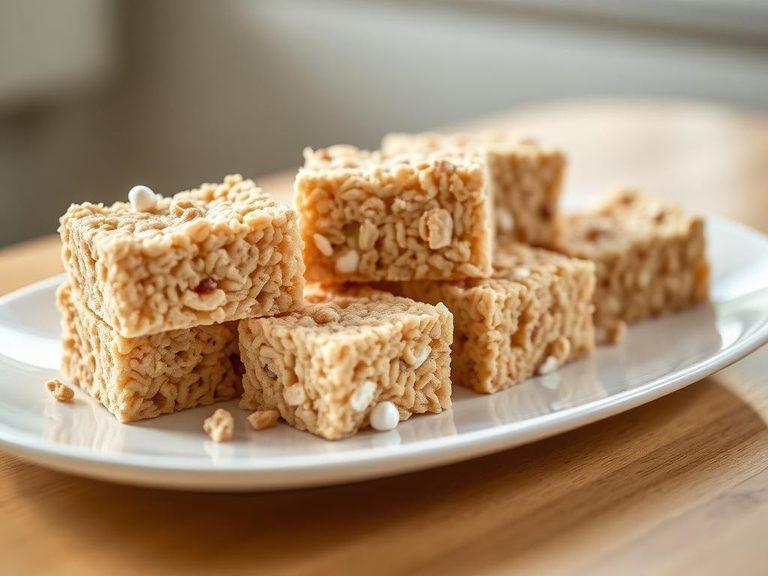
A compact, crunchy bar made from puffed rice and wheat, bound together with a sweet, syrupy glaze. It offers a satisfyingly crisp texture with a straightforward, malty sweetness. Nutritionally, it's a dense energy source, primarily from carbohydrates.
Calorie split: 9% protein · 71% carbs · 20% fat
↓ Full nutrition💚 Why it's loved
People love it for its simple, nostalgic crunch and reliable sweetness, often evoking childhood memories. It's a versatile, no-mess snack that pairs well with milk or coffee.
⚠️ Watch-outs & how to enjoy it better
The high sugar content (31.8g per 100g) can lead to rapid blood-sugar spikes, making it less ideal for sustained energy. To counteract this, pair it with a source of protein or healthy fat (like a handful of nuts or a dollop of Greek yogurt) to slow sugar absorption and practice portion control.
Key benefits
- Quick source of energy from carbohydrates
- Convenient, portable snack format
- Provides a small amount of plant-based protein
- Low in fat compared to many snack bars
🍽️ Popular dishes
🌍 Where it's eaten
💡 Did you know?
The most famous puffed rice cereal, Rice Krispies, gets its signature 'snap, crackle, and pop' sound from the air pockets inside the grains bursting when they absorb liquid.
Full nutrition (USDA data · scales with serving)
| Water | 7.5 g |
| Energy | 409 kcal |
| Energy | 1712 kj |
| Protein | 9.1 g |
| Total lipid (fat) | 9.1 g |
| Ash | 1.6 g |
| Carbohydrate, by difference | 72.7 g |
| Fiber, total dietary | 1.8 g |
| Total Sugars | 31.8 g |
| Calcium, Ca | 31.0 mg |
| Iron, Fe | 2.6 mg |
| Magnesium, Mg | 46.0 mg |
| Phosphorus, P | 136 mg |
| Potassium, K | 143 mg |
| Sodium, Na | 428 mg |
| Zinc, Zn | 1.8 mg |
| Copper, Cu | 0.18 mg |
| Manganese, Mn | 1.4 mg |
| Selenium, Se | 24.9 ug |
| Vitamin C, total ascorbic acid | 0.00 mg |
| Thiamin | 0.68 mg |
| Riboflavin | 0.77 mg |
| Niacin | 9.1 mg |
| Pantothenic acid | 0.06 mg |
| Vitamin B-6 | 0.91 mg |
| Folate, total | 15.0 ug |
| Folic acid | 0.00 ug |
| Folate, food | 15.0 ug |
| Folate, DFE | 15.0 ug |
| Choline, total | 22.4 mg |
| Vitamin B-12 | 0.00 ug |
| Vitamin B-12, added | 0.00 ug |
| Vitamin A, RAE | 0.00 ug |
| Retinol | 0.00 ug |
| Carotene, beta | 0.00 ug |
| Carotene, alpha | 0.00 ug |
| Cryptoxanthin, beta | 0.00 ug |
| Vitamin A, IU | 0.00 iu |
| Lycopene | 0.00 ug |
| Lutein + zeaxanthin | 0.00 ug |
| Vitamin E (alpha-tocopherol) | 2.9 mg |
| Vitamin E, added | 0.00 mg |
| Vitamin D (D2 + D3), International Units | 0.00 iu |
| Vitamin D (D2 + D3) | 0.00 ug |
| Vitamin K (phylloquinone) | 1.2 ug |
| Alcohol, ethyl | 0.00 g |
| Caffeine | 0.00 mg |
| Theobromine | 0.00 mg |
Fat & fatty acid profile (per 100g)
| Fatty acids, total saturated | 0.00 g |
| SFA 4:0 | 0.00 g |
| SFA 6:0 | 0.00 g |
| SFA 8:0 | 0.00 g |
| SFA 10:0 | 0.00 g |
| SFA 12:0 | 0.00 g |
| SFA 14:0 | 0.00 g |
| SFA 16:0 | 0.00 g |
| SFA 18:0 | 0.00 g |
| SFA 20:0 | 0.00 g |
| Fatty acids, total monounsaturated | 6.6 g |
| MUFA 16:1 | 0.02 g |
| MUFA 18:1 | 6.5 g |
| MUFA 20:1 | 0.07 g |
| MUFA 22:1 | 0.00 g |
| MUFA 24:1 c | 0.00 g |
| Fatty acids, total polyunsaturated | 2.0 g |
| PUFA 18:2 | 2.0 g |
| PUFA 18:3 | 0.08 g |
| PUFA 18:4 | 0.00 g |
| PUFA 20:2 n-6 c,c | 0.00 g |
| PUFA 20:3 | 0.00 g |
| PUFA 20:4 | 0.00 g |
| PUFA 20:5 n-3 (EPA) | 0.00 g |
| PUFA 22:5 n-3 (DPA) | 0.00 g |
| PUFA 22:6 n-3 (DHA) | 0.00 g |
| Fatty acids, total trans | 0.00 g |
| Cholesterol | 0.00 mg |
FAQ
Is this a healthy breakfast option?
It can be part of a balanced breakfast if paired with protein (like eggs or yogurt) and fiber (like fruit) to offset the high sugar and provide more sustained energy. On its own, it's more of a quick-energy snack than a nutritionally complete meal.
How is it different from granola?
Cereal bars are typically made from refined grains (puffed rice/wheat) and bound with sugary syrups, while granola is usually made from whole rolled oats, nuts, seeds, and often less added sugar, offering more fiber and texture.
Can I make a lower-sugar version at home?
Yes. You can use mashed banana, unsweetened applesauce, or a small amount of honey/maple syrup as a binder instead of sugary syrups, and add nuts, seeds, or unsweetened dried fruit for flavor and texture.
Nutrient density (calculated · NRF9.3)
Nutrient Rich Foods index: beneficial nutrients (protein, fiber, vitamins, minerals) minus saturated fat, added sugar & sodium, per 100 kcal.
NRF9.3 index — Fulgoni, Keast & Drewnowski, 2009. Computed from USDA nutrients.
Weight-loss friendliness (composite index)
Energy density 4.09 kcal/g · 9% calories from protein · 1.8 g fiber · 31.8 g sugar per 100 g.
Composite of energy density (Rolls et al., 1999), protein & fiber satiety, minus sugar. A calculated heuristic — ranks satiety-per-calorie, not a clinical measure.
Dietary load (calculated from USDA values)
Potential renal acid load. Positive = acid-forming, negative = alkaline-forming.
Sodium-to-potassium ratio: 2.99 (lower is better — aim for ≤ 1)
Sodium:potassium per WHO potassium guidance. Computed from USDA nutrients.