

Muffins, corn, prepared from recipe, made with low fat (2%) milk
Whole food · Baked Products

Photo: Wikipedia
This is a classic, golden-brown cornbread muffin, baked from a recipe using low-fat milk for a tender, moist crumb. Its flavor is a delightful balance of sweet corn and a subtle, savory butteriness, with a texture that's soft inside and slightly crisp on top. Nutritionally, it's a significant source of carbohydrates, providing quick energy, with a modest amount of protein.
Calorie split: 9% protein · 56% carbs · 35% fat
↓ Full nutrition💚 Why it's loved
People love cornbread muffins for their comforting, slightly sweet corn flavor and their perfect role as a side to soak up chili, stews, or soups. They are a beloved staple in Southern U.S. cuisine, evoking a sense of home cooking and tradition.
⚠️ Watch-outs & how to enjoy it better
The primary downside is the high carbohydrate content (44.2g per 100g) and lack of fiber (0g), which can lead to rapid blood sugar spikes. To counteract this, pair it with a protein-rich food like chili con carne or a side of beans, and practice portion control by enjoying half a muffin instead of a whole one.
Key benefits
- Good source of quick energy from carbohydrates
- Contains protein for muscle maintenance
- Made with low-fat milk for reduced saturated fat
- Versatile side dish for breakfast or dinner
- Provides a comforting, familiar taste
🍽️ Popular dishes
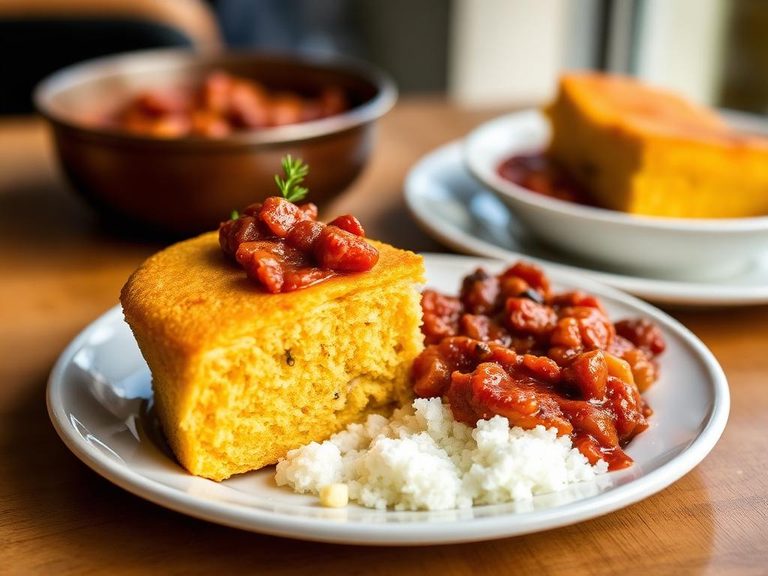
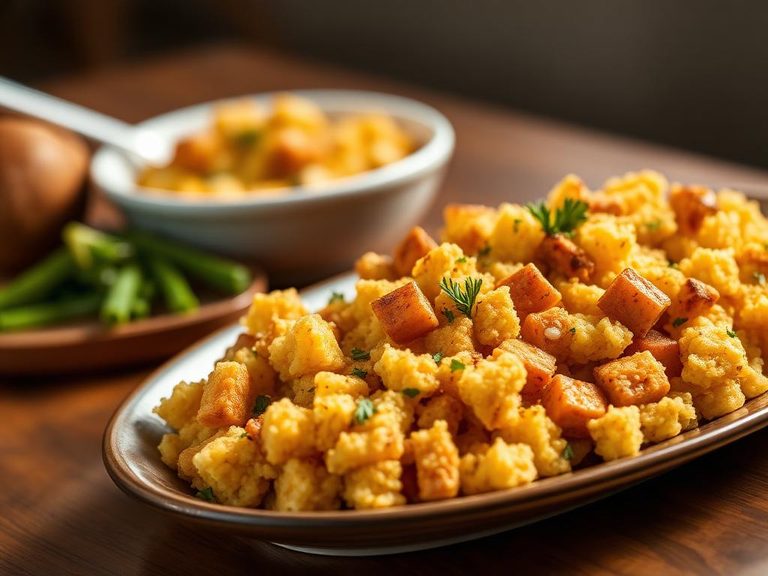
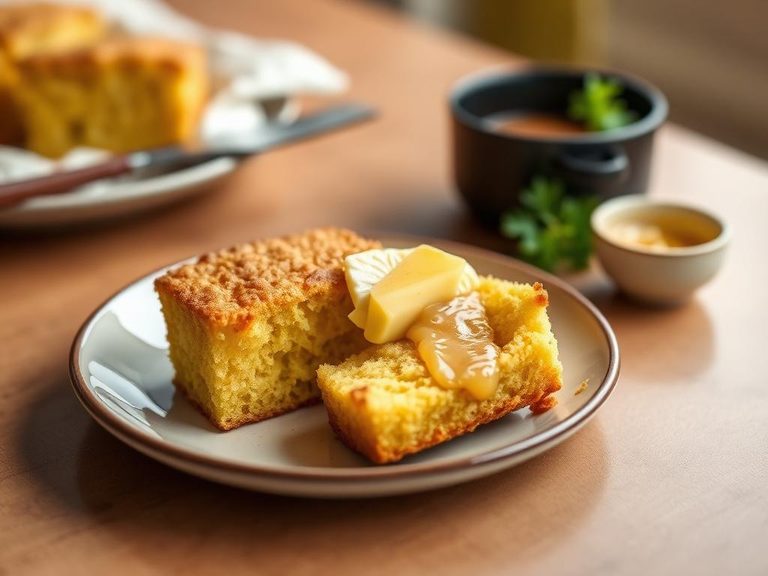
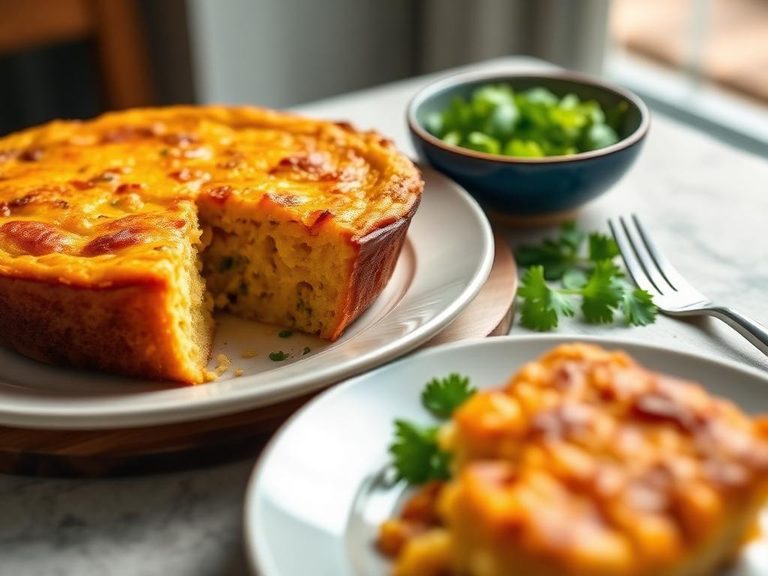
🌍 Where it's eaten
💡 Did you know?
Traditional Southern cornbread recipes often use no sugar or sweeteners at all, relying solely on the natural sweetness of the cornmeal and the browning of the crust for flavor.
Full nutrition (USDA data · scales with serving)
| Water | 33.0 g |
| Energy | 316 kcal |
| Energy | 1322 kj |
| Protein | 7.1 g |
| Total lipid (fat) | 12.3 g |
| Ash | 3.4 g |
| Carbohydrate, by difference | 44.2 g |
| Calcium, Ca | 259 mg |
| Iron, Fe | 2.6 mg |
| Magnesium, Mg | 23.0 mg |
| Phosphorus, P | 177 mg |
| Potassium, K | 145 mg |
| Sodium, Na | 585 mg |
| Zinc, Zn | 0.61 mg |
| Copper, Cu | 0.06 mg |
| Manganese, Mn | 0.19 mg |
| Selenium, Se | 13.4 ug |
| Vitamin C, total ascorbic acid | 0.30 mg |
| Thiamin | 0.30 mg |
| Riboflavin | 0.31 mg |
| Niacin | 2.4 mg |
| Pantothenic acid | 0.36 mg |
| Vitamin B-6 | 0.09 mg |
| Folate, total | 75.0 ug |
| Folic acid | 57.0 ug |
| Folate, food | 18.0 ug |
| Folate, DFE | 115 ug |
| Vitamin B-12 | 0.16 ug |
| Vitamin A, IU | 241 iu |
Fat & fatty acid profile (per 100g)
| Fatty acids, total saturated | 2.3 g |
| SFA 4:0 | 0.03 g |
| SFA 6:0 | 0.02 g |
| SFA 8:0 | 0.01 g |
| SFA 10:0 | 0.02 g |
| SFA 12:0 | 0.03 g |
| SFA 14:0 | 0.10 g |
| SFA 16:0 | 1.5 g |
| SFA 18:0 | 0.56 g |
| Fatty acids, total monounsaturated | 3.0 g |
| MUFA 16:1 | 0.07 g |
| MUFA 18:1 | 2.9 g |
| MUFA 20:1 | 0.02 g |
| MUFA 22:1 | 0.00 g |
| Fatty acids, total polyunsaturated | 6.2 g |
| PUFA 18:2 | 5.4 g |
| PUFA 18:3 | 0.70 g |
| PUFA 18:4 | 0.00 g |
| PUFA 20:4 | 0.01 g |
| PUFA 20:5 n-3 (EPA) | 0.00 g |
| PUFA 22:5 n-3 (DPA) | 0.00 g |
| PUFA 22:6 n-3 (DHA) | 0.00 g |
| Cholesterol | 42.0 mg |
Amino acid profile (per 100g)
| Tryptophan | 0.08 g |
| Threonine | 0.26 g |
| Isoleucine | 0.30 g |
| Leucine | 0.66 g |
| Lysine | 0.30 g |
| Methionine | 0.16 g |
| Cystine | 0.13 g |
| Phenylalanine | 0.35 g |
| Tyrosine | 0.27 g |
| Valine | 0.36 g |
| Arginine | 0.32 g |
| Histidine | 0.18 g |
| Alanine | 0.34 g |
| Aspartic acid | 0.47 g |
| Glutamic acid | 1.6 g |
| Glycine | 0.24 g |
| Proline | 0.64 g |
| Serine | 0.38 g |
FAQ
How is this different from regular cornbread?
This is specifically a 'muffin' version, baked in a muffin tin for individual portions with a domed top. The recipe uses low-fat (2%) milk, which affects the texture and fat content compared to versions made with buttermilk or whole milk.
Why does it have 0g of sugar and fiber?
This nutritional profile suggests a traditional recipe that may use minimal added sugar and refined cornmeal, which lacks the bran and germ. The sweetness likely comes from the corn itself and caramelization during baking.
Is it gluten-free?
Not necessarily. While cornmeal is gluten-free, many recipes include all-purpose wheat flour for structure. To be safe, you must check the specific recipe or product label for wheat flour or other gluten-containing ingredients.
Nutrient density (calculated · NRF9.3)
Nutrient Rich Foods index: beneficial nutrients (protein, fiber, vitamins, minerals) minus saturated fat, added sugar & sodium, per 100 kcal.
NRF9.3 index — Fulgoni, Keast & Drewnowski, 2009. Computed from USDA nutrients.
Weight-loss friendliness (composite index)
Energy density 3.16 kcal/g · 9% calories from protein · 0.0 g fiber · 0.0 g sugar per 100 g.
Composite of energy density (Rolls et al., 1999), protein & fiber satiety, minus sugar. A calculated heuristic — ranks satiety-per-calorie, not a clinical measure.
Dietary load (calculated from USDA values)
Potential renal acid load. Positive = acid-forming, negative = alkaline-forming.
Sodium-to-potassium ratio: 4.03 (lower is better — aim for ≤ 1)
Sodium:potassium per WHO potassium guidance. Computed from USDA nutrients.