

Jellyfish, dried, salted
Whole food · Finfish and Shellfish Products
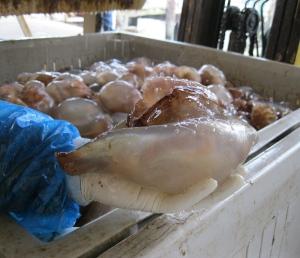
Photo: Wikipedia
Dried, salted jellyfish is a preserved seafood delicacy with a uniquely crunchy, cartilaginous texture that softens slightly when rehydrated. It has a mild, oceanic flavor and is prized more for its satisfying mouthfeel than a strong taste. Nutritionally, it is an ultra-low-calorie, high-protein, virtually fat-free food.
Calorie split: 64% protein · 0% carbs · 36% fat
↓ Full nutrition💚 Why it's loved
People love it primarily for its signature crisp, bouncy texture, which adds a delightful contrast to salads and cold dishes. It's a beloved staple in many Asian cuisines, valued for its ability to absorb flavors from dressings and sauces while maintaining its unique crunch.
⚠️ Watch-outs & how to enjoy it better
The primary concern is its very high sodium content from the salting process, which can be problematic for those monitoring salt intake. To counteract this, it is essential to thoroughly soak and rinse the jellyfish in multiple changes of cold water for several hours (or overnight) before use. It is also a common allergen for some individuals with shellfish sensitivities.
Key benefits
- Extremely low in calories (36 kcal per 100g)
- High in protein (5.5g per 100g)
- Contains zero carbohydrates or sugars
- A good source of collagen and minerals like calcium and selenium
- Naturally gluten-free
🍽️ Popular dishes
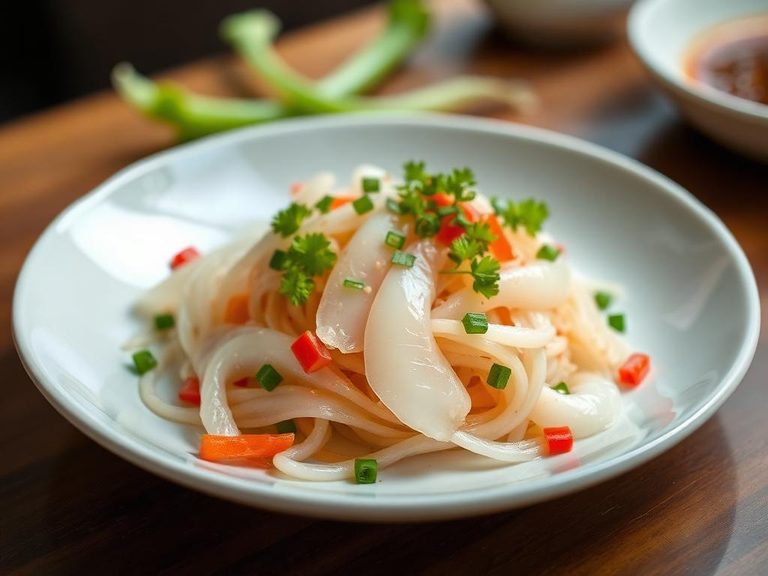
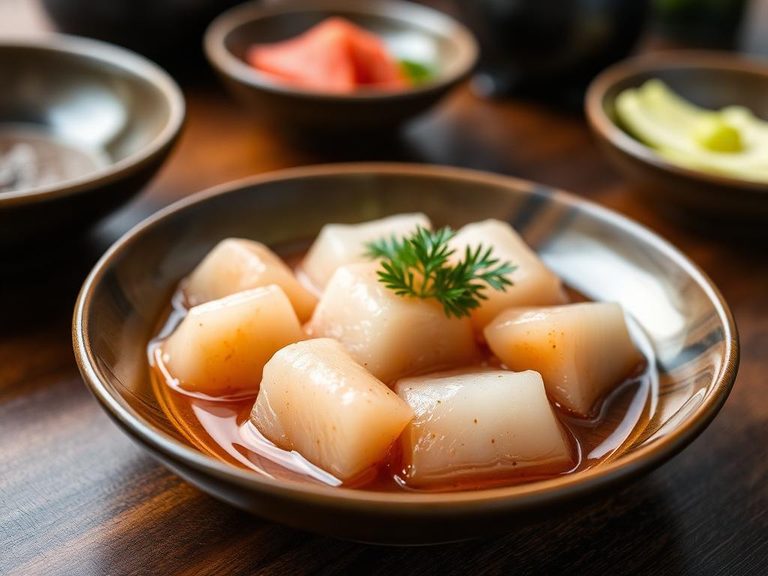
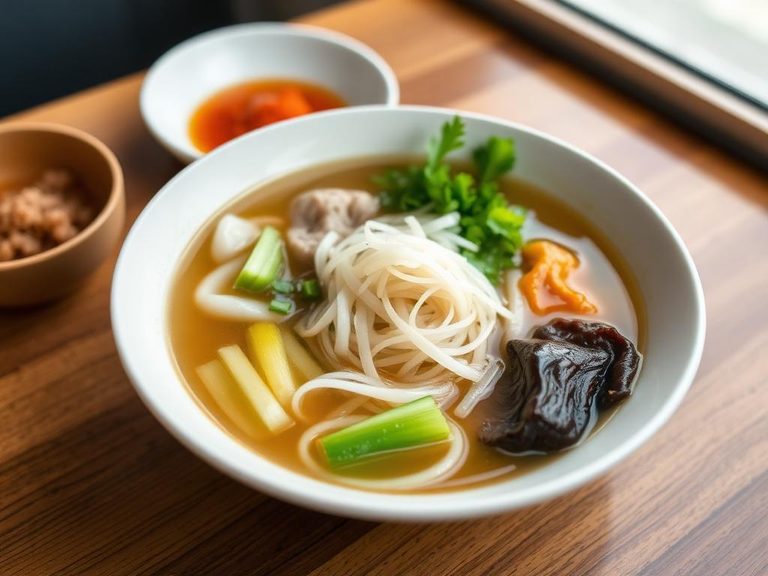
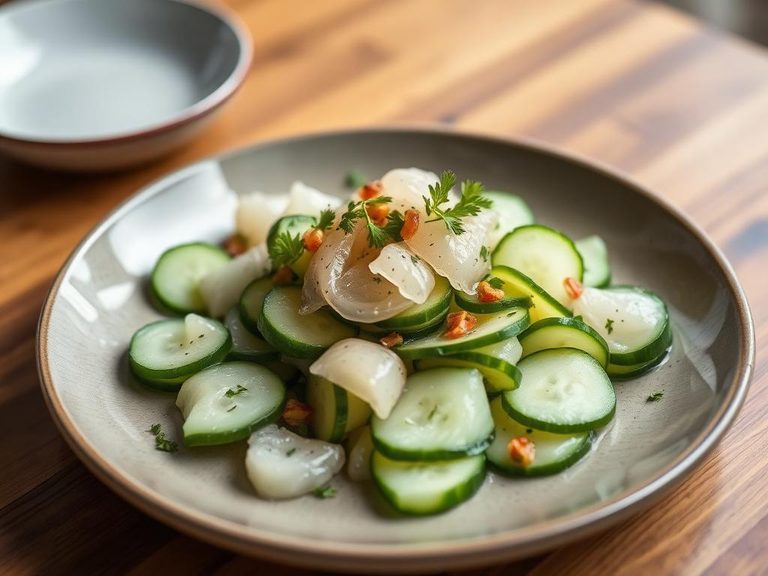
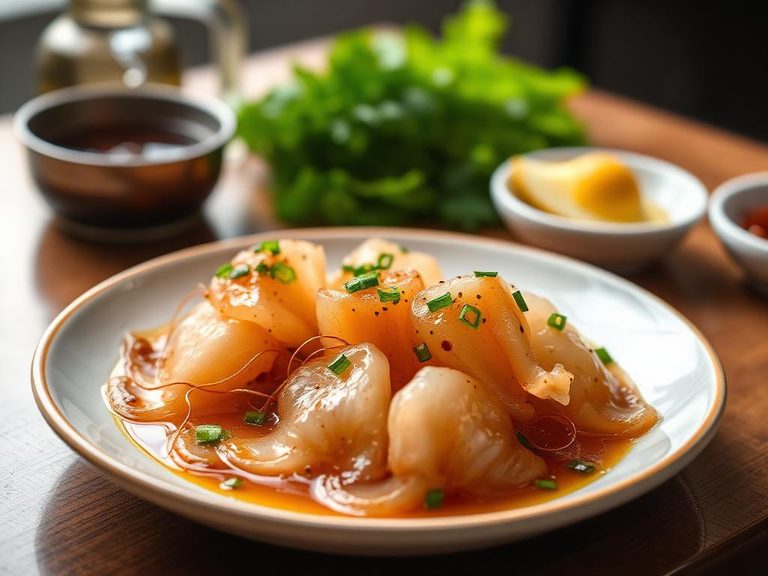
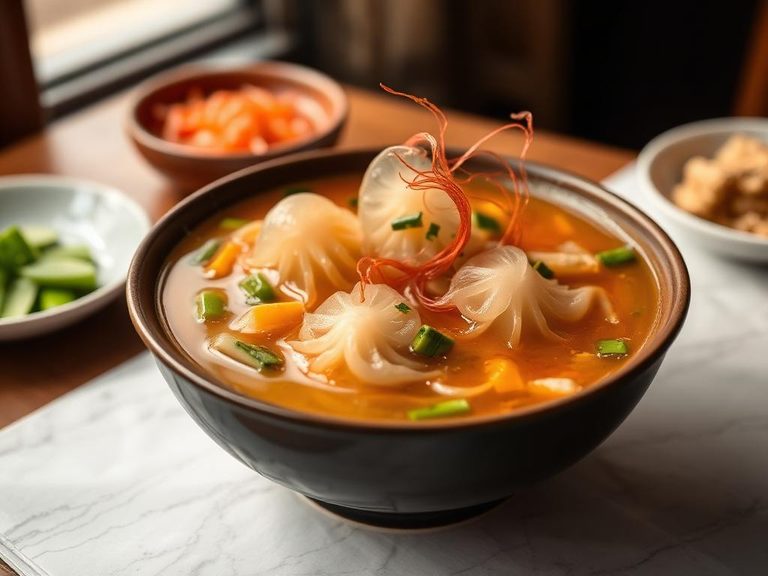
🌍 Where it's eaten
💡 Did you know?
The 'jellyfish' used in cuisine is not the soft, gelatinous bellfish you might see at the beach, but a different class called 'scyphozoans,' which have a more substantial, fibrous oral arm structure that is suitable for eating after processing.
Full nutrition (USDA data · scales with serving)
| Water | 68.0 g |
| Energy | 36.0 kcal |
| Energy | 151 kj |
| Protein | 5.5 g |
| Total lipid (fat) | 1.4 g |
| Ash | 25.1 g |
| Carbohydrate, by difference | 0.00 g |
| Fiber, total dietary | 0.00 g |
| Total Sugars | 0.00 g |
| Calcium, Ca | 2.0 mg |
| Iron, Fe | 2.3 mg |
| Magnesium, Mg | 2.0 mg |
| Phosphorus, P | 20.0 mg |
| Potassium, K | 3.0 mg |
| Sodium, Na | 9690 mg |
| Zinc, Zn | 0.42 mg |
| Copper, Cu | 0.14 mg |
| Selenium, Se | 42.2 ug |
| Vitamin C, total ascorbic acid | 0.00 mg |
| Thiamin | 0.01 mg |
| Riboflavin | 0.01 mg |
| Niacin | 0.20 mg |
| Vitamin B-6 | 0.01 mg |
| Folate, total | 1.0 ug |
| Folic acid | 0.00 ug |
| Folate, food | 1.0 ug |
| Folate, DFE | 1.0 ug |
| Choline, total | 95.0 mg |
| Vitamin B-12 | 0.02 ug |
| Vitamin B-12, added | 0.00 ug |
| Vitamin A, RAE | 2.0 ug |
| Retinol | 2.0 ug |
| Carotene, beta | 0.00 ug |
| Carotene, alpha | 0.00 ug |
| Cryptoxanthin, beta | 0.00 ug |
| Vitamin A, IU | 7.0 iu |
| Lycopene | 0.00 ug |
| Lutein + zeaxanthin | 0.00 ug |
| Vitamin E (alpha-tocopherol) | 0.02 mg |
| Vitamin E, added | 0.00 mg |
| Vitamin D (D2 + D3), International Units | 0.00 iu |
| Vitamin D (D2 + D3) | 0.00 ug |
| Vitamin D3 (cholecalciferol) | 0.00 ug |
| Vitamin K (phylloquinone) | 0.10 ug |
| Alcohol, ethyl | 0.00 g |
| Caffeine | 0.00 mg |
| Theobromine | 0.00 mg |
Fat & fatty acid profile (per 100g)
| Fatty acids, total saturated | 0.27 g |
| SFA 4:0 | 0.00 g |
| SFA 6:0 | 0.00 g |
| SFA 8:0 | 0.00 g |
| SFA 10:0 | 0.00 g |
| SFA 12:0 | 0.00 g |
| SFA 14:0 | 0.02 g |
| SFA 16:0 | 0.19 g |
| SFA 18:0 | 0.06 g |
| Fatty acids, total monounsaturated | 0.20 g |
| MUFA 16:1 | 0.03 g |
| MUFA 18:1 | 0.13 g |
| MUFA 20:1 | 0.03 g |
| MUFA 22:1 | 0.01 g |
| Fatty acids, total polyunsaturated | 0.47 g |
| PUFA 18:2 | 0.01 g |
| PUFA 18:3 | 0.00 g |
| PUFA 18:4 | 0.00 g |
| PUFA 20:4 | 0.05 g |
| PUFA 20:5 n-3 (EPA) | 0.01 g |
| PUFA 22:5 n-3 (DPA) | 0.02 g |
| PUFA 22:6 n-3 (DHA) | 0.25 g |
| Cholesterol | 5.0 mg |
FAQ
How do I prepare dried, salted jellyfish?
It must be rehydrated and desalinated. Soak it in several changes of cold water for 4-8 hours (or overnight in the fridge), changing the water every few hours. Some recipes suggest a brief blanch in boiling water (5-10 seconds) to improve texture.
What does jellyfish taste like?
It has a very mild, slightly briny, oceanic flavor. Its main appeal is its texture—a crisp, crunchy, and slightly chewy bite, often compared to a very firm noodle or cartilage.
Is jellyfish nutritious?
It is a low-calorie, high-protein food with virtually no fat or carbs. It provides collagen and minerals, but its high sodium content after salting is a key nutritional consideration.
Nutrient density (calculated · NRF9.3)
Nutrient Rich Foods index: beneficial nutrients (protein, fiber, vitamins, minerals) minus saturated fat, added sugar & sodium, per 100 kcal.
NRF9.3 index — Fulgoni, Keast & Drewnowski, 2009. Computed from USDA nutrients.
Weight-loss friendliness (composite index)
Energy density 0.36 kcal/g · 61% calories from protein · 0.0 g fiber · 0.0 g sugar per 100 g.
Composite of energy density (Rolls et al., 1999), protein & fiber satiety, minus sugar. A calculated heuristic — ranks satiety-per-calorie, not a clinical measure.
Dietary load (calculated from USDA values)
Potential renal acid load. Positive = acid-forming, negative = alkaline-forming.
Sodium-to-potassium ratio: 3230.00 (lower is better — aim for ≤ 1)
Sodium:potassium per WHO potassium guidance. Computed from USDA nutrients.