

English muffins, plain, unenriched, with calcium propionate (includes sourdough)
Whole food · Baked Products
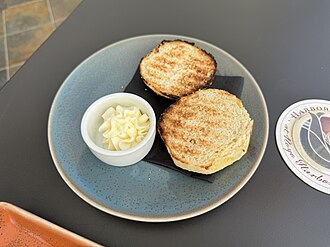
Photo: Wikipedia
The English muffin is a small, round, yeast-leavened bread with a distinctive chewy, open crumb and a crisp, cornmeal-dusted exterior. Its signature 'nooks and crannies' are perfect for trapping melted butter, jam, or poached egg yolks. Nutritionally, it is a solid source of plant-based protein and provides a moderate energy boost from complex carbohydrates.
Calorie split: 13% protein · 80% carbs · 7% fat
↓ Full nutrition💚 Why it's loved
People love the English muffin for its unique, chewy texture and the iconic 'nooks and crannies' that perfectly hold toppings. It's a beloved staple of breakfast culture, offering a satisfying, less sweet alternative to toast or pastries.
⚠️ Watch-outs & how to enjoy it better
As a refined carbohydrate, it can cause blood-sugar spikes if eaten alone, and some commercial versions are high in sodium. To counteract this, pair it with protein and fat (like eggs, cheese, or nut butter) to slow digestion, or choose a whole-grain variety. Those with gluten sensitivity must avoid it as it contains wheat.
Key benefits
- Provides a good source of plant-based protein (7.7g per 100g).
- Low in fat, making it a lean carbohydrate option.
- Contains dietary fiber (2.7g per 100g) for digestive health.
- Calcium propionate is a common, effective mold inhibitor for shelf stability.
- Versatile base for both sweet and savory meals.
🍽️ Popular dishes


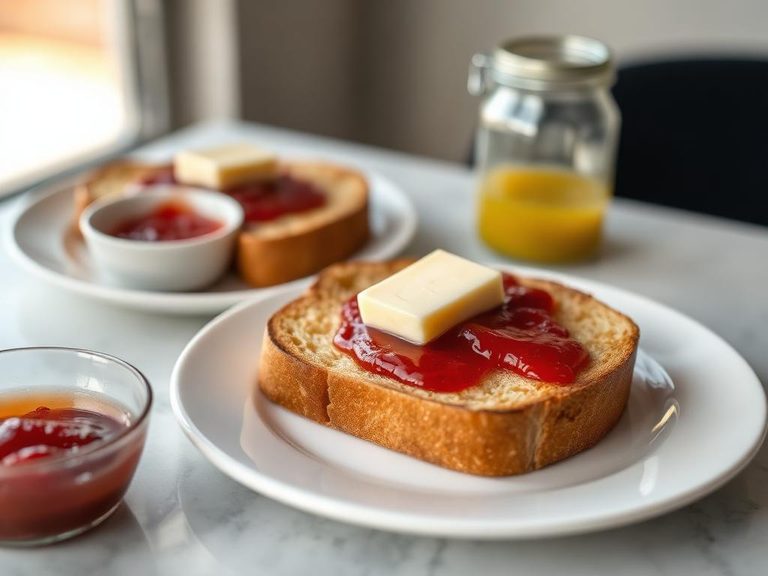
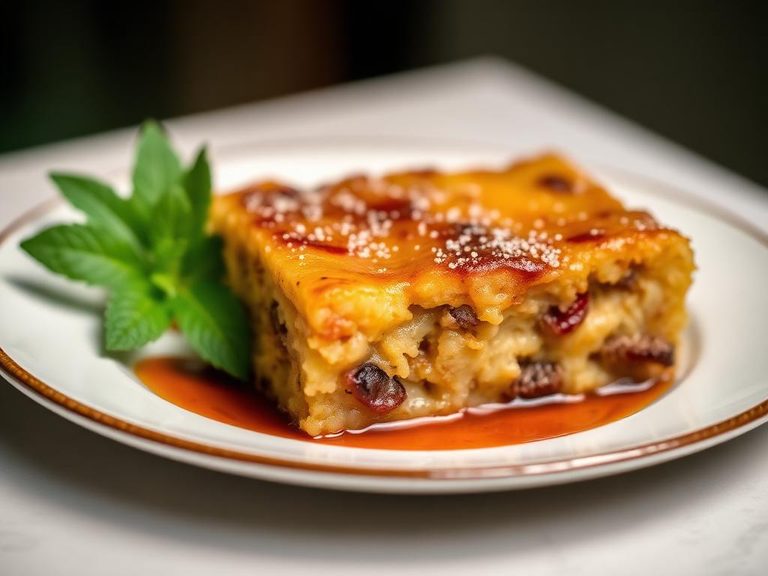

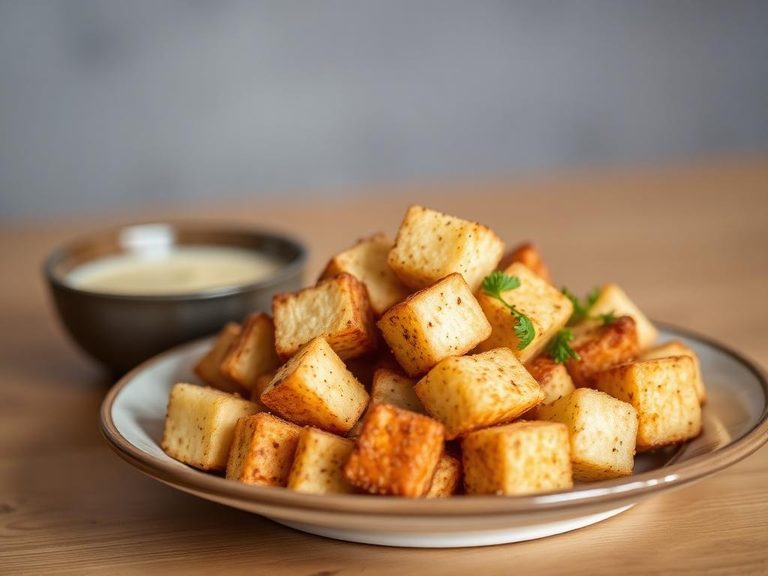
🌍 Where it's eaten
💡 Did you know?
The 'English' muffin was actually popularized in the United States by an English immigrant named Samuel Bath Thomas in the late 19th century, who perfected the 'nooks and crannies' texture using a unique griddle-baking method.
Full nutrition (USDA data · scales with serving)
| Water | 42.1 g |
| Energy | 235 kcal |
| Energy | 983 kj |
| Protein | 7.7 g |
| Total lipid (fat) | 1.8 g |
| Ash | 2.2 g |
| Carbohydrate, by difference | 46.0 g |
| Fiber, total dietary | 2.7 g |
| Calcium, Ca | 174 mg |
| Iron, Fe | 0.89 mg |
| Magnesium, Mg | 21.0 mg |
| Phosphorus, P | 133 mg |
| Potassium, K | 131 mg |
| Sodium, Na | 464 mg |
| Zinc, Zn | 0.70 mg |
| Copper, Cu | 0.13 mg |
| Manganese, Mn | 0.36 mg |
| Vitamin C, total ascorbic acid | 0.00 mg |
| Thiamin | 0.18 mg |
| Riboflavin | 0.15 mg |
| Niacin | 1.6 mg |
| Pantothenic acid | 0.45 mg |
| Vitamin B-6 | 0.04 mg |
| Folate, total | 37.0 ug |
| Folic acid | 0.00 ug |
| Folate, food | 37.0 ug |
| Folate, DFE | 37.0 ug |
| Vitamin B-12 | 0.04 ug |
| Vitamin A, RAE | 0.00 ug |
| Retinol | 0.00 ug |
| Vitamin A, IU | 0.00 iu |
Fat & fatty acid profile (per 100g)
| Fatty acids, total saturated | 0.26 g |
| SFA 4:0 | 0.00 g |
| SFA 6:0 | 0.00 g |
| SFA 8:0 | 0.00 g |
| SFA 10:0 | 0.00 g |
| SFA 12:0 | 0.00 g |
| SFA 14:0 | 0.00 g |
| SFA 16:0 | 0.21 g |
| SFA 18:0 | 0.04 g |
| Fatty acids, total monounsaturated | 0.30 g |
| MUFA 16:1 | 0.03 g |
| MUFA 18:1 | 0.27 g |
| MUFA 20:1 | 0.00 g |
| Fatty acids, total polyunsaturated | 0.89 g |
| PUFA 18:2 | 0.81 g |
| PUFA 18:3 | 0.07 g |
| Cholesterol | 0.00 mg |
Amino acid profile (per 100g)
| Tryptophan | 0.09 g |
| Threonine | 0.24 g |
| Isoleucine | 0.32 g |
| Leucine | 0.55 g |
| Lysine | 0.24 g |
| Methionine | 0.14 g |
| Cystine | 0.16 g |
| Phenylalanine | 0.38 g |
| Tyrosine | 0.23 g |
| Valine | 0.35 g |
| Arginine | 0.29 g |
| Histidine | 0.17 g |
| Alanine | 0.28 g |
| Aspartic acid | 0.40 g |
| Glutamic acid | 2.4 g |
| Glycine | 0.28 g |
| Proline | 0.81 g |
| Serine | 0.38 g |
FAQ
What is the difference between an English muffin and regular bread?
English muffins are yeast-leavened, griddle-baked (not oven-baked), and have a distinctive chewy texture with a cornmeal-dusted exterior. They are typically smaller, rounder, and have a more open crumb structure than sliced bread.
Are English muffins healthier than regular toast?
It depends on the variety. A plain, unenriched English muffin is low in fat and provides protein, but it is still a refined carbohydrate. Whole-grain versions offer more fiber and nutrients. Both can be part of a healthy diet when paired with protein and healthy fats.
How do I get the best 'nooks and crannies'?
Always split an English muffin with a fork, not a knife. This preserves the open, porous interior structure that is perfect for holding butter, jam, or egg yolk.
Nutrient density (calculated · NRF9.3)
Nutrient Rich Foods index: beneficial nutrients (protein, fiber, vitamins, minerals) minus saturated fat, added sugar & sodium, per 100 kcal.
NRF9.3 index — Fulgoni, Keast & Drewnowski, 2009. Computed from USDA nutrients.
Weight-loss friendliness (composite index)
Energy density 2.35 kcal/g · 13% calories from protein · 2.7 g fiber · 0.0 g sugar per 100 g.
Composite of energy density (Rolls et al., 1999), protein & fiber satiety, minus sugar. A calculated heuristic — ranks satiety-per-calorie, not a clinical measure.
Dietary load (calculated from USDA values)
Potential renal acid load. Positive = acid-forming, negative = alkaline-forming.
Sodium-to-potassium ratio: 3.54 (lower is better — aim for ≤ 1)
Sodium:potassium per WHO potassium guidance. Computed from USDA nutrients.