

Cereals ready-to-eat, POST, GREAT GRAINS, Raisin, Date & Pecan
Whole food · Breakfast Cereals

Photo: Wikipedia
Post Great Grains Raisin, Date & Pecan is a crunchy, sweetened cereal blend featuring whole grain wheat flakes, plump raisins, chewy dates, and toasted pecans. It offers a satisfying mix of textures—from the crisp flakes to the soft, caramel-like sweetness of the fruit. With 9.3g of fiber per 100g, it's a notably high-fiber choice for a ready-to-eat cereal, though it also contains a significant 24.1g of sugar.
Calorie split: 8% protein · 76% carbs · 16% fat
↓ Full nutrition💚 Why it's loved
People love it for the delicious, nostalgic combination of sweet dried fruit and nutty crunch that makes breakfast feel like a treat. It's a versatile cereal that works equally well with milk, yogurt, or even sprinkled over oatmeal for added texture.
⚠️ Watch-outs & how to enjoy it better
The high sugar content (24.1g per 100g) can lead to a quick blood-sugar spike, especially if eaten alone. To counteract this, pair it with a protein source like Greek yogurt or a handful of nuts, and practice portion control by sticking to a single serving. Also, note that it contains wheat and pecans, which are common allergens.
Key benefits
- High in dietary fiber (9.3g per 100g) for digestive health.
- Contains whole grains, a key source of complex carbohydrates and nutrients.
- Provides plant-based protein (7.9g per 100g) from wheat and nuts.
- Includes natural sugars and minerals from raisins and dates.
- Offers healthy fats and a satisfying crunch from pecans.
🍽️ Popular dishes

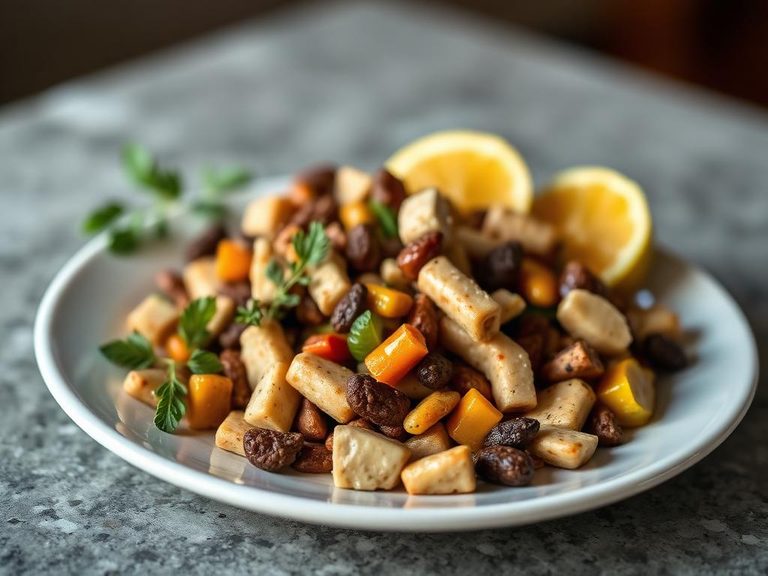

🌍 Where it's eaten
💡 Did you know?
The 'Great Grains' brand was originally launched in the 1980s as a healthier, more 'adult' cereal option, and its signature blend of whole grains and fruit was a pioneer in the ready-to-eat cereal aisle.
Full nutrition (USDA data · scales with serving)
| Water | 8.5 g |
| Energy | 378 kcal |
| Energy | 1582 kj |
| Protein | 7.9 g |
| Total lipid (fat) | 7.1 g |
| Ash | 2.1 g |
| Carbohydrate, by difference | 74.3 g |
| Fiber, total dietary | 9.3 g |
| Total Sugars | 24.1 g |
| Calcium, Ca | 39.0 mg |
| Iron, Fe | 16.4 mg |
| Magnesium, Mg | 87.0 mg |
| Phosphorus, P | 253 mg |
| Potassium, K | 378 mg |
| Sodium, Na | 247 mg |
| Zinc, Zn | 2.2 mg |
| Copper, Cu | 0.40 mg |
| Selenium, Se | 30.4 ug |
| Vitamin C, total ascorbic acid | 0.50 mg |
| Thiamin | 0.70 mg |
| Riboflavin | 0.80 mg |
| Niacin | 9.1 mg |
| Vitamin B-6 | 0.90 mg |
| Folate, total | 182 ug |
| Folic acid | 163 ug |
| Folate, food | 19.0 ug |
| Folate, DFE | 296 ug |
| Choline, total | 24.1 mg |
| Vitamin B-12 | 2.7 ug |
| Vitamin B-12, added | 2.7 ug |
| Vitamin A, RAE | 407 ug |
| Retinol | 407 ug |
| Carotene, beta | 4.0 ug |
| Carotene, alpha | 0.00 ug |
| Cryptoxanthin, beta | 1.0 ug |
| Vitamin A, IU | 1364 iu |
| Lycopene | 0.00 ug |
| Lutein + zeaxanthin | 115 ug |
| Vitamin E (alpha-tocopherol) | 0.57 mg |
| Vitamin E, added | 0.00 mg |
| Vitamin D (D2 + D3), International Units | 73.0 iu |
| Vitamin D (D2 + D3) | 1.8 ug |
| Vitamin D3 (cholecalciferol) | 1.8 ug |
| Vitamin K (phylloquinone) | 2.6 ug |
| Alcohol, ethyl | 0.00 g |
| Caffeine | 0.00 mg |
| Theobromine | 0.00 mg |
Fat & fatty acid profile (per 100g)
| Fatty acids, total saturated | 0.80 g |
| SFA 4:0 | 0.00 g |
| SFA 6:0 | 0.00 g |
| SFA 8:0 | 0.00 g |
| SFA 10:0 | 0.00 g |
| SFA 12:0 | 0.00 g |
| SFA 14:0 | 0.00 g |
| SFA 16:0 | 0.63 g |
| SFA 18:0 | 0.14 g |
| Fatty acids, total monounsaturated | 3.8 g |
| MUFA 16:1 | 0.01 g |
| MUFA 18:1 | 3.8 g |
| MUFA 20:1 | 0.02 g |
| MUFA 22:1 | 0.00 g |
| Fatty acids, total polyunsaturated | 2.1 g |
| PUFA 18:2 | 2.0 g |
| PUFA 18:3 | 0.12 g |
| PUFA 18:4 | 0.00 g |
| PUFA 20:2 n-6 c,c | 0.00 g |
| PUFA 20:3 | 0.00 g |
| PUFA 20:4 | 0.00 g |
| PUFA 20:5 n-3 (EPA) | 0.00 g |
| PUFA 22:5 n-3 (DPA) | 0.00 g |
| PUFA 22:6 n-3 (DHA) | 0.00 g |
| Fatty acids, total trans | 0.10 g |
| Cholesterol | 0.00 mg |
FAQ
Is this cereal a good source of fiber?
Yes, it is notably high in fiber, providing 9.3g per 100g, which is beneficial for digestive health and satiety.
What are the main allergens in this cereal?
The primary allergens are wheat and pecans (tree nuts). Always check the label for specific allergen warnings.
Can I eat this cereal if I'm watching my sugar intake?
It contains 24.1g of sugar per 100g, so it's best consumed in moderation. Pairing it with protein or fat can help mitigate blood-sugar spikes.
Nutrient density (calculated · NRF9.3)
Nutrient Rich Foods index: beneficial nutrients (protein, fiber, vitamins, minerals) minus saturated fat, added sugar & sodium, per 100 kcal.
NRF9.3 index — Fulgoni, Keast & Drewnowski, 2009. Computed from USDA nutrients.
Weight-loss friendliness (composite index)
Energy density 3.78 kcal/g · 8% calories from protein · 9.3 g fiber · 24.1 g sugar per 100 g.
Composite of energy density (Rolls et al., 1999), protein & fiber satiety, minus sugar. A calculated heuristic — ranks satiety-per-calorie, not a clinical measure.
Dietary load (calculated from USDA values)
Potential renal acid load. Positive = acid-forming, negative = alkaline-forming.
Sodium-to-potassium ratio: 0.65 (lower is better — aim for ≤ 1)
Sodium:potassium per WHO potassium guidance. Computed from USDA nutrients.