

Cereals ready-to-eat, MALT-O-MEAL, TOOTIE FRUITIES
Whole food · Breakfast Cereals

Photo: Wikipedia
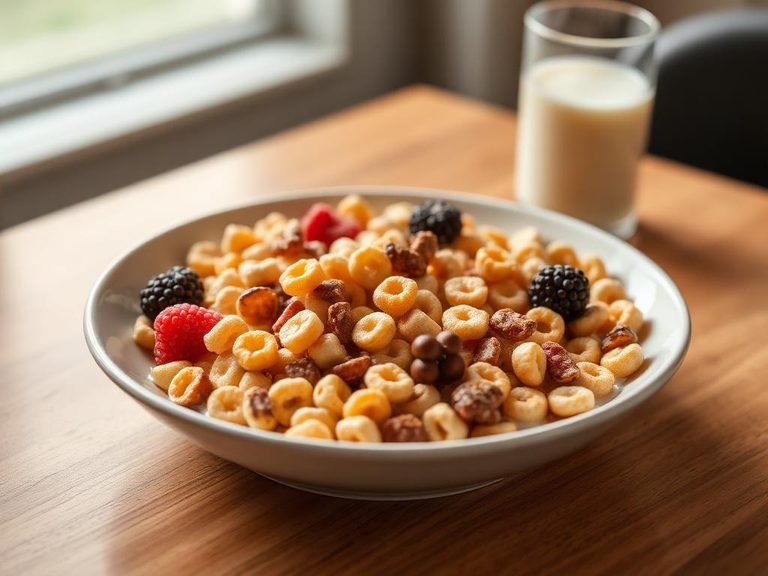
Malt-O-Meal Tootie Fruities are a vibrant, berry-flavored puffed corn cereal coated in a sweet, fruity glaze. The texture is light and crunchy, offering a satisfying pop with each bite, while the flavor delivers a nostalgic, candy-like sweetness reminiscent of fruit snacks. Nutritionally, it's a high-carbohydrate, high-sugar cereal with minimal protein and fat.
Calorie split: 5% protein · 88% carbs · 7% fat
↓ Full nutrition💚 Why it's loved
People love it for its intensely sweet, fruity flavor and playful, colorful appearance that makes breakfast feel like a treat. Its light, crunchy texture and association with childhood nostalgia make it a comforting, fun choice.
⚠️ Watch-outs & how to enjoy it better
The high sugar content (over 45g per 100g) can lead to rapid blood-sugar spikes and subsequent energy crashes, making it a poor choice for those managing diabetes or seeking sustained energy. To counteract this, pair it with a source of protein and healthy fat like Greek yogurt or milk, and practice strict portion control by measuring a single serving.
Key benefits
- Provides a quick source of energy from carbohydrates
- Fortified with essential vitamins and minerals
- Offers a fun, colorful, and appealing option for children
- Convenient and ready-to-eat for busy mornings
- Typically lower in fat compared to many other breakfast cereals
🍽️ Popular dishes
🌍 Where it's eaten
💡 Did you know?
The name 'Tootie Fruities' is a playful, onomatopoeic twist on 'fruity,' designed to sound fun and catchy for children, much like other sugary cereals of its era.
Full nutrition (USDA data · scales with serving)
| Water | 2.5 g |
| Energy | 391 kcal |
| Energy | 1634 kj |
| Protein | 4.7 g |
| Total lipid (fat) | 3.2 g |
| Ash | 3.7 g |
| Carbohydrate, by difference | 85.9 g |
| Fiber, total dietary | 2.2 g |
| Total Sugars | 45.3 g |
| Calcium, Ca | 313 mg |
| Iron, Fe | 28.1 mg |
| Magnesium, Mg | 24.0 mg |
| Phosphorus, P | 78.0 mg |
| Potassium, K | 104 mg |
| Sodium, Na | 453 mg |
| Zinc, Zn | 11.7 mg |
| Copper, Cu | 0.06 mg |
| Selenium, Se | 9.9 ug |
| Vitamin C, total ascorbic acid | 18.8 mg |
| Thiamin | 1.2 mg |
| Riboflavin | 1.3 mg |
| Niacin | 15.6 mg |
| Vitamin B-6 | 1.6 mg |
| Folate, total | 625 ug |
| Folic acid | 606 ug |
| Folate, food | 19.0 ug |
| Folate, DFE | 1049 ug |
| Choline, total | 5.8 mg |
| Vitamin B-12 | 4.7 ug |
| Vitamin B-12, added | 4.7 ug |
| Vitamin A, RAE | 448 ug |
| Retinol | 444 ug |
| Carotene, beta | 37.0 ug |
| Carotene, alpha | 24.0 ug |
| Cryptoxanthin, beta | 0.00 ug |
| Vitamin A, IU | 1563 iu |
| Lycopene | 0.00 ug |
| Lutein + zeaxanthin | 625 ug |
| Vitamin E (alpha-tocopherol) | 0.01 mg |
| Vitamin E, added | 0.00 mg |
| Vitamin D (D2 + D3), International Units | 125 iu |
| Vitamin D (D2 + D3) | 3.1 ug |
| Vitamin D3 (cholecalciferol) | 3.1 ug |
| Vitamin K (phylloquinone) | 0.10 ug |
| Alcohol, ethyl | 0.00 g |
| Caffeine | 0.00 mg |
| Theobromine | 0.00 mg |
Fat & fatty acid profile (per 100g)
| Fatty acids, total saturated | 0.69 g |
| SFA 4:0 | 0.00 g |
| SFA 6:0 | 0.00 g |
| SFA 8:0 | 0.00 g |
| SFA 10:0 | 0.00 g |
| SFA 12:0 | 0.01 g |
| SFA 14:0 | 0.00 g |
| SFA 16:0 | 0.57 g |
| SFA 18:0 | 0.09 g |
| Fatty acids, total monounsaturated | 1.5 g |
| MUFA 16:1 | 0.01 g |
| MUFA 17:1 | 0.00 g |
| MUFA 18:1 | 1.5 g |
| MUFA 20:1 | 0.00 g |
| MUFA 22:1 | 0.00 g |
| Fatty acids, total polyunsaturated | 0.98 g |
| PUFA 18:2 | 0.95 g |
| PUFA 18:3 | 0.03 g |
| PUFA 18:4 | 0.00 g |
| PUFA 20:4 | 0.00 g |
| PUFA 20:5 n-3 (EPA) | 0.00 g |
| PUFA 22:5 n-3 (DPA) | 0.00 g |
| PUFA 22:6 n-3 (DHA) | 0.00 g |
| Fatty acids, total trans | 0.00 g |
| Cholesterol | 0.00 mg |
FAQ
Is Tootie Fruities a healthy breakfast option?
It is considered a sugary, less nutritious cereal. While it may be fortified with vitamins, its very high sugar and low protein/fiber content make it an occasional treat rather than a daily health food.
What is the main ingredient?
The primary ingredient is whole grain corn, which is puffed and then coated with sugar and artificial flavors to create its signature sweet, fruity taste.
Does it contain common allergens?
Standard versions are typically gluten-free and made in facilities that may process other allergens. Always check the specific product label for the most accurate allergen information.
Nutrient density (calculated · NRF9.3)
Nutrient Rich Foods index: beneficial nutrients (protein, fiber, vitamins, minerals) minus saturated fat, added sugar & sodium, per 100 kcal.
NRF9.3 index — Fulgoni, Keast & Drewnowski, 2009. Computed from USDA nutrients.
Weight-loss friendliness (composite index)
Energy density 3.91 kcal/g · 5% calories from protein · 2.2 g fiber · 45.3 g sugar per 100 g.
Composite of energy density (Rolls et al., 1999), protein & fiber satiety, minus sugar. A calculated heuristic — ranks satiety-per-calorie, not a clinical measure.
Dietary load (calculated from USDA values)
Potential renal acid load. Positive = acid-forming, negative = alkaline-forming.
Sodium-to-potassium ratio: 4.36 (lower is better — aim for ≤ 1)
Sodium:potassium per WHO potassium guidance. Computed from USDA nutrients.