

Candies, semisweet chocolate, made with butter
Whole food · Sweets

Photo: Wikipedia
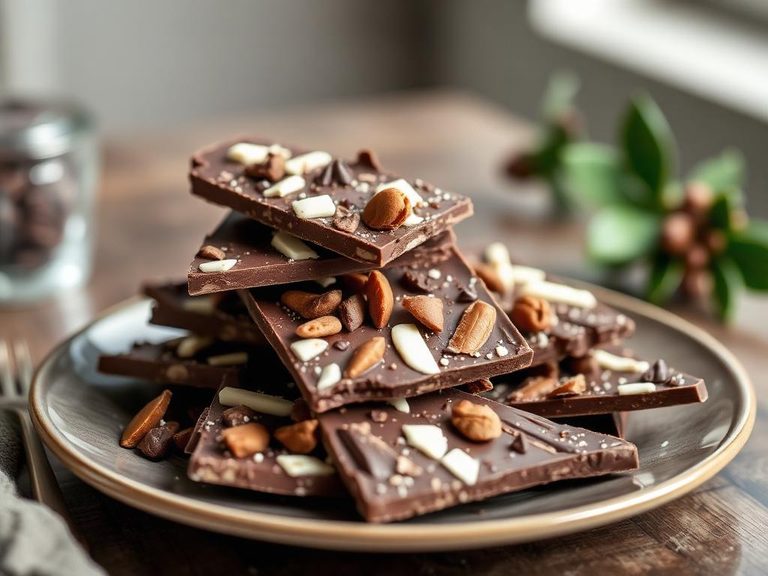
This is a rich, dense confection made by blending cocoa solids and sugar with butter, creating a smoother, creamier texture than standard chocolate. It delivers a deep, bittersweet cocoa flavor with a velvety mouthfeel that melts slowly on the tongue. Despite its indulgence, it provides a notable 5.9g of fiber per 100g, offering a surprisingly substantial digestive boost for a sweet treat.
Calorie split: 3% protein · 47% carbs · 50% fat
↓ Full nutrition💚 Why it's loved
People adore it for the luxurious, buttery mouthfeel that elevates simple chocolate into a decadent experience. Its versatility makes it a beloved ingredient in both sweet and savory dishes, from classic truffles to sophisticated sauces.
⚠️ Watch-outs & how to enjoy it better
The high calorie and fat content (29.7g per 100g) can be a concern for those monitoring energy intake or managing weight. To mitigate this, practice strict portion control (e.g., 1-2 squares) and pair it with a source of protein or fiber, like a handful of almonds, to slow sugar absorption and increase satiety.
Key benefits
- Rich in dietary fiber (5.9g per 100g)
- Provides a quick source of energy (477 kcal per 100g)
- Contains cocoa flavonoids (antioxidants)
- Offers a satisfying, slow-melting texture
- Source of small amounts of protein (4.2g)
🍽️ Popular dishes




🌍 Where it's eaten
💡 Did you know?
The 'semisweet' designation in chocolate typically means it contains between 35% and 65% cocoa solids, but this butter-enriched version often has a lower sugar content than milk chocolate, allowing the complex, roasted notes of the cocoa to shine through more prominently.
Full nutrition (USDA data · scales with serving)
| Water | 0.70 g |
| Energy | 477 kcal |
| Energy | 1996 kj |
| Protein | 4.2 g |
| Total lipid (fat) | 29.7 g |
| Ash | 1.2 g |
| Carbohydrate, by difference | 63.4 g |
| Fiber, total dietary | 5.9 g |
| Calcium, Ca | 32.0 mg |
| Iron, Fe | 3.1 mg |
| Magnesium, Mg | 115 mg |
| Phosphorus, P | 132 mg |
| Potassium, K | 365 mg |
| Sodium, Na | 11.0 mg |
| Zinc, Zn | 1.6 mg |
| Copper, Cu | 0.70 mg |
| Manganese, Mn | 0.80 mg |
| Selenium, Se | 3.2 ug |
| Vitamin C, total ascorbic acid | 0.00 mg |
| Thiamin | 0.06 mg |
| Riboflavin | 0.09 mg |
| Niacin | 0.43 mg |
| Pantothenic acid | 0.10 mg |
| Vitamin B-6 | 0.05 mg |
| Folate, total | 3.0 ug |
| Folic acid | 0.00 ug |
| Folate, food | 3.0 ug |
| Folate, DFE | 3.0 ug |
| Vitamin B-12 | 0.00 ug |
| Vitamin A, RAE | 3.0 ug |
| Retinol | 0.00 ug |
| Vitamin A, IU | 60.0 iu |
| Caffeine | 62.0 mg |
| Theobromine | 486 mg |
Fat & fatty acid profile (per 100g)
| Fatty acids, total saturated | 17.5 g |
| SFA 4:0 | 0.48 g |
| SFA 6:0 | 0.28 g |
| SFA 8:0 | 0.17 g |
| SFA 10:0 | 0.38 g |
| SFA 12:0 | 0.42 g |
| SFA 14:0 | 0.05 g |
| SFA 16:0 | 8.0 g |
| SFA 18:0 | 9.2 g |
| Fatty acids, total monounsaturated | 9.9 g |
| MUFA 16:1 | 0.36 g |
| MUFA 18:1 | 9.9 g |
| Fatty acids, total polyunsaturated | 0.95 g |
| PUFA 18:2 | 0.95 g |
| PUFA 18:3 | 0.24 g |
| Cholesterol | 18.0 mg |
Amino acid profile (per 100g)
| Tryptophan | 0.06 g |
| Threonine | 0.17 g |
| Isoleucine | 0.16 g |
| Leucine | 0.26 g |
| Lysine | 0.21 g |
| Methionine | 0.04 g |
| Cystine | 0.05 g |
| Phenylalanine | 0.20 g |
| Tyrosine | 0.16 g |
| Valine | 0.25 g |
| Arginine | 0.24 g |
| Histidine | 0.07 g |
| Alanine | 0.20 g |
| Aspartic acid | 0.42 g |
| Glutamic acid | 0.64 g |
| Glycine | 0.19 g |
| Proline | 0.18 g |
| Serine | 0.18 g |
FAQ
What is the difference between semisweet and bittersweet chocolate?
Both are dark chocolates, but semisweet typically has a higher sugar content (around 35-65% cocoa) compared to bittersweet (usually 60-80% cocoa). The addition of butter in this version gives it a creamier, less sharp profile than traditional bittersweet chocolate.
Can I use this chocolate for baking?
Yes, it's excellent for baking, especially in recipes where a rich, buttery flavor is desired, like brownies, cookies, or ganache. However, because it contains butter, it may have a slightly different melting point and texture than chocolate made with just cocoa butter.
Is this chocolate suitable for people with lactose intolerance?
It depends on the specific product. While it contains butter (a dairy product), some brands may use lactose-free butter or have very low lactose levels. Always check the ingredient list for milk derivatives if you have a severe intolerance.
Nutrient density (calculated · NRF9.3)
Nutrient Rich Foods index: beneficial nutrients (protein, fiber, vitamins, minerals) minus saturated fat, added sugar & sodium, per 100 kcal.
NRF9.3 index — Fulgoni, Keast & Drewnowski, 2009. Computed from USDA nutrients.
Weight-loss friendliness (composite index)
Energy density 4.77 kcal/g · 4% calories from protein · 5.9 g fiber · 0.0 g sugar per 100 g.
Composite of energy density (Rolls et al., 1999), protein & fiber satiety, minus sugar. A calculated heuristic — ranks satiety-per-calorie, not a clinical measure.
Dietary load (calculated from USDA values)
Potential renal acid load. Positive = acid-forming, negative = alkaline-forming.
Sodium-to-potassium ratio: 0.03 (lower is better — aim for ≤ 1)
Sodium:potassium per WHO potassium guidance. Computed from USDA nutrients.