

Watermelon juice, 100%
Common food
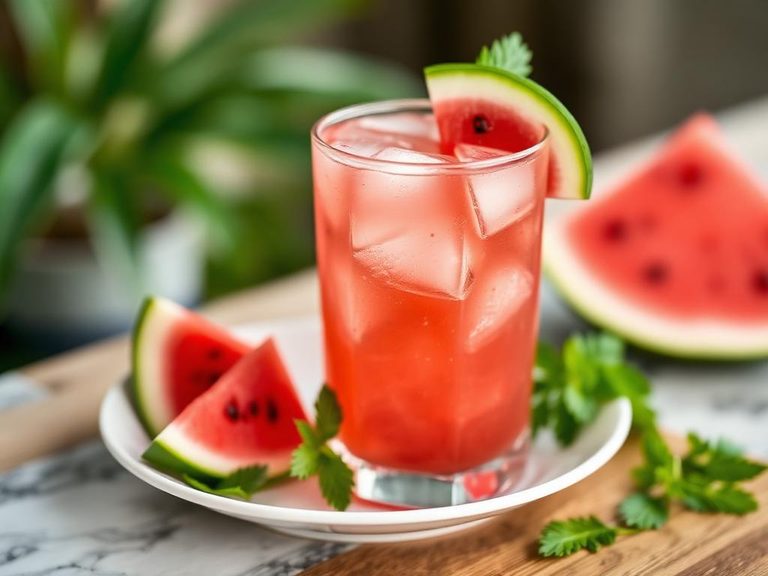
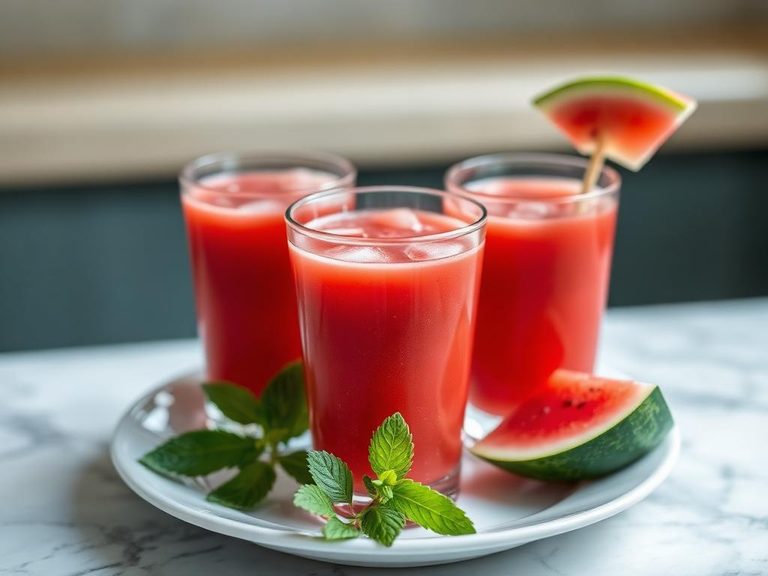
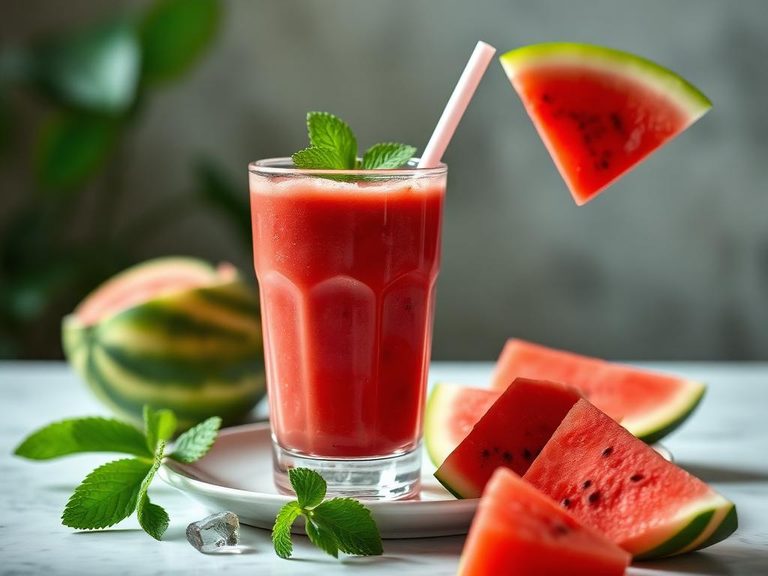
Pure, chilled watermelon juice is a vibrant, ruby-red elixir that captures the essence of summer in a glass. It has a light, watery texture and a refreshingly sweet, subtly floral taste. Despite its indulgent flavor, it's remarkably low in calories, offering a guilt-free hydrating boost.
Calorie split: 7% protein · 89% carbs · 4% fat
↓ Full nutrition💚 Why it's loved
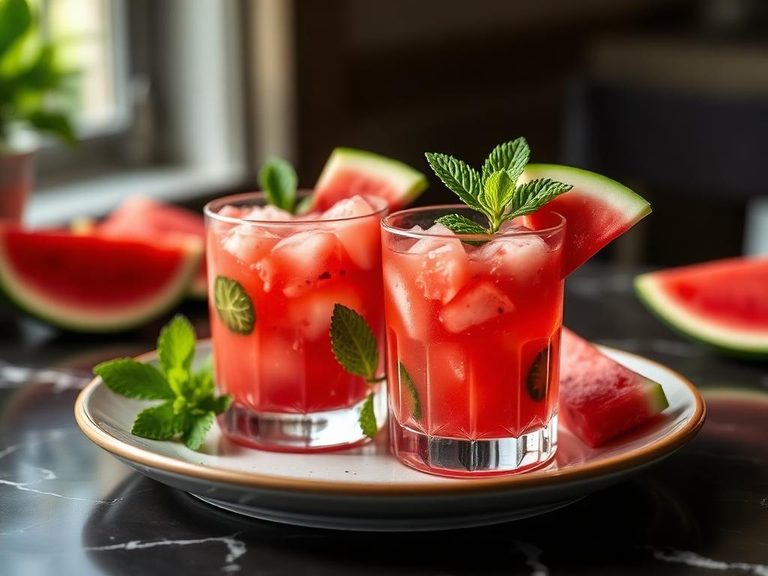
People adore its pure, unadulterated taste of summer and its incredible ability to quench thirst on a hot day. It's a beloved, versatile base for cocktails, smoothies, and agua frescas across many cultures.
⚠️ Watch-outs & how to enjoy it better
Its high natural sugar content (6.2g per 100g) can cause a rapid blood-sugar spike, which is a consideration for diabetics or those monitoring sugar intake. To mitigate this, pair it with a source of protein or healthy fat (like a handful of nuts) to slow sugar absorption, or dilute it with sparkling water for a lighter spritzer.
Key benefits
- Excellent source of hydration due to high water content.
- Rich in lycopene, an antioxidant linked to heart and skin health.
- Provides vitamin C, which supports immune function.
- Naturally low in fat and a source of quick energy from natural sugars.
🍽️ Popular dishes

🌍 Where it's eaten
💡 Did you know?
Watermelon is botanically a berry, and it's over 90% water, which is why juicing it yields such a high volume with minimal waste.
Full nutrition (USDA data · scales with serving)
| Water | 91.5 g |
| Energy | 30.0 kcal |
| Protein | 0.61 g |
| Total lipid (fat) | 0.15 g |
| Carbohydrate, by difference | 7.5 g |
| Fiber, total dietary | 0.40 g |
| Total Sugars | 6.2 g |
| Calcium, Ca | 7.0 mg |
| Iron, Fe | 0.24 mg |
| Magnesium, Mg | 10.0 mg |
| Phosphorus, P | 11.0 mg |
| Potassium, K | 112 mg |
| Sodium, Na | 1.0 mg |
| Zinc, Zn | 0.10 mg |
| Copper, Cu | 0.04 mg |
| Selenium, Se | 0.40 ug |
| Vitamin C, total ascorbic acid | 8.1 mg |
| Thiamin | 0.03 mg |
| Riboflavin | 0.02 mg |
| Niacin | 0.18 mg |
| Vitamin B-6 | 0.04 mg |
| Folate, total | 3.0 ug |
| Folic acid | 0.00 ug |
| Folate, food | 3.0 ug |
| Folate, DFE | 3.0 ug |
| Choline, total | 4.1 mg |
| Vitamin B-12 | 0.00 ug |
| Vitamin B-12, added | 0.00 ug |
| Vitamin A, RAE | 28.0 ug |
| Retinol | 0.00 ug |
| Carotene, beta | 303 ug |
| Carotene, alpha | 0.00 ug |
| Cryptoxanthin, beta | 78.0 ug |
| Lycopene | 4532 ug |
| Lutein + zeaxanthin | 8.0 ug |
| Vitamin E (alpha-tocopherol) | 0.05 mg |
| Vitamin E, added | 0.00 mg |
| Vitamin D (D2 + D3) | 0.00 ug |
| Vitamin K (phylloquinone) | 0.10 ug |
| Alcohol, ethyl | 0.00 g |
| Caffeine | 0.00 mg |
| Theobromine | 0.00 mg |
Fat & fatty acid profile (per 100g)
| Fatty acids, total saturated | 0.02 g |
| SFA 4:0 | 0.00 g |
| SFA 6:0 | 0.00 g |
| SFA 8:0 | 0.00 g |
| SFA 10:0 | 0.00 g |
| SFA 12:0 | 0.00 g |
| SFA 14:0 | 0.00 g |
| SFA 16:0 | 0.01 g |
| SFA 18:0 | 0.01 g |
| Fatty acids, total monounsaturated | 0.04 g |
| MUFA 16:1 | 0.00 g |
| MUFA 18:1 | 0.04 g |
| MUFA 20:1 | 0.00 g |
| MUFA 22:1 | 0.00 g |
| Fatty acids, total polyunsaturated | 0.05 g |
| PUFA 18:2 | 0.05 g |
| PUFA 18:3 | 0.00 g |
| PUFA 18:4 | 0.00 g |
| PUFA 20:4 | 0.00 g |
| PUFA 20:5 n-3 (EPA) | 0.00 g |
| PUFA 22:5 n-3 (DPA) | 0.00 g |
| PUFA 22:6 n-3 (DHA) | 0.00 g |
| Cholesterol | 0.00 mg |
FAQ
Is watermelon juice as healthy as eating the fruit?
Juicing removes most of the beneficial fiber found in the whole fruit, which helps regulate sugar absorption. While you still get vitamins and antioxidants, the juice has a more concentrated sugar impact than eating watermelon chunks.
How can I prevent watermelon juice from separating?
Natural separation is normal. Give it a good stir or shake before drinking. Using a high-speed blender and drinking it immediately will also help maintain a uniform texture.
Can I juice watermelon rind?
Yes, the white part of the rind is edible and can be juiced, often with ginger or lime. It adds a slightly more bitter, vegetal note and is a good way to reduce food waste.
Nutrient density (calculated · NRF9.3)
Nutrient Rich Foods index: beneficial nutrients (protein, fiber, vitamins, minerals) minus saturated fat, added sugar & sodium, per 100 kcal.
NRF9.3 index — Fulgoni, Keast & Drewnowski, 2009. Computed from USDA nutrients.
Weight-loss friendliness (composite index)
Energy density 0.30 kcal/g · 8% calories from protein · 0.4 g fiber · 6.2 g sugar per 100 g.
Composite of energy density (Rolls et al., 1999), protein & fiber satiety, minus sugar. A calculated heuristic — ranks satiety-per-calorie, not a clinical measure.
Dietary load (calculated from USDA values)
Potential renal acid load. Positive = acid-forming, negative = alkaline-forming.
Sodium-to-potassium ratio: 0.01 (lower is better — aim for ≤ 1)
Sodium:potassium per WHO potassium guidance. Computed from USDA nutrients.