

Vegetable and fruit juice drink, with high vitamin C, diet
Common food

Photo: Wikipedia
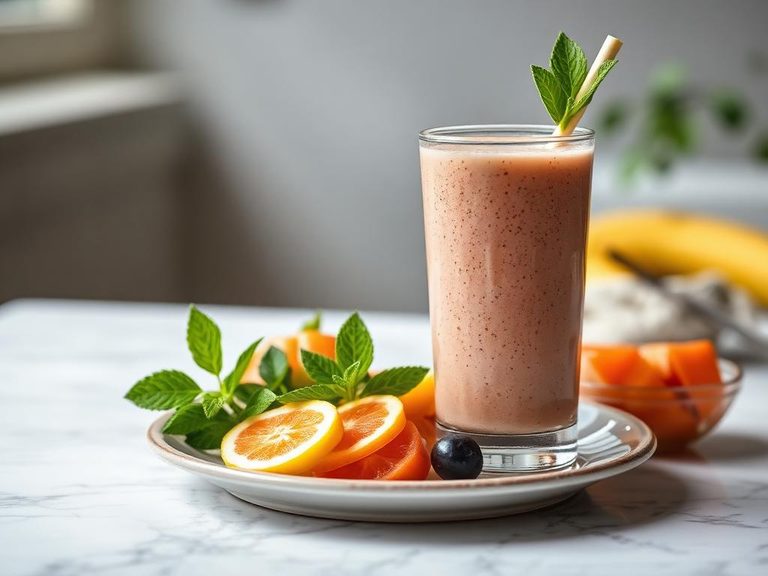
This is a vibrant, low-calorie beverage engineered for a quick, guilt-free vitamin C boost. It typically offers a crisp, clean taste with a subtle, sweet-tart fruitiness, often from a blend of citrus, berry, or tropical fruit extracts, and is smooth and light in texture. Its primary nutritional highlight is the high concentration of vitamin C, essential for immune function and collagen synthesis, delivered with minimal calories and no fat.
Calorie split: 0% protein · 100% carbs · 0% fat
↓ Full nutrition💚 Why it's loved
People love it for its refreshing, thirst-quenching quality and the convenience of getting a significant vitamin C dose without the sugar or calories of a full-fruit juice. It's a popular, versatile choice for a light drink, a mixer, or a post-workout hydrator.
⚠️ Watch-outs & how to enjoy it better
The primary concern is the lack of fiber and the potential for added sugars (even in 'diet' versions, artificial sweeteners are used), which can affect gut health and blood sugar regulation for some. It also lacks the full nutrient profile of whole fruits. To counteract this, pair it with a source of fiber (like a handful of nuts or a piece of whole fruit) and be mindful of overall daily sweetener intake.
Key benefits
- Excellent source of vitamin C (often >100% DV per serving)
- Extremely low in calories (4 kcal/100g)
- Contains no fat or protein
- May support immune system health
- Provides a quick hydration option
🍽️ Popular dishes



🌍 Where it's eaten
💡 Did you know?
The vitamin C in these drinks is often derived from acerola cherry or camu camu, superfruits from the Amazon that contain up to 60 times more vitamin C per gram than an orange.
Full nutrition (USDA data · scales with serving)
| Water | 98.8 g |
| Energy | 4.0 kcal |
| Protein | 0.00 g |
| Total lipid (fat) | 0.00 g |
| Carbohydrate, by difference | 1.1 g |
| Fiber, total dietary | 0.00 g |
| Total Sugars | 0.63 g |
| Calcium, Ca | 8.0 mg |
| Iron, Fe | 0.30 mg |
| Magnesium, Mg | 1.0 mg |
| Phosphorus, P | 1.0 mg |
| Potassium, K | 24.0 mg |
| Sodium, Na | 14.0 mg |
| Zinc, Zn | 0.01 mg |
| Copper, Cu | 0.01 mg |
| Selenium, Se | 0.00 ug |
| Vitamin C, total ascorbic acid | 25.1 mg |
| Thiamin | 0.00 mg |
| Riboflavin | 0.00 mg |
| Niacin | 0.01 mg |
| Vitamin B-6 | 0.00 mg |
| Folate, total | 0.00 ug |
| Folic acid | 0.00 ug |
| Folate, food | 0.00 ug |
| Folate, DFE | 0.00 ug |
| Choline, total | 0.20 mg |
| Vitamin B-12 | 0.00 ug |
| Vitamin B-12, added | 0.00 ug |
| Vitamin A, RAE | 105 ug |
| Retinol | 0.00 ug |
| Carotene, beta | 1253 ug |
| Carotene, alpha | 3.0 ug |
| Cryptoxanthin, beta | 0.00 ug |
| Lycopene | 144 ug |
| Lutein + zeaxanthin | 2.0 ug |
| Vitamin E (alpha-tocopherol) | 1.1 mg |
| Vitamin E, added | 1.1 mg |
| Vitamin D (D2 + D3) | 0.00 ug |
| Vitamin K (phylloquinone) | 0.10 ug |
| Alcohol, ethyl | 0.00 g |
| Caffeine | 0.00 mg |
| Theobromine | 0.00 mg |
Fat & fatty acid profile (per 100g)
| Fatty acids, total saturated | 0.00 g |
| SFA 4:0 | 0.00 g |
| SFA 6:0 | 0.00 g |
| SFA 8:0 | 0.00 g |
| SFA 10:0 | 0.00 g |
| SFA 12:0 | 0.00 g |
| SFA 14:0 | 0.00 g |
| SFA 16:0 | 0.00 g |
| SFA 18:0 | 0.00 g |
| Fatty acids, total monounsaturated | 0.00 g |
| MUFA 16:1 | 0.00 g |
| MUFA 18:1 | 0.00 g |
| MUFA 20:1 | 0.00 g |
| MUFA 22:1 | 0.00 g |
| Fatty acids, total polyunsaturated | 0.00 g |
| PUFA 18:2 | 0.00 g |
| PUFA 18:3 | 0.00 g |
| PUFA 18:4 | 0.00 g |
| PUFA 20:4 | 0.00 g |
| PUFA 20:5 n-3 (EPA) | 0.00 g |
| PUFA 22:5 n-3 (DPA) | 0.00 g |
| PUFA 22:6 n-3 (DHA) | 0.00 g |
| Cholesterol | 0.00 mg |
FAQ
Is this the same as orange juice?
No. While orange juice is a whole fruit juice with natural sugars and some fiber, this is typically a formulated drink with added vitamin C (ascorbic acid), water, sweeteners, and flavorings, resulting in far fewer calories and carbs.
Why is it so low in calories?
The calories come almost entirely from a small amount of carbohydrate (likely from added sweeteners or minimal fruit juice concentrate), with no fat, protein, or significant fiber to add caloric density.
Can I drink this every day?
It can be part of a daily routine, but it shouldn't replace whole fruits and vegetables. Relying solely on juice drinks for nutrients means missing out on dietary fiber and the complex phytonutrients found in whole foods.
Nutrient density (calculated · NRF9.3)
Nutrient Rich Foods index: beneficial nutrients (protein, fiber, vitamins, minerals) minus saturated fat, added sugar & sodium, per 100 kcal.
NRF9.3 index — Fulgoni, Keast & Drewnowski, 2009. Computed from USDA nutrients.
Weight-loss friendliness (composite index)
Energy density 0.04 kcal/g · 0% calories from protein · 0.0 g fiber · 0.6 g sugar per 100 g.
Composite of energy density (Rolls et al., 1999), protein & fiber satiety, minus sugar. A calculated heuristic — ranks satiety-per-calorie, not a clinical measure.
Dietary load (calculated from USDA values)
Potential renal acid load. Positive = acid-forming, negative = alkaline-forming.
Sodium-to-potassium ratio: 0.58 (lower is better — aim for ≤ 1)
Sodium:potassium per WHO potassium guidance. Computed from USDA nutrients.