

Tart, breakfast, low fat
Whole food · Baked Products
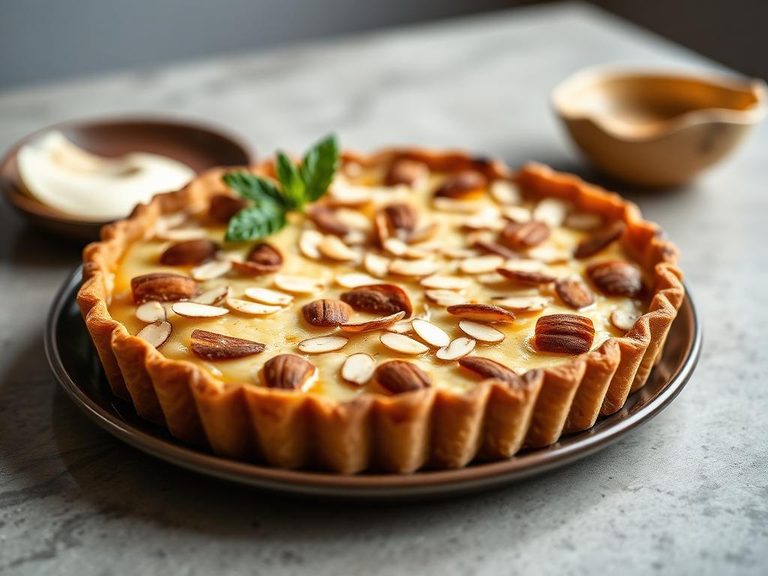
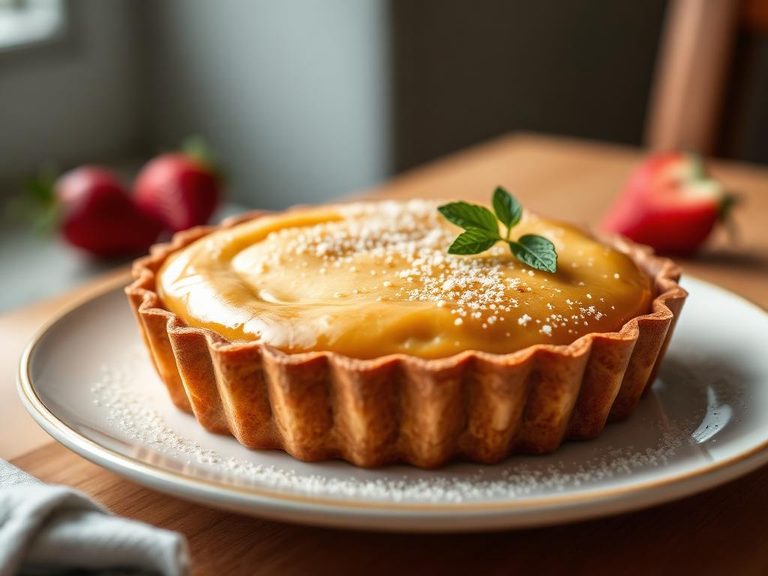
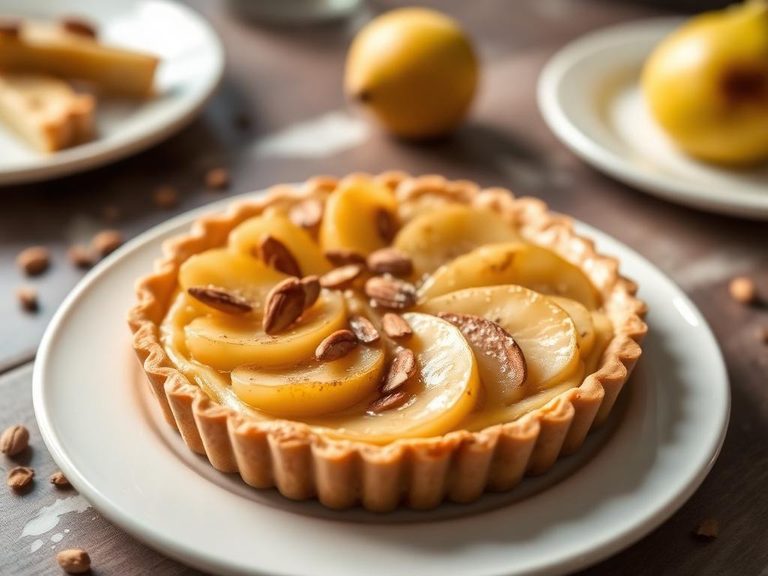
This is a light, crisp pastry shell, typically blind-baked to a golden hue, designed to cradle a fresh, low-fat breakfast filling like fruit compote or yogurt. Its texture is a satisfying contrast of a flaky, buttery base with a soft, moist topping. Nutritionally, it's a carb-forward energy source, with minimal fat and protein, making it a lighter start to the day than a traditional buttery tart.
Calorie split: 4% protein · 81% carbs · 14% fat
↓ Full nutrition💚 Why it's loved
People love it for its comforting, familiar pastry taste and the delightful textural contrast between the crisp shell and soft filling. It's a versatile base that can be customized with seasonal fruits, from tangy berries to sweet stone fruits.
⚠️ Watch-outs & how to enjoy it better
Its high carbohydrate and sugar content can lead to rapid blood sugar spikes, especially if the filling is sugary. Those monitoring glycemic index or managing diabetes should be cautious. Tip: Pair it with a source of protein or healthy fat, like a side of Greek yogurt or a handful of nuts, to slow sugar absorption and increase satiety.
Key benefits
- Provides quick, accessible energy from carbohydrates.
- Low in fat, making it suitable for low-fat dietary patterns.
- Can be a vehicle for nutrient-rich fillings like fresh fruit or yogurt.
- Offers a satisfying, sweet start to the day without excessive calories.
🍽️ Popular dishes


🌍 Where it's eaten
💡 Did you know?
The technique of 'blind baking' a tart shell—lining it with parchment and weights before adding the filling—was developed to prevent the pastry from puffing up or becoming soggy, a method perfected by French pâtissiers.
Full nutrition (USDA data · scales with serving)
| Water | 12.0 g |
| Energy | 372 kcal |
| Energy | 1556 kj |
| Protein | 4.0 g |
| Total lipid (fat) | 6.0 g |
| Ash | 1.2 g |
| Carbohydrate, by difference | 76.8 g |
| Fiber, total dietary | 1.5 g |
| Total Sugars | 4.9 g |
| Calcium, Ca | 44.0 mg |
| Iron, Fe | 3.4 mg |
| Magnesium, Mg | 44.0 mg |
| Phosphorus, P | 93.0 mg |
| Potassium, K | 66.0 mg |
| Sodium, Na | 361 mg |
| Zinc, Zn | 0.28 mg |
| Copper, Cu | 0.07 mg |
| Selenium, Se | 12.9 ug |
| Vitamin C, total ascorbic acid | 3.8 mg |
| Thiamin | 0.28 mg |
| Riboflavin | 0.55 mg |
| Niacin | 3.8 mg |
| Vitamin B-6 | 0.38 mg |
| Folate, total | 100 ug |
| Folic acid | 47.0 ug |
| Folate, food | 53.0 ug |
| Folate, DFE | 133 ug |
| Choline, total | 8.4 mg |
| Vitamin B-12 | 0.00 ug |
| Vitamin B-12, added | 0.00 ug |
| Vitamin A, RAE | 285 ug |
| Retinol | 285 ug |
| Carotene, beta | 3.0 ug |
| Carotene, alpha | 0.00 ug |
| Cryptoxanthin, beta | 1.0 ug |
| Vitamin A, IU | 950 iu |
| Lycopene | 0.00 ug |
| Lutein + zeaxanthin | 4.0 ug |
| Vitamin E (alpha-tocopherol) | 0.53 mg |
| Vitamin E, added | 0.00 mg |
| Vitamin D (D2 + D3), International Units | 0.00 iu |
| Vitamin D (D2 + D3) | 0.00 ug |
| Vitamin K (phylloquinone) | 0.40 ug |
| Alcohol, ethyl | 0.00 g |
| Caffeine | 0.00 mg |
| Theobromine | 0.00 mg |
Fat & fatty acid profile (per 100g)
| Fatty acids, total saturated | 1.4 g |
| SFA 4:0 | 0.00 g |
| SFA 6:0 | 0.00 g |
| SFA 8:0 | 0.00 g |
| SFA 10:0 | 0.00 g |
| SFA 12:0 | 0.01 g |
| SFA 14:0 | 0.00 g |
| SFA 16:0 | 0.68 g |
| SFA 18:0 | 0.68 g |
| Fatty acids, total monounsaturated | 3.3 g |
| MUFA 16:1 | 0.00 g |
| MUFA 18:1 | 3.3 g |
| MUFA 20:1 | 0.01 g |
| MUFA 22:1 | 0.00 g |
| Fatty acids, total polyunsaturated | 0.88 g |
| PUFA 18:2 | 0.86 g |
| PUFA 18:3 | 0.02 g |
| PUFA 18:4 | 0.00 g |
| PUFA 20:4 | 0.00 g |
| PUFA 20:5 n-3 (EPA) | 0.00 g |
| PUFA 22:5 n-3 (DPA) | 0.00 g |
| PUFA 22:6 n-3 (DHA) | 0.00 g |
| Cholesterol | 0.00 mg |
FAQ
What makes a breakfast tart 'low-fat'?
The low-fat designation typically refers to the pastry shell, which uses significantly less butter or oil than a traditional shortcrust. The filling is often fruit-based, yogurt, or a light custard, avoiding heavy creams or butter.
Can I make this ahead of time?
Yes, the tart shell can be blind-baked and stored airtight for 1-2 days. Add fresh, wet fillings like yogurt or fresh fruit just before serving to maintain crispness.
What's the best way to store leftovers?
Refrigerate covered for up to 2 days. The pastry may soften; you can refresh it in a low oven for a few minutes to re-crisp the base before serving.
Nutrient density (calculated · NRF9.3)
Nutrient Rich Foods index: beneficial nutrients (protein, fiber, vitamins, minerals) minus saturated fat, added sugar & sodium, per 100 kcal.
NRF9.3 index — Fulgoni, Keast & Drewnowski, 2009. Computed from USDA nutrients.
Weight-loss friendliness (composite index)
Energy density 3.72 kcal/g · 4% calories from protein · 1.5 g fiber · 4.9 g sugar per 100 g.
Composite of energy density (Rolls et al., 1999), protein & fiber satiety, minus sugar. A calculated heuristic — ranks satiety-per-calorie, not a clinical measure.
Dietary load (calculated from USDA values)
Potential renal acid load. Positive = acid-forming, negative = alkaline-forming.
Sodium-to-potassium ratio: 5.47 (lower is better — aim for ≤ 1)
Sodium:potassium per WHO potassium guidance. Computed from USDA nutrients.