

Soup, oyster stew, canned, condensed
Whole food · Soups, Sauces, and Gravies
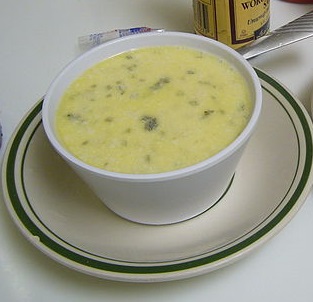
Photo: Wikipedia
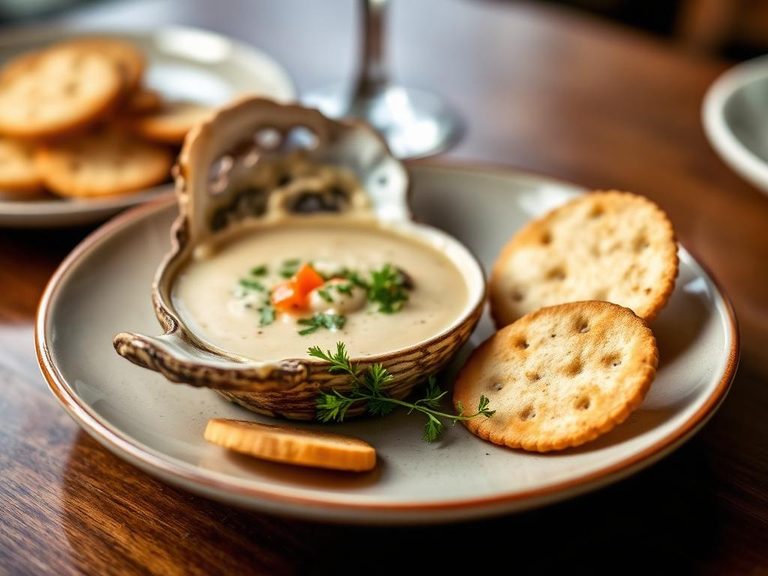
This is a smooth, briny, and creamy base for a classic comfort soup, made by concentrating oyster broth with milk or cream. It offers a delicate, savory ocean flavor and a velvety texture that becomes rich and comforting when diluted and heated. Nutritionally, it provides a modest source of protein and fat with very few calories per serving, making it a light yet satisfying option.
Calorie split: 14% protein · 27% carbs · 58% fat
↓ Full nutrition💚 Why it's loved
People love it for its rich, briny, and comforting flavor that evokes coastal New England traditions. It's prized for its versatility as a quick base that can be easily enhanced with a splash of milk, a pat of butter, or a sprinkle of paprika.
⚠️ Watch-outs & how to enjoy it better
The condensed form can be high in sodium, which may be a concern for those monitoring salt intake. To counteract this, dilute it with unsalted water or milk and avoid adding extra salt; pairing it with a side of fresh vegetables can also help balance the meal.
Key benefits
- Low in calories per 100g, suitable for light meals
- Provides a source of protein from oysters
- Contains healthy fats, including omega-3s from seafood
- Quick and easy to prepare as a base for a warm meal
- Offers a good source of minerals like zinc and iron from oysters
🍽️ Popular dishes
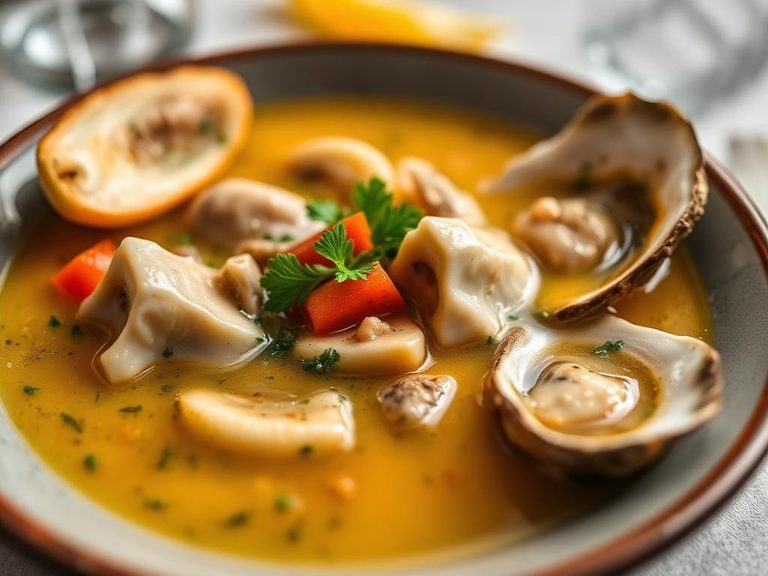
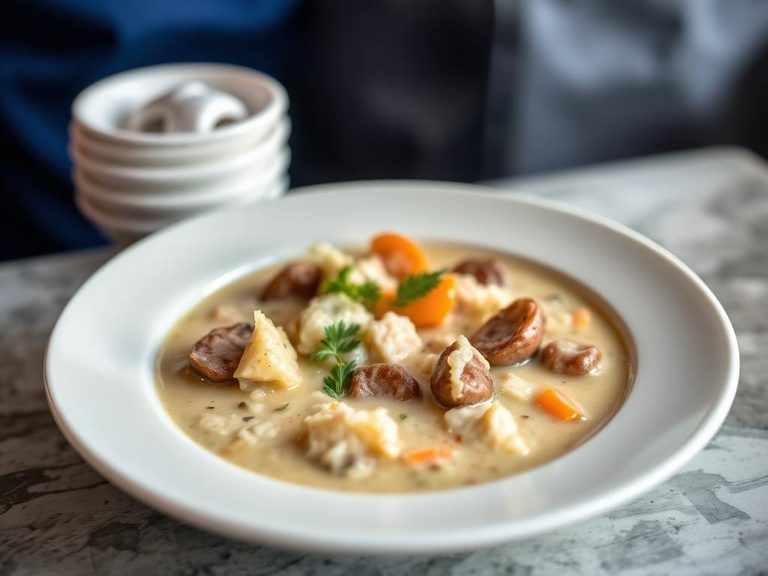
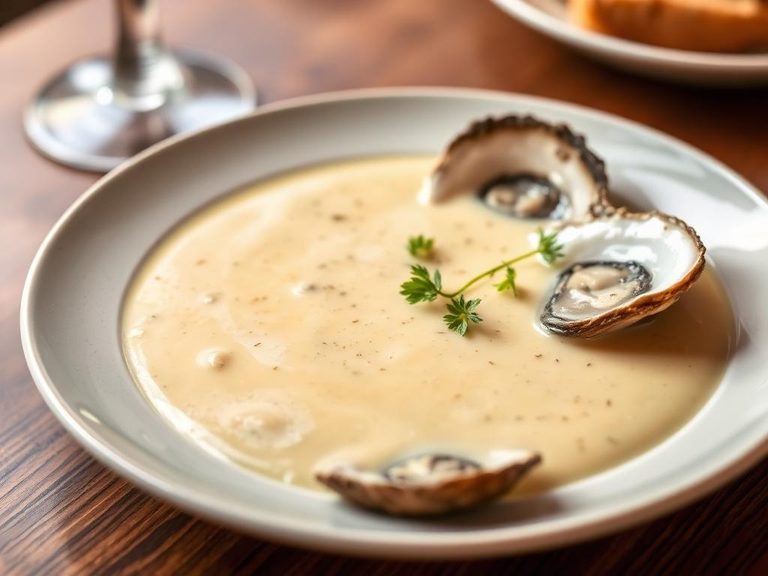

🌍 Where it's eaten
💡 Did you know?
Canned condensed oyster stew was a popular pantry staple in the United States during the mid-20th century, often promoted as a quick, elegant appetizer for holiday meals like Christmas Eve.
Full nutrition (USDA data · scales with serving)
| Water | 89.9 g |
| Energy | 48.0 kcal |
| Energy | 201 kj |
| Protein | 1.7 g |
| Total lipid (fat) | 3.1 g |
| Ash | 1.9 g |
| Carbohydrate, by difference | 3.3 g |
| Fiber, total dietary | 0.00 g |
| Calcium, Ca | 18.0 mg |
| Iron, Fe | 0.80 mg |
| Magnesium, Mg | 4.0 mg |
| Phosphorus, P | 39.0 mg |
| Potassium, K | 40.0 mg |
| Sodium, Na | 722 mg |
| Zinc, Zn | 8.4 mg |
| Copper, Cu | 1.3 mg |
| Manganese, Mn | 0.30 mg |
| Selenium, Se | 6.8 ug |
| Vitamin C, total ascorbic acid | 2.6 mg |
| Thiamin | 0.02 mg |
| Riboflavin | 0.03 mg |
| Niacin | 0.19 mg |
| Pantothenic acid | 0.10 mg |
| Vitamin B-6 | 0.01 mg |
| Folate, total | 2.0 ug |
| Folic acid | 0.00 ug |
| Folate, food | 2.0 ug |
| Folate, DFE | 2.0 ug |
| Vitamin B-12 | 1.8 ug |
| Vitamin A, RAE | 3.0 ug |
| Retinol | 0.00 ug |
| Vitamin A, IU | 58.0 iu |
Fat & fatty acid profile (per 100g)
| Fatty acids, total saturated | 2.0 g |
| SFA 4:0 | 0.12 g |
| SFA 6:0 | 0.07 g |
| SFA 8:0 | 0.05 g |
| SFA 10:0 | 0.11 g |
| SFA 12:0 | 0.09 g |
| SFA 14:0 | 0.34 g |
| SFA 16:0 | 0.77 g |
| SFA 18:0 | 0.37 g |
| Fatty acids, total monounsaturated | 0.74 g |
| MUFA 16:1 | 0.04 g |
| MUFA 18:1 | 0.66 g |
| Fatty acids, total polyunsaturated | 0.13 g |
| PUFA 18:2 | 0.10 g |
| PUFA 18:3 | 0.02 g |
| Cholesterol | 11.0 mg |
Amino acid profile (per 100g)
Estimated from Soup, bean with pork, canned, condensed — USDA does not publish this profile for Soup.
| Tryptophan | 0.06 g |
| Threonine | 0.24 g |
| Isoleucine | 0.29 g |
| Leucine | 0.48 g |
| Lysine | 0.40 g |
| Methionine | 0.07 g |
| Cystine | 0.07 g |
| Phenylalanine | 0.33 g |
| Tyrosine | 0.18 g |
| Valine | 0.32 g |
| Arginine | 0.31 g |
| Histidine | 0.15 g |
| Alanine | 0.29 g |
| Aspartic acid | 0.66 g |
| Glutamic acid | 1.1 g |
| Glycine | 0.28 g |
| Proline | 0.27 g |
| Serine | 0.29 g |
FAQ
Is canned oyster stew healthy?
It can be part of a healthy diet in moderation. It's low in calories and provides some protein and minerals, but it may be high in sodium, so it's best to check the label and balance it with low-sodium foods.
How do you prepare canned condensed oyster stew?
Typically, you dilute the condensed soup with an equal amount of milk or water, then heat it gently until hot. Avoid boiling to prevent curdling, and serve with crackers or bread.
Can I use it in other recipes?
Yes, it can be used as a base for chowders, bisques, or as a sauce for seafood dishes. It adds a rich, briny flavor to many recipes without needing to start from scratch.
Nutrient density (calculated · NRF9.3)
Nutrient Rich Foods index: beneficial nutrients (protein, fiber, vitamins, minerals) minus saturated fat, added sugar & sodium, per 100 kcal.
NRF9.3 index — Fulgoni, Keast & Drewnowski, 2009. Computed from USDA nutrients.
Weight-loss friendliness (composite index)
Energy density 0.48 kcal/g · 14% calories from protein · 0.0 g fiber · 0.0 g sugar per 100 g.
Composite of energy density (Rolls et al., 1999), protein & fiber satiety, minus sugar. A calculated heuristic — ranks satiety-per-calorie, not a clinical measure.
Dietary load (calculated from USDA values)
Potential renal acid load. Positive = acid-forming, negative = alkaline-forming.
Sodium-to-potassium ratio: 18.05 (lower is better — aim for ≤ 1)
Sodium:potassium per WHO potassium guidance. Computed from USDA nutrients.