

Raspberries, raw
Common food

Photo: Wikipedia
Raspberries are delicate, hollow berries with a vibrant red hue and a perfect balance of sweet and tart flavors. Their unique texture is a delightful burst of juicy segments surrounding a tiny core. Nutritionally, they are a fiber powerhouse, offering more than 20% of your daily value per cup, while remaining very low in calories and sugar.
Calorie split: 7% protein · 90% carbs · 3% fat
↓ Full nutrition💚 Why it's loved
People adore raspberries for their intense, aromatic sweetness with a bright, tangy finish that makes them a favorite in both sweet and savory contexts. Their versatility shines in everything from fresh summer salads and decadent desserts to sauces and jams.
⚠️ Watch-outs & how to enjoy it better
The primary downside is their short shelf life and delicate nature, making them prone to quick spoilage if not handled carefully. For those monitoring blood sugar, while they are low-GI, the natural sugars can still add up if consumed in very large quantities. Tip: Pair them with a source of protein or healthy fat, like Greek yogurt or nuts, to slow sugar absorption and increase satiety.
Key benefits
- Excellent source of dietary fiber (6.5g per 100g)
- Very low in calories (57 kcal per 100g)
- Contains high levels of antioxidants like vitamin C and ellagic acid
- Low glycemic index (GI) fruit
- Good source of manganese and vitamin K
🍽️ Popular dishes

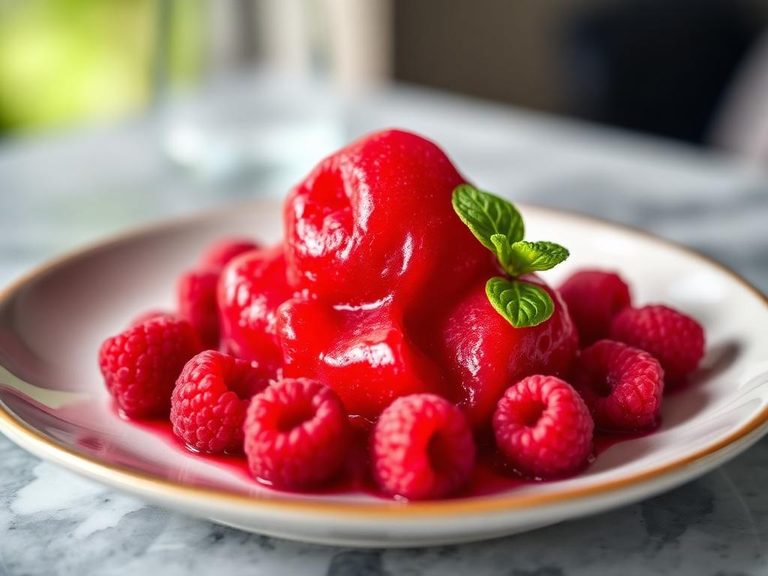

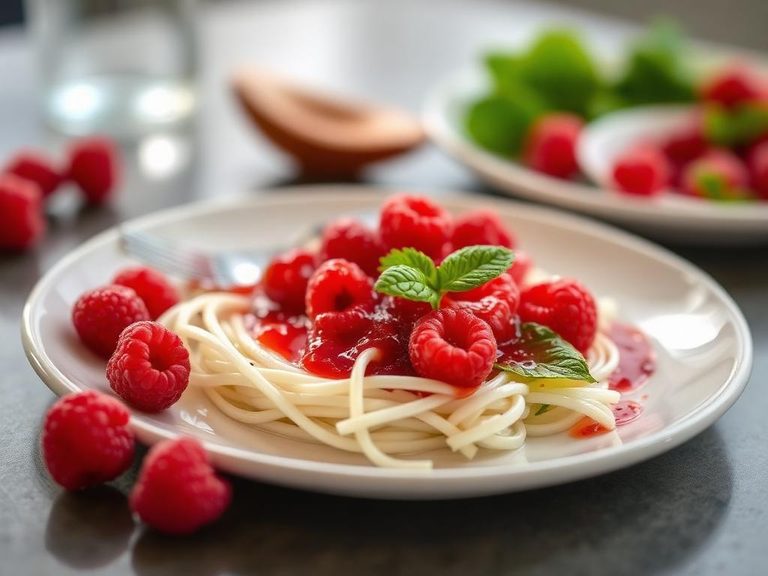
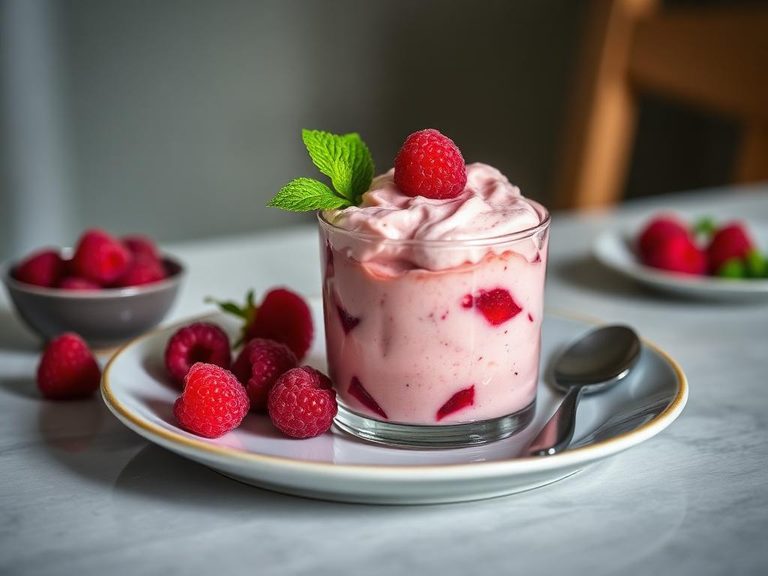
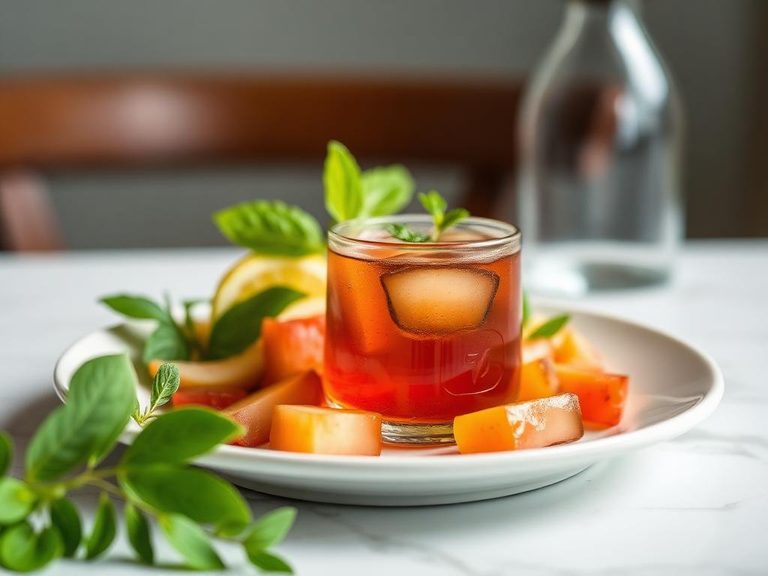
🌍 Where it's eaten
💡 Did you know?
A raspberry is not a single fruit, but an aggregate fruit made up of dozens of tiny individual fruits called drupelets, each containing a single seed.
Full nutrition (USDA data · scales with serving)
| Water | 85.5 g |
| Energy | 57.0 kcal |
| Protein | 1.0 g |
| Total lipid (fat) | 0.19 g |
| Carbohydrate, by difference | 12.9 g |
| Fiber, total dietary | 6.5 g |
| Total Sugars | 2.7 g |
| Calcium, Ca | 16.0 mg |
| Iron, Fe | 0.45 mg |
| Magnesium, Mg | 19.0 mg |
| Phosphorus, P | 27.0 mg |
| Potassium, K | 156 mg |
| Sodium, Na | 0.00 mg |
| Zinc, Zn | 0.22 mg |
| Copper, Cu | 0.05 mg |
| Selenium, Se | 0.20 ug |
| Vitamin C, total ascorbic acid | 23.0 mg |
| Thiamin | 0.03 mg |
| Riboflavin | 0.04 mg |
| Niacin | 0.60 mg |
| Vitamin B-6 | 0.06 mg |
| Folate, total | 21.0 ug |
| Folic acid | 0.00 ug |
| Folate, food | 21.0 ug |
| Folate, DFE | 21.0 ug |
| Choline, total | 12.3 mg |
| Vitamin B-12 | 0.00 ug |
| Vitamin B-12, added | 0.00 ug |
| Vitamin A, RAE | 2.0 ug |
| Retinol | 0.00 ug |
| Carotene, beta | 12.0 ug |
| Carotene, alpha | 16.0 ug |
| Cryptoxanthin, beta | 0.00 ug |
| Lycopene | 0.00 ug |
| Lutein + zeaxanthin | 136 ug |
| Vitamin E (alpha-tocopherol) | 0.87 mg |
| Vitamin E, added | 0.00 mg |
| Vitamin D (D2 + D3) | 0.00 ug |
| Vitamin K (phylloquinone) | 7.8 ug |
| Alcohol, ethyl | 0.00 g |
| Caffeine | 0.00 mg |
| Theobromine | 0.00 mg |
Fat & fatty acid profile (per 100g)
| Fatty acids, total saturated | 0.02 g |
| SFA 4:0 | 0.00 g |
| SFA 6:0 | 0.00 g |
| SFA 8:0 | 0.00 g |
| SFA 10:0 | 0.00 g |
| SFA 12:0 | 0.00 g |
| SFA 14:0 | 0.00 g |
| SFA 16:0 | 0.02 g |
| SFA 18:0 | 0.00 g |
| Fatty acids, total monounsaturated | 0.06 g |
| MUFA 16:1 | 0.00 g |
| MUFA 18:1 | 0.06 g |
| MUFA 20:1 | 0.01 g |
| MUFA 22:1 | 0.00 g |
| Fatty acids, total polyunsaturated | 0.38 g |
| PUFA 18:2 | 0.25 g |
| PUFA 18:3 | 0.13 g |
| PUFA 18:4 | 0.00 g |
| PUFA 20:4 | 0.00 g |
| PUFA 20:5 n-3 (EPA) | 0.00 g |
| PUFA 22:5 n-3 (DPA) | 0.00 g |
| PUFA 22:6 n-3 (DHA) | 0.00 g |
| Cholesterol | 0.00 mg |
FAQ
What's the difference between red and black raspberries?
Red raspberries (Rubus idaeus) are the most common, with a classic sweet-tart flavor. Black raspberries (Rubus occidentalis) are a distinct species, often smaller, with a deeper, more earthy, and slightly more intense flavor, and are particularly rich in anthocyanin antioxidants.
How should I store fresh raspberries to make them last?
Do not wash them until ready to eat. Store them in a single layer on a paper towel in a breathable container in the refrigerator. They are best consumed within 2-3 days of purchase.
Can you eat the seeds in raspberries?
Yes, absolutely. The tiny seeds are edible and contribute to the fruit's high fiber content. While some people find them slightly gritty, they are a normal and nutritious part of eating a raspberry.
Nutrient density (calculated · NRF9.3)
Nutrient Rich Foods index: beneficial nutrients (protein, fiber, vitamins, minerals) minus saturated fat, added sugar & sodium, per 100 kcal.
NRF9.3 index — Fulgoni, Keast & Drewnowski, 2009. Computed from USDA nutrients.
Weight-loss friendliness (composite index)
Energy density 0.57 kcal/g · 7% calories from protein · 6.5 g fiber · 2.7 g sugar per 100 g.
Composite of energy density (Rolls et al., 1999), protein & fiber satiety, minus sugar. A calculated heuristic — ranks satiety-per-calorie, not a clinical measure.
Dietary load (calculated from USDA values)
Potential renal acid load. Positive = acid-forming, negative = alkaline-forming.
Sodium-to-potassium ratio: 0.00 (lower is better — aim for ≤ 1)
Sodium:potassium per WHO potassium guidance. Computed from USDA nutrients.