

Potatoes, microwaved, cooked in skin, flesh, without salt
Whole food · Vegetables and Vegetable Products
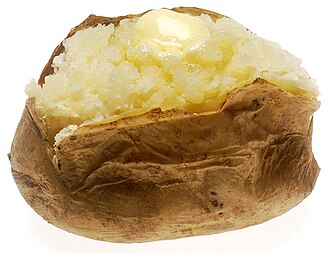
Photo: Wikipedia
A whole potato cooked in its skin using a microwave, resulting in a fluffy, moist interior and a slightly chewy, earthy skin. The flesh is creamy and mild, absorbing butter or herbs beautifully. Nutritionally, it's a low-fat, high-carb energy source with a respectable dose of fiber from the skin.
Calorie split: 8% protein · 91% carbs · 1% fat
↓ Full nutrition💚 Why it's loved
People love its comforting, neutral canvas that pairs with almost anything, from a dollop of sour cream to a sprinkle of paprika. It's a staple of convenience, delivering a warm, satisfying meal in minutes.
⚠️ Watch-outs & how to enjoy it better
As a high-glycemic carbohydrate, it can cause rapid blood sugar spikes, especially when eaten alone. To counteract this, pair it with a source of protein (like Greek yogurt or cottage cheese) or healthy fat (like avocado or olive oil) to slow digestion. Those monitoring potassium intake should be mindful of portion size.
Key benefits
- Excellent source of potassium for heart and muscle function
- Provides resistant starch, which may support gut health
- Skin-on preparation retains more fiber and nutrients
- Quick, convenient, and requires minimal added fat
- Naturally gluten-free and low in sodium
🍽️ Popular dishes
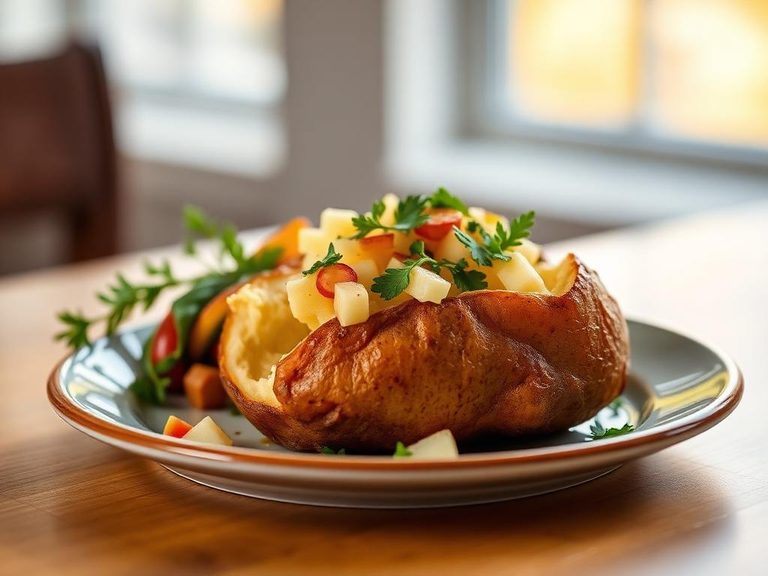

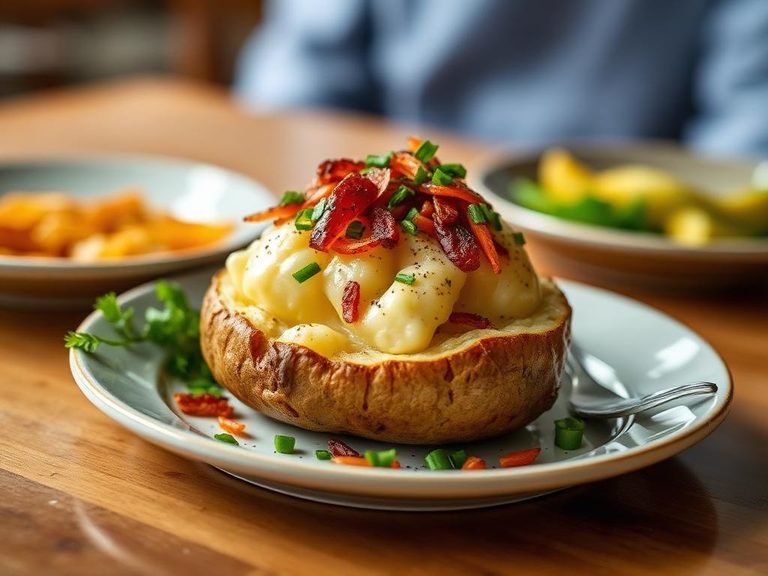
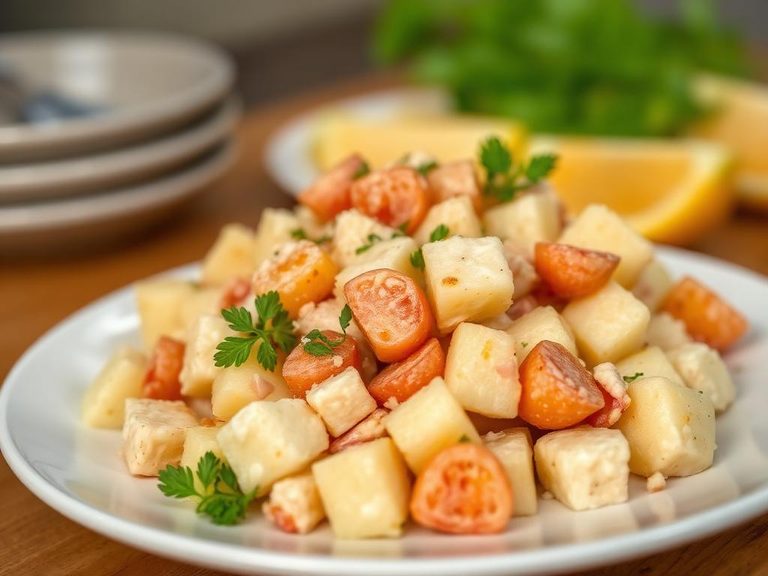

🌍 Where it's eaten
💡 Did you know?
Microwaving a potato in its skin actually preserves more vitamin C than boiling it, as the shorter cooking time and less water contact reduce nutrient leaching.
Full nutrition (USDA data · scales with serving)
| Water | 73.5 g |
| Energy | 100 kcal |
| Energy | 418 kj |
| Protein | 2.1 g |
| Total lipid (fat) | 0.10 g |
| Ash | 0.97 g |
| Carbohydrate, by difference | 23.3 g |
| Fiber, total dietary | 1.6 g |
| Calcium, Ca | 5.0 mg |
| Iron, Fe | 0.41 mg |
| Magnesium, Mg | 25.0 mg |
| Phosphorus, P | 109 mg |
| Potassium, K | 411 mg |
| Sodium, Na | 7.0 mg |
| Zinc, Zn | 0.33 mg |
| Copper, Cu | 0.24 mg |
| Manganese, Mn | 0.17 mg |
| Selenium, Se | 0.40 ug |
| Vitamin C, total ascorbic acid | 15.1 mg |
| Thiamin | 0.13 mg |
| Riboflavin | 0.03 mg |
| Niacin | 1.6 mg |
| Pantothenic acid | 0.60 mg |
| Vitamin B-6 | 0.32 mg |
| Folate, total | 12.0 ug |
| Folic acid | 0.00 ug |
| Folate, food | 12.0 ug |
| Folate, DFE | 12.0 ug |
| Vitamin B-12 | 0.00 ug |
| Vitamin A, RAE | 0.00 ug |
| Retinol | 0.00 ug |
| Vitamin A, IU | 0.00 iu |
| Vitamin D (D2 + D3), International Units | 0.00 iu |
| Vitamin D (D2 + D3) | 0.00 ug |
Fat & fatty acid profile (per 100g)
| Fatty acids, total saturated | 0.03 g |
| SFA 10:0 | 0.00 g |
| SFA 12:0 | 0.00 g |
| SFA 14:0 | 0.00 g |
| SFA 16:0 | 0.02 g |
| SFA 18:0 | 0.00 g |
| Fatty acids, total monounsaturated | 0.00 g |
| MUFA 16:1 | 0.00 g |
| MUFA 18:1 | 0.00 g |
| Fatty acids, total polyunsaturated | 0.04 g |
| PUFA 18:2 | 0.03 g |
| PUFA 18:3 | 0.01 g |
| Fatty acids, total trans | 0.00 g |
| Cholesterol | 0.00 mg |
Amino acid profile (per 100g)
| Tryptophan | 0.03 g |
| Threonine | 0.08 g |
| Isoleucine | 0.09 g |
| Leucine | 0.13 g |
| Lysine | 0.13 g |
| Methionine | 0.03 g |
| Cystine | 0.03 g |
| Phenylalanine | 0.09 g |
| Tyrosine | 0.08 g |
| Valine | 0.12 g |
| Arginine | 0.10 g |
| Histidine | 0.05 g |
| Alanine | 0.07 g |
| Aspartic acid | 0.51 g |
| Glutamic acid | 0.35 g |
| Glycine | 0.06 g |
| Proline | 0.08 g |
| Serine | 0.09 g |
FAQ
Why is my microwaved potato sometimes hard or rubbery?
This happens if it's overcooked. The microwave heats water molecules rapidly, so cooking times vary by wattage. Start with 3-4 minutes for a medium potato, then check by piercing with a fork. Let it rest for a minute after cooking to allow the heat to distribute evenly.
Is the skin safe to eat?
Yes, and it's nutritious! Just scrub the potato thoroughly under running water before cooking to remove any dirt or residue. The skin provides a significant portion of the fiber and some vitamins.
How does it compare nutritionally to a boiled potato?
Microwaving with the skin on generally retains more water-soluble vitamins (like vitamin C and B vitamins) than boiling, as less leaches into cooking water. The nutritional profile is very similar otherwise, with the skin being the key variable.
Nutrient density (calculated · NRF9.3)
Nutrient Rich Foods index: beneficial nutrients (protein, fiber, vitamins, minerals) minus saturated fat, added sugar & sodium, per 100 kcal.
NRF9.3 index — Fulgoni, Keast & Drewnowski, 2009. Computed from USDA nutrients.
Weight-loss friendliness (composite index)
Energy density 1.00 kcal/g · 8% calories from protein · 1.6 g fiber · 0.0 g sugar per 100 g.
Composite of energy density (Rolls et al., 1999), protein & fiber satiety, minus sugar. A calculated heuristic — ranks satiety-per-calorie, not a clinical measure.
Dietary load (calculated from USDA values)
Potential renal acid load. Positive = acid-forming, negative = alkaline-forming.
Sodium-to-potassium ratio: 0.02 (lower is better — aim for ≤ 1)
Sodium:potassium per WHO potassium guidance. Computed from USDA nutrients.