

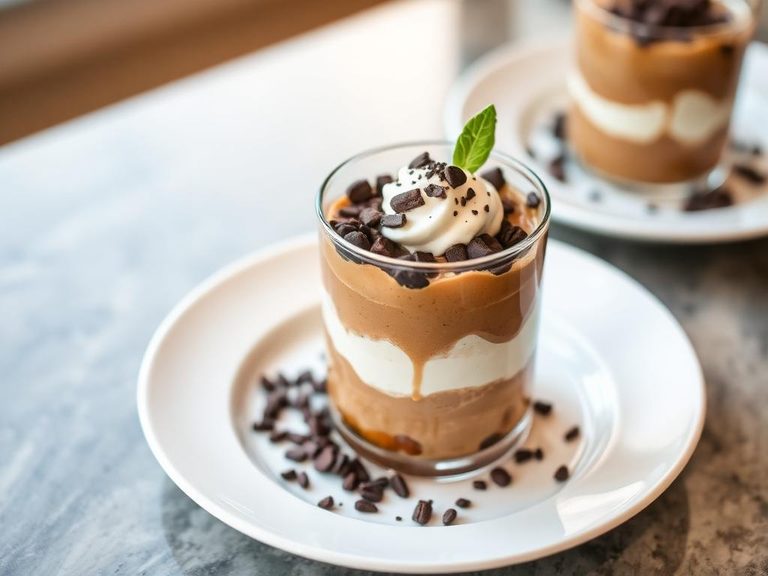
Frozen coffee drink, decaffeinated, with non-dairy milk and whipped cream
Common food

Photo: Wikipedia
A chilled, blended beverage that mimics the indulgence of a frozen coffee treat without the caffeine jolt. It typically features a smooth, icy texture from non-dairy milk, topped with a dollop of whipped cream. Nutritionally, it's a low-calorie, sugar-forward option, with most of its energy coming from carbohydrates.
Calorie split: 6% protein · 65% carbs · 29% fat
↓ Full nutrition💚 Why it's loved
People love it as a guilt-free, sweet treat that satisfies a craving for a frozen coffeehouse drink without the caffeine or high calorie count. Its versatility allows for easy flavor customization with syrups or spices, making it a popular choice for a refreshing, indulgent pick-me-up.
⚠️ Watch-outs & how to enjoy it better
The high sugar content (12.12g per 100g) can lead to rapid blood sugar spikes and subsequent crashes, which may be concerning for individuals managing diabetes or insulin resistance. To counteract this, pair the drink with a source of protein or healthy fat (like a handful of nuts) to slow sugar absorption, and practice portion control by sticking to a smaller serving size.
Key benefits
- Low in calories (80 kcal per 100g)
- Caffeine-free, suitable for evening consumption
- Quick source of energy from carbohydrates
- Dairy-free option for lactose-intolerant individuals
- Light, refreshing texture for warm weather
🍽️ Popular dishes





🌍 Where it's eaten
💡 Did you know?
The concept of a frozen coffee drink is believed to have originated in Greece in the 1950s, where it was called 'Frappé' and made with instant coffee, water, sugar, and milk.
Full nutrition (USDA data · scales with serving)
| Water | 82.8 g |
| Energy | 80.0 kcal |
| Protein | 1.3 g |
| Total lipid (fat) | 2.6 g |
| Carbohydrate, by difference | 12.9 g |
| Fiber, total dietary | 0.10 g |
| Total Sugars | 12.1 g |
| Calcium, Ca | 58.0 mg |
| Iron, Fe | 0.21 mg |
| Magnesium, Mg | 19.0 mg |
| Phosphorus, P | 23.0 mg |
| Potassium, K | 75.0 mg |
| Sodium, Na | 25.0 mg |
| Zinc, Zn | 0.13 mg |
| Copper, Cu | 0.08 mg |
| Selenium, Se | 1.2 ug |
| Vitamin C, total ascorbic acid | 0.10 mg |
| Thiamin | 0.01 mg |
| Riboflavin | 0.12 mg |
| Niacin | 0.93 mg |
| Vitamin B-6 | 0.01 mg |
| Folate, total | 4.0 ug |
| Folic acid | 0.00 ug |
| Folate, food | 4.0 ug |
| Folate, DFE | 4.0 ug |
| Choline, total | 11.3 mg |
| Vitamin B-12 | 0.37 ug |
| Vitamin B-12, added | 0.37 ug |
| Vitamin A, RAE | 41.0 ug |
| Retinol | 41.0 ug |
| Carotene, beta | 1.0 ug |
| Carotene, alpha | 0.00 ug |
| Cryptoxanthin, beta | 0.00 ug |
| Lycopene | 0.00 ug |
| Lutein + zeaxanthin | 0.00 ug |
| Vitamin E (alpha-tocopherol) | 0.10 mg |
| Vitamin E, added | 0.00 mg |
| Vitamin D (D2 + D3) | 0.60 ug |
| Vitamin K (phylloquinone) | 1.5 ug |
| Alcohol, ethyl | 0.00 g |
| Caffeine | 0.00 mg |
| Theobromine | 0.00 mg |
Fat & fatty acid profile (per 100g)
| Fatty acids, total saturated | 1.2 g |
| SFA 4:0 | 0.04 g |
| SFA 6:0 | 0.03 g |
| SFA 8:0 | 0.02 g |
| SFA 10:0 | 0.05 g |
| SFA 12:0 | 0.06 g |
| SFA 14:0 | 0.18 g |
| SFA 16:0 | 0.57 g |
| SFA 18:0 | 0.19 g |
| Fatty acids, total monounsaturated | 0.56 g |
| MUFA 16:1 | 0.04 g |
| MUFA 18:1 | 0.56 g |
| MUFA 20:1 | 0.01 g |
| MUFA 22:1 | 0.00 g |
| Fatty acids, total polyunsaturated | 0.47 g |
| PUFA 18:2 | 0.31 g |
| PUFA 18:3 | 0.04 g |
| PUFA 18:4 | 0.00 g |
| PUFA 20:4 | 0.00 g |
| PUFA 20:5 n-3 (EPA) | 0.00 g |
| PUFA 22:5 n-3 (DPA) | 0.00 g |
| PUFA 22:6 n-3 (DHA) | 0.00 g |
| Cholesterol | 5.0 mg |
FAQ
Is this drink suitable for people with lactose intolerance?
Yes, as it is made with non-dairy milk, it is typically lactose-free and suitable for those with lactose intolerance.
Can I make this drink at home?
Absolutely. You can blend decaffeinated coffee or cold brew with ice, non-dairy milk, and a sweetener of choice, then top with whipped cream.
How does the sugar content compare to a regular coffee drink?
With 12.12g of sugar per 100g, it is moderately high in sugar, similar to many sweetened coffee beverages, but lower in calories than many full-fat versions.
Nutrient density (calculated · NRF9.3)
Nutrient Rich Foods index: beneficial nutrients (protein, fiber, vitamins, minerals) minus saturated fat, added sugar & sodium, per 100 kcal.
NRF9.3 index — Fulgoni, Keast & Drewnowski, 2009. Computed from USDA nutrients.
Weight-loss friendliness (composite index)
Energy density 0.80 kcal/g · 6% calories from protein · 0.1 g fiber · 12.1 g sugar per 100 g.
Composite of energy density (Rolls et al., 1999), protein & fiber satiety, minus sugar. A calculated heuristic — ranks satiety-per-calorie, not a clinical measure.
Dietary load (calculated from USDA values)
Potential renal acid load. Positive = acid-forming, negative = alkaline-forming.
Sodium-to-potassium ratio: 0.33 (lower is better — aim for ≤ 1)
Sodium:potassium per WHO potassium guidance. Computed from USDA nutrients.