

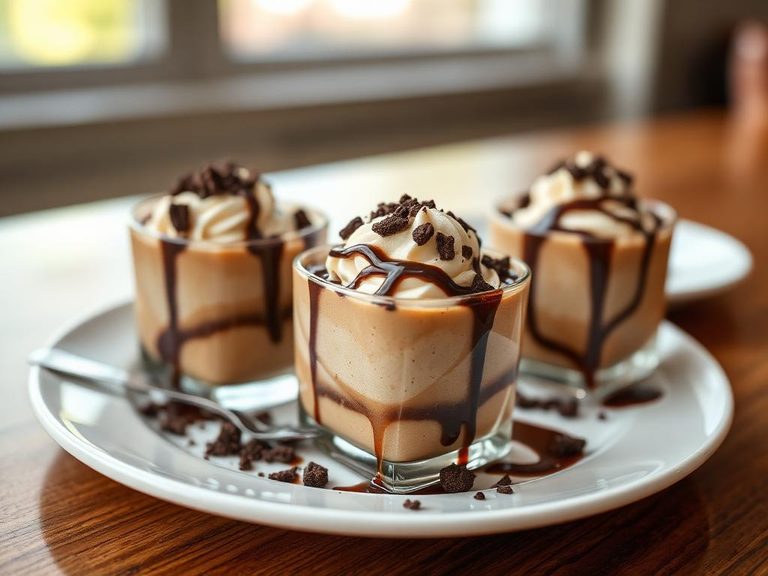
Frozen mocha coffee drink, decaffeinated, with non-dairy milk and whipped cream
Common food

Photo: Wikipedia
A chilled, blended beverage that delivers the rich, roasted essence of coffee without the caffeine jolt, balanced by the creamy, slightly sweet notes of non-dairy milk and a cloud of whipped cream. Its texture is smooth and frosty, reminiscent of a milkshake but lighter, with a sweet, chocolatey coffee flavor profile. Nutritionally, it is a low-calorie indulgence at 73 kcal per 100g, with the majority of its energy coming from carbohydrates, specifically sugars.
Calorie split: 3% protein · 65% carbs · 32% fat
↓ Full nutrition💚 Why it's loved
People love it as a guilt-free, sweet treat that satisfies coffee and dessert cravings simultaneously, often enjoyed as a social or celebratory drink. Its versatility allows for customization with different non-dairy milks and toppings, making it a popular choice in modern café culture.
⚠️ Watch-outs & how to enjoy it better
The high sugar content (10.52g per 100g) can lead to rapid blood-sugar spikes and subsequent crashes, which is a concern for those managing blood glucose levels or seeking sustained energy. To counteract this, pair the drink with a source of protein or healthy fat (like a handful of nuts) to slow sugar absorption, and practice portion control by opting for a smaller serving size.
Key benefits
- Low in calories (73 kcal per 100g)
- Caffeine-free option for evening or sensitive individuals
- Quick source of energy from carbohydrates
- Dairy-free base suitable for lactose intolerance
- Provides a sweet, indulgent flavor without a heavy meal
🍽️ Popular dishes




🌍 Where it's eaten
💡 Did you know?
The original Greek Frappé, a foamy iced coffee drink, was accidentally invented in 1957 when a Nestlé representative demonstrated a new instant coffee product by shaking it with water and ice in a shaker.
Full nutrition (USDA data · scales with serving)
| Water | 84.6 g |
| Energy | 73.0 kcal |
| Protein | 0.60 g |
| Total lipid (fat) | 2.6 g |
| Carbohydrate, by difference | 11.8 g |
| Fiber, total dietary | 0.00 g |
| Total Sugars | 10.5 g |
| Calcium, Ca | 69.0 mg |
| Iron, Fe | 0.16 mg |
| Magnesium, Mg | 19.0 mg |
| Phosphorus, P | 24.0 mg |
| Potassium, K | 54.0 mg |
| Sodium, Na | 38.0 mg |
| Zinc, Zn | 0.15 mg |
| Copper, Cu | 0.05 mg |
| Selenium, Se | 0.60 ug |
| Vitamin C, total ascorbic acid | 0.10 mg |
| Thiamin | 0.01 mg |
| Riboflavin | 0.05 mg |
| Niacin | 0.78 mg |
| Vitamin B-6 | 0.01 mg |
| Folate, total | 2.0 ug |
| Folic acid | 0.00 ug |
| Folate, food | 2.0 ug |
| Folate, DFE | 2.0 ug |
| Choline, total | 4.0 mg |
| Vitamin B-12 | 0.16 ug |
| Vitamin B-12, added | 0.16 ug |
| Vitamin A, RAE | 32.0 ug |
| Retinol | 32.0 ug |
| Carotene, beta | 0.00 ug |
| Carotene, alpha | 0.00 ug |
| Cryptoxanthin, beta | 0.00 ug |
| Lycopene | 0.00 ug |
| Lutein + zeaxanthin | 2.0 ug |
| Vitamin E (alpha-tocopherol) | 0.93 mg |
| Vitamin E, added | 0.84 mg |
| Vitamin D (D2 + D3) | 0.50 ug |
| Vitamin K (phylloquinone) | 0.60 ug |
| Alcohol, ethyl | 0.00 g |
| Caffeine | 2.0 mg |
| Theobromine | 14.0 mg |
Fat & fatty acid profile (per 100g)
| Fatty acids, total saturated | 1.1 g |
| SFA 4:0 | 0.04 g |
| SFA 6:0 | 0.03 g |
| SFA 8:0 | 0.02 g |
| SFA 10:0 | 0.05 g |
| SFA 12:0 | 0.06 g |
| SFA 14:0 | 0.18 g |
| SFA 16:0 | 0.54 g |
| SFA 18:0 | 0.18 g |
| Fatty acids, total monounsaturated | 0.71 g |
| MUFA 16:1 | 0.04 g |
| MUFA 18:1 | 0.74 g |
| MUFA 20:1 | 0.01 g |
| MUFA 22:1 | 0.00 g |
| Fatty acids, total polyunsaturated | 0.31 g |
| PUFA 18:2 | 0.24 g |
| PUFA 18:3 | 0.03 g |
| PUFA 18:4 | 0.00 g |
| PUFA 20:4 | 0.00 g |
| PUFA 20:5 n-3 (EPA) | 0.00 g |
| PUFA 22:5 n-3 (DPA) | 0.00 g |
| PUFA 22:6 n-3 (DHA) | 0.00 g |
| Cholesterol | 5.0 mg |
FAQ
Is this drink suitable for vegans?
It can be, if the non-dairy milk used is plant-based (like almond, soy, or oat) and the whipped cream is also a non-dairy alternative. Always check the specific product ingredients for animal-derived additives.
How does the sugar content affect energy levels?
With over 10g of sugar per 100g, it can cause a quick energy boost followed by a potential crash. Consuming it with fiber or protein can help moderate this effect.
Can I make a lower-sugar version at home?
Yes, you can reduce sugar by using unsweetened non-dairy milk, a sugar-free coffee syrup, and topping with a small amount of whipped cream or a dollop of Greek yogurt for creaminess without added sugar.
Nutrient density (calculated · NRF9.3)
Nutrient Rich Foods index: beneficial nutrients (protein, fiber, vitamins, minerals) minus saturated fat, added sugar & sodium, per 100 kcal.
NRF9.3 index — Fulgoni, Keast & Drewnowski, 2009. Computed from USDA nutrients.
Weight-loss friendliness (composite index)
Energy density 0.73 kcal/g · 3% calories from protein · 0.0 g fiber · 10.5 g sugar per 100 g.
Composite of energy density (Rolls et al., 1999), protein & fiber satiety, minus sugar. A calculated heuristic — ranks satiety-per-calorie, not a clinical measure.
Dietary load (calculated from USDA values)
Potential renal acid load. Positive = acid-forming, negative = alkaline-forming.
Sodium-to-potassium ratio: 0.70 (lower is better — aim for ≤ 1)
Sodium:potassium per WHO potassium guidance. Computed from USDA nutrients.