

Cereals ready-to-eat, POST SELECTS Maple Pecan Crunch
Whole food · Breakfast Cereals

Photo: Wikipedia
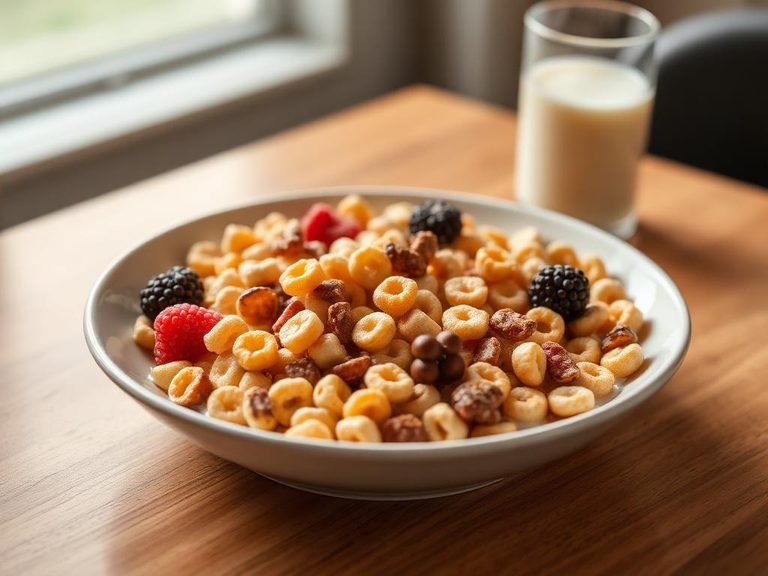
POST SELECTS Maple Pecan Crunch is a ready-to-eat cereal featuring a satisfying mix of toasted oat clusters, crunchy pecans, and sweet maple-flavored flakes. Each bite delivers a delightful contrast of textures, from the crisp clusters to the tender oats, all coated in a warm, sweet maple glaze. With 7.4g of fiber and 8.5g of protein per 100g, it offers a more substantial start than many sugary cereals.
Calorie split: 8% protein · 73% carbs · 19% fat
↓ Full nutrition💚 Why it's loved
People love it for the authentic, comforting taste of real maple and toasted pecans, which feels like a special treat. Its versatility makes it a popular choice for a quick breakfast, a topping for yogurt, or a satisfying standalone snack.
⚠️ Watch-outs & how to enjoy it better
The 22.5g of sugar per 100g can lead to a rapid blood-sugar spike, especially if eaten alone. To counteract this, pair it with a source of protein or fat like Greek yogurt, milk, or a handful of nuts to slow digestion. Also, be mindful of portion size, as the sweet, crunchy clusters are easy to overeat.
Key benefits
- Good source of dietary fiber (7.4g per 100g)
- Contains plant-based protein from oats and pecans (8.5g per 100g)
- Provides manganese from whole grain oats
- Convenient, no-prep breakfast or snack option
- Pecans offer heart-healthy monounsaturated fats
🍽️ Popular dishes

🌍 Where it's eaten
💡 Did you know?
The 'crunch' clusters are made by baking a mixture of oats, nuts, and a sugar syrup until caramelized, a process similar to making granola but resulting in denser, more cohesive pieces.
Full nutrition (USDA data · scales with serving)
| Water | 3.0 g |
| Energy | 413 kcal |
| Energy | 1729 kj |
| Protein | 8.5 g |
| Total lipid (fat) | 8.7 g |
| Ash | 2.4 g |
| Carbohydrate, by difference | 77.4 g |
| Fiber, total dietary | 7.4 g |
| Total Sugars | 22.5 g |
| Calcium, Ca | 39.0 mg |
| Iron, Fe | 3.5 mg |
| Magnesium, Mg | 85.0 mg |
| Phosphorus, P | 259 mg |
| Potassium, K | 274 mg |
| Sodium, Na | 239 mg |
| Zinc, Zn | 2.9 mg |
| Copper, Cu | 0.30 mg |
| Selenium, Se | 32.1 ug |
| Vitamin C, total ascorbic acid | 0.10 mg |
| Thiamin | 0.70 mg |
| Riboflavin | 0.80 mg |
| Niacin | 9.6 mg |
| Vitamin B-6 | 1.0 mg |
| Folate, total | 192 ug |
| Folic acid | 173 ug |
| Folate, food | 19.0 ug |
| Folate, DFE | 314 ug |
| Choline, total | 25.0 mg |
| Vitamin B-12 | 2.9 ug |
| Vitamin B-12, added | 2.9 ug |
| Vitamin A, RAE | 431 ug |
| Retinol | 431 ug |
| Carotene, beta | 3.0 ug |
| Carotene, alpha | 0.00 ug |
| Cryptoxanthin, beta | 0.00 ug |
| Vitamin A, IU | 1442 iu |
| Lycopene | 0.00 ug |
| Lutein + zeaxanthin | 119 ug |
| Vitamin E (alpha-tocopherol) | 0.99 mg |
| Vitamin E, added | 0.00 mg |
| Vitamin D (D2 + D3), International Units | 77.0 iu |
| Vitamin D (D2 + D3) | 1.9 ug |
| Vitamin D3 (cholecalciferol) | 1.9 ug |
| Vitamin K (phylloquinone) | 3.7 ug |
| Alcohol, ethyl | 0.00 g |
| Caffeine | 0.00 mg |
| Theobromine | 0.00 mg |
Fat & fatty acid profile (per 100g)
| Fatty acids, total saturated | 1.0 g |
| SFA 4:0 | 0.00 g |
| SFA 6:0 | 0.00 g |
| SFA 8:0 | 0.00 g |
| SFA 10:0 | 0.00 g |
| SFA 12:0 | 0.01 g |
| SFA 13:0 | 0.00 g |
| SFA 14:0 | 0.00 g |
| SFA 15:0 | 0.00 g |
| SFA 16:0 | 0.76 g |
| SFA 17:0 | 0.00 g |
| SFA 18:0 | 0.16 g |
| Fatty acids, total monounsaturated | 4.4 g |
| MUFA 16:1 | 0.01 g |
| MUFA 18:1 | 4.4 g |
| MUFA 20:1 | 0.03 g |
| MUFA 22:1 | 0.00 g |
| Fatty acids, total polyunsaturated | 2.6 g |
| PUFA 18:2 | 2.4 g |
| PUFA 18:3 | 0.18 g |
| PUFA 18:4 | 0.00 g |
| PUFA 20:4 | 0.00 g |
| PUFA 20:5 n-3 (EPA) | 0.00 g |
| PUFA 22:5 n-3 (DPA) | 0.00 g |
| PUFA 22:6 n-3 (DHA) | 0.00 g |
| Fatty acids, total trans | 0.00 g |
| Cholesterol | 0.00 mg |
FAQ
Is this cereal gluten-free?
While oats are naturally gluten-free, they are often processed in facilities that handle wheat. Unless explicitly labeled 'certified gluten-free,' there is a risk of cross-contamination. Check the packaging for specific allergen information.
How does the sugar content compare to other cereals?
At 22.5g per 100g, its sugar content is moderate to high—similar to many granolas but higher than plain oatmeal or unsweetened cereals. The maple flavor contributes significantly to this.
Can I use this as a baking ingredient?
Yes, it's excellent crushed as a topping for crisps, crumbles, or yogurt, or mixed into cookie dough for added texture and maple-pecan flavor.
Nutrient density (calculated · NRF9.3)
Nutrient Rich Foods index: beneficial nutrients (protein, fiber, vitamins, minerals) minus saturated fat, added sugar & sodium, per 100 kcal.
NRF9.3 index — Fulgoni, Keast & Drewnowski, 2009. Computed from USDA nutrients.
Weight-loss friendliness (composite index)
Energy density 4.13 kcal/g · 8% calories from protein · 7.4 g fiber · 22.5 g sugar per 100 g.
Composite of energy density (Rolls et al., 1999), protein & fiber satiety, minus sugar. A calculated heuristic — ranks satiety-per-calorie, not a clinical measure.
Dietary load (calculated from USDA values)
Potential renal acid load. Positive = acid-forming, negative = alkaline-forming.
Sodium-to-potassium ratio: 0.87 (lower is better — aim for ≤ 1)
Sodium:potassium per WHO potassium guidance. Computed from USDA nutrients.