

Soup, oyster stew, canned, prepared with equal volume water
Whole food · Soups, Sauces, and Gravies
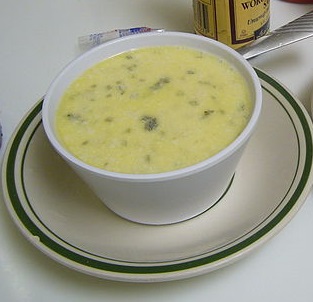
Photo: Wikipedia
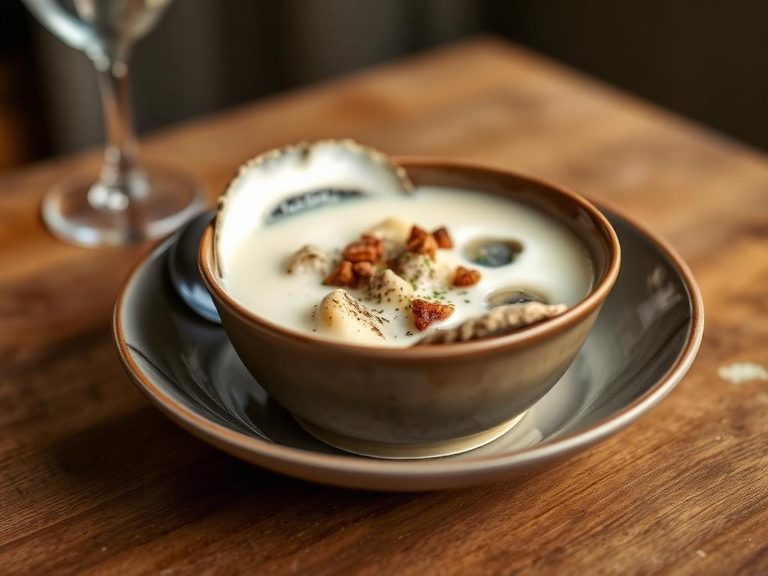
This is a smooth, briny broth made by diluting canned oyster stew with water, resulting in a light, savory soup with tender oyster pieces. Its taste is a clean, oceanic umami with a subtle creamy note from the natural oyster liquor. Nutritionally, it's a very low-calorie, low-carb source of protein and healthy fats.
Calorie split: 14% protein · 28% carbs · 58% fat
↓ Full nutrition💚 Why it's loved
People love it for its deep, comforting ocean flavor and the satisfying texture of the oysters, often enjoying it as a warming, nostalgic meal. It's also prized for its simplicity and speed, making it a classic quick supper or starter.
⚠️ Watch-outs & how to enjoy it better
The primary concern is the high sodium content typical of canned soups, which can be problematic for those monitoring blood pressure. To mitigate this, look for 'low sodium' versions or rinse the oysters briefly before use. Additionally, shellfish is a common allergen, and the rich flavor can be too intense for some palates.
Key benefits
- Excellent source of lean protein for muscle maintenance.
- Rich in heart-healthy omega-3 fatty acids from oysters.
- Very low in calories and carbohydrates.
- Contains essential minerals like zinc and selenium.
- Hydrating and easy to digest.
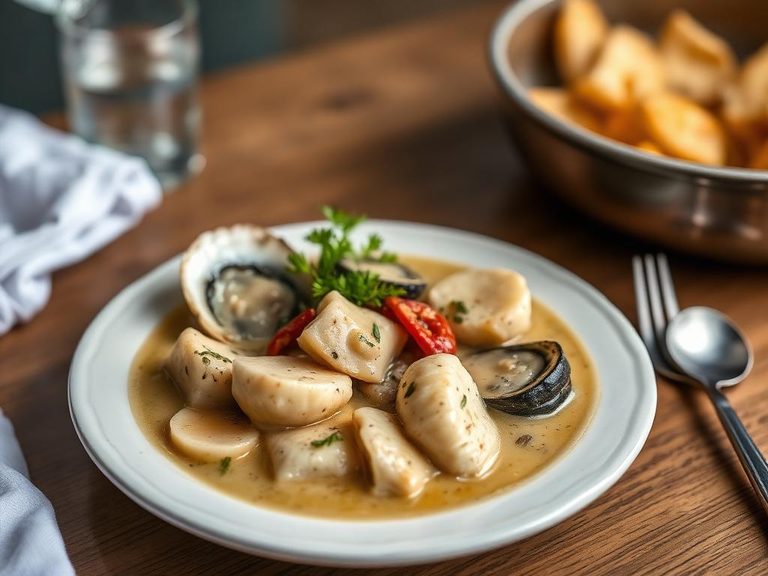
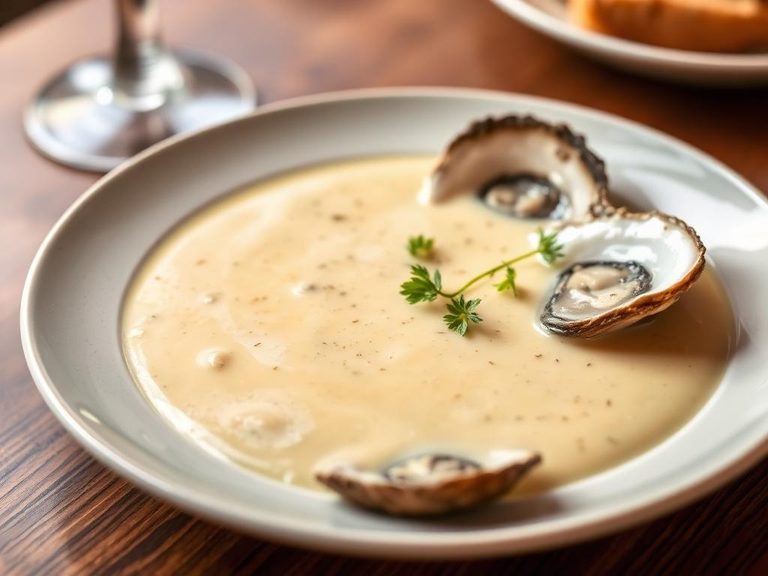
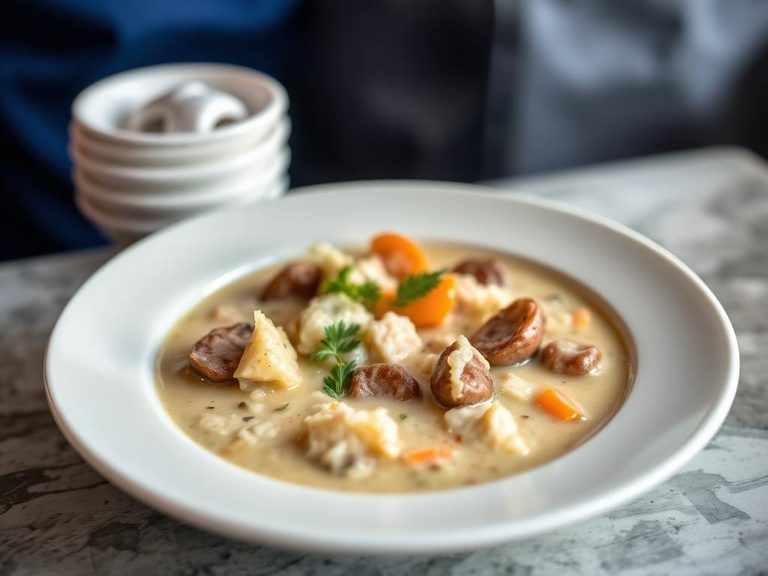
🍽️ Popular dishes
🌍 Where it's eaten
💡 Did you know?
A traditional New England 'oyster stew' was historically a Christmas Eve dinner staple, as its lightness was seen as a necessary contrast to the rich holiday feasts.
Full nutrition (USDA data · scales with serving)
| Water | 94.9 g |
| Energy | 24.0 kcal |
| Energy | 100 kj |
| Protein | 0.87 g |
| Total lipid (fat) | 1.6 g |
| Ash | 0.99 g |
| Carbohydrate, by difference | 1.7 g |
| Calcium, Ca | 9.0 mg |
| Iron, Fe | 0.41 mg |
| Magnesium, Mg | 2.0 mg |
| Phosphorus, P | 20.0 mg |
| Potassium, K | 20.0 mg |
| Sodium, Na | 407 mg |
| Zinc, Zn | 4.3 mg |
| Copper, Cu | 0.66 mg |
| Manganese, Mn | 0.15 mg |
| Vitamin C, total ascorbic acid | 1.3 mg |
| Thiamin | 0.01 mg |
| Riboflavin | 0.01 mg |
| Niacin | 0.10 mg |
| Pantothenic acid | 0.05 mg |
| Vitamin B-6 | 0.01 mg |
| Folate, total | 1.0 ug |
| Folic acid | 0.00 ug |
| Folate, food | 1.0 ug |
| Folate, DFE | 1.0 ug |
| Vitamin B-12 | 0.91 ug |
| Vitamin A, RAE | 8.0 ug |
| Retinol | 7.0 ug |
| Vitamin A, IU | 29.0 iu |
Fat & fatty acid profile (per 100g)
| Fatty acids, total saturated | 1.0 g |
| SFA 4:0 | 0.06 g |
| SFA 6:0 | 0.04 g |
| SFA 8:0 | 0.02 g |
| SFA 10:0 | 0.05 g |
| SFA 12:0 | 0.05 g |
| SFA 14:0 | 0.17 g |
| SFA 16:0 | 0.39 g |
| SFA 18:0 | 0.19 g |
| Fatty acids, total monounsaturated | 0.38 g |
| MUFA 16:1 | 0.02 g |
| MUFA 18:1 | 0.33 g |
| Fatty acids, total polyunsaturated | 0.07 g |
| PUFA 18:2 | 0.05 g |
| PUFA 18:3 | 0.01 g |
| Cholesterol | 6.0 mg |
Amino acid profile (per 100g)
Estimated from Soup, bean with pork, canned, condensed — USDA does not publish this profile for Soup.
| Tryptophan | 0.06 g |
| Threonine | 0.24 g |
| Isoleucine | 0.29 g |
| Leucine | 0.48 g |
| Lysine | 0.40 g |
| Methionine | 0.07 g |
| Cystine | 0.07 g |
| Phenylalanine | 0.33 g |
| Tyrosine | 0.18 g |
| Valine | 0.32 g |
| Arginine | 0.31 g |
| Histidine | 0.15 g |
| Alanine | 0.29 g |
| Aspartic acid | 0.66 g |
| Glutamic acid | 1.1 g |
| Glycine | 0.28 g |
| Proline | 0.27 g |
| Serine | 0.29 g |
FAQ
How is this different from fresh oyster stew?
Canned oyster stew uses pre-cooked oysters and a prepared broth base, offering convenience and consistent flavor. Fresh versions involve shucking raw oysters and building the stew from scratch, often resulting in a more delicate, fresh oyster taste and varied texture.
Is the canning liquid nutritious?
Yes, the liquid (oyster liquor) is packed with the natural minerals and umami from the oysters. Using it as the base for the stew preserves these flavors and nutrients, though it also contributes to the sodium content.
Can I use this as a base for other recipes?
Absolutely. It makes an excellent, flavorful foundation for seafood chowders, sauces for pasta or rice, or as a poaching liquid for fish. Its concentrated umami can enhance many dishes.
Nutrient density (calculated · NRF9.3)
Nutrient Rich Foods index: beneficial nutrients (protein, fiber, vitamins, minerals) minus saturated fat, added sugar & sodium, per 100 kcal.
NRF9.3 index — Fulgoni, Keast & Drewnowski, 2009. Computed from USDA nutrients.
Weight-loss friendliness (composite index)
Energy density 0.24 kcal/g · 14% calories from protein · 0.0 g fiber · 0.0 g sugar per 100 g.
Composite of energy density (Rolls et al., 1999), protein & fiber satiety, minus sugar. A calculated heuristic — ranks satiety-per-calorie, not a clinical measure.
Dietary load (calculated from USDA values)
Potential renal acid load. Positive = acid-forming, negative = alkaline-forming.
Sodium-to-potassium ratio: 20.35 (lower is better — aim for ≤ 1)
Sodium:potassium per WHO potassium guidance. Computed from USDA nutrients.