

Pie, fried pies, lemon
Whole food · Baked Products

Photo: Wikipedia
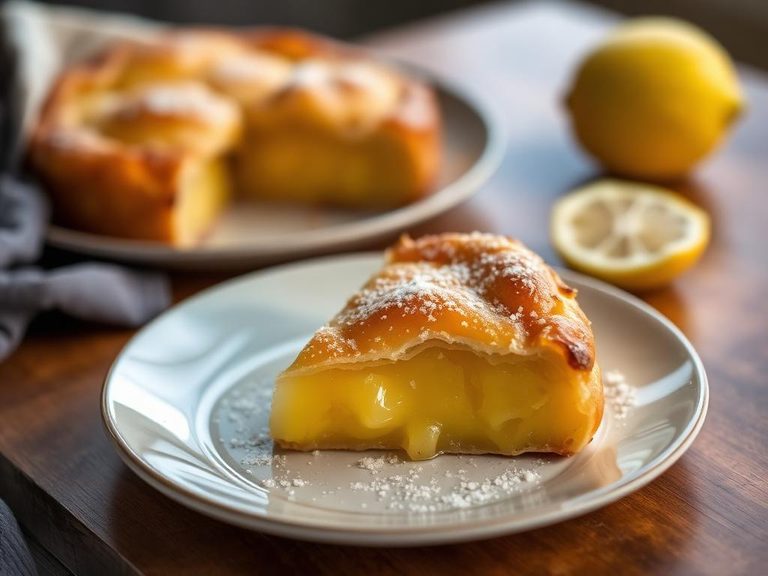
A fried pie, often called a hand pie or turnover, is a pocket of flaky pastry filled with sweetened lemon curd, then deep-fried until golden and crispy. The exterior shatters with a satisfying crunch, giving way to a warm, tangy, and sweet lemon filling that is both bright and comforting. Nutritionally, it is an energy-dense treat, providing a significant calorie boost primarily from carbohydrates and fat.
Calorie split: 4% protein · 52% carbs · 44% fat
↓ Full nutrition💚 Why it's loved
People love the delightful contrast of a shatteringly crisp, buttery exterior with a warm, tangy, and sweet lemon filling. It's a beloved comfort food, often associated with fairs, bakeries, and Southern U.S. cuisine, offering a nostalgic and indulgent treat.
⚠️ Watch-outs & how to enjoy it better
The high fat and carbohydrate content, with minimal protein or fiber, can lead to blood sugar spikes and is not suitable for low-fat or low-carb diets. To mitigate this, pair a small portion with a protein source like Greek yogurt or nuts, and be mindful of portion control to avoid excessive calorie intake.
Key benefits
- Provides quick energy from carbohydrates
- Offers a portable, handheld snack or dessert
- Can be a comforting, nostalgic food for many
- The fat content helps with satiety in the short term
- Often made with simple, traditional ingredients
🍽️ Popular dishes




🌍 Where it's eaten
💡 Did you know?
The modern fried pie in the U.S. has roots in the British meat pie, but it was popularized in the South by companies like the J.M. Smucker Company, which began selling pre-packaged fried pies in the 1920s.
Full nutrition (USDA data · scales with serving)
| Water | 37.6 g |
| Energy | 316 kcal |
| Energy | 1322 kj |
| Protein | 3.0 g |
| Total lipid (fat) | 16.1 g |
| Ash | 1.1 g |
| Carbohydrate, by difference | 42.6 g |
| Fiber, total dietary | 2.6 g |
| Calcium, Ca | 22.0 mg |
| Iron, Fe | 1.2 mg |
| Magnesium, Mg | 10.0 mg |
| Phosphorus, P | 43.0 mg |
| Potassium, K | 65.0 mg |
| Sodium, Na | 374 mg |
| Zinc, Zn | 0.23 mg |
| Copper, Cu | 0.05 mg |
| Manganese, Mn | 0.22 mg |
| Selenium, Se | 2.4 ug |
| Vitamin C, total ascorbic acid | 0.00 mg |
| Thiamin | 0.14 mg |
| Riboflavin | 0.11 mg |
| Niacin | 1.4 mg |
| Pantothenic acid | 0.11 mg |
| Vitamin B-6 | 0.03 mg |
| Folate, total | 18.0 ug |
| Folic acid | 15.0 ug |
| Folate, food | 3.0 ug |
| Folate, DFE | 29.0 ug |
| Vitamin B-12 | 0.08 ug |
| Vitamin A, RAE | 2.0 ug |
| Retinol | 0.00 ug |
| Vitamin A, IU | 32.0 iu |
Fat & fatty acid profile (per 100g)
| Fatty acids, total saturated | 2.5 g |
| SFA 4:0 | 0.00 g |
| SFA 10:0 | 0.00 g |
| SFA 12:0 | 0.00 g |
| SFA 14:0 | 0.03 g |
| SFA 16:0 | 1.5 g |
| SFA 18:0 | 0.83 g |
| Fatty acids, total monounsaturated | 7.4 g |
| MUFA 16:1 | 0.01 g |
| MUFA 18:1 | 7.3 g |
| MUFA 20:1 | 0.09 g |
| MUFA 22:1 | 0.03 g |
| Fatty acids, total polyunsaturated | 5.4 g |
| PUFA 18:2 | 4.8 g |
| PUFA 18:3 | 0.57 g |
| Cholesterol | 0.00 mg |
Amino acid profile (per 100g)
| Tryptophan | 0.04 g |
| Threonine | 0.09 g |
| Isoleucine | 0.12 g |
| Leucine | 0.21 g |
| Lysine | 0.12 g |
| Methionine | 0.05 g |
| Cystine | 0.06 g |
| Phenylalanine | 0.14 g |
| Tyrosine | 0.09 g |
| Valine | 0.14 g |
| Arginine | 0.11 g |
| Histidine | 0.06 g |
| Alanine | 0.09 g |
| Aspartic acid | 0.16 g |
| Glutamic acid | 0.91 g |
| Glycine | 0.10 g |
| Proline | 0.31 g |
| Serine | 0.15 g |
FAQ
Is a fried lemon pie the same as a lemon hand pie?
Yes, the terms are often used interchangeably. A hand pie is a small, individual-sized pie that can be baked or fried, and a fried lemon pie is a specific type of hand pie that is deep-fried.
How does frying affect the nutrition of a lemon pie?
Frying significantly increases the fat and calorie content compared to baking, as the pastry absorbs oil. It also creates a crispier texture but can make the pie heavier and more energy-dense.
Can I make a healthier version at home?
You can bake the pie instead of frying it to reduce fat, use whole wheat flour for the crust to add fiber, and fill it with a less sugary lemon filling. Baking will yield a different, less crispy texture but is a lighter alternative.
Nutrient density (calculated · NRF9.3)
Nutrient Rich Foods index: beneficial nutrients (protein, fiber, vitamins, minerals) minus saturated fat, added sugar & sodium, per 100 kcal.
NRF9.3 index — Fulgoni, Keast & Drewnowski, 2009. Computed from USDA nutrients.
Weight-loss friendliness (composite index)
Energy density 3.16 kcal/g · 4% calories from protein · 2.6 g fiber · 0.0 g sugar per 100 g.
Composite of energy density (Rolls et al., 1999), protein & fiber satiety, minus sugar. A calculated heuristic — ranks satiety-per-calorie, not a clinical measure.
Dietary load (calculated from USDA values)
Potential renal acid load. Positive = acid-forming, negative = alkaline-forming.
Sodium-to-potassium ratio: 5.75 (lower is better — aim for ≤ 1)
Sodium:potassium per WHO potassium guidance. Computed from USDA nutrients.