

Infant formula, ABBOTT NUTRITION, SIMILAC, ISOMIL, ADVANCE with iron, ready-to-feed
Whole food · Baby Foods

Photo: Wikipedia
This is a ready-to-feed, iron-fortified soy-based infant formula designed for babies with cow's milk protein sensitivity or lactose intolerance. It has a smooth, thin liquid texture and a mild, slightly sweet, beany taste that's carefully formulated to be palatable to infants. Nutritionally, it's a complete meal providing 66 kcal per 100g, with a balanced macronutrient profile focused on easy digestion and growth support.
Calorie split: 10% protein · 41% carbs · 49% fat
↓ Full nutrition💚 Why it's loved
Parents of infants with cow's milk allergy or lactose intolerance rely on it for peace of mind, knowing their baby is getting complete, safe nutrition. Its no-prep, ready-to-feed format is a lifesaver for nighttime feedings or on-the-go situations.
⚠️ Watch-outs & how to enjoy it better
Some babies may initially reject the distinct soy-based taste, and the formula is a highly processed product, not a whole food. For infants with soy allergy (which is less common but possible), it is unsuitable; always consult a pediatrician before switching formulas.
Key benefits
- Soy-based, lactose-free for sensitive digestion
- Iron-fortified to support cognitive development
- Ready-to-feed convenience, no mixing required
- Provides complete nutrition for infants with specific dietary needs
🍽️ Popular dishes
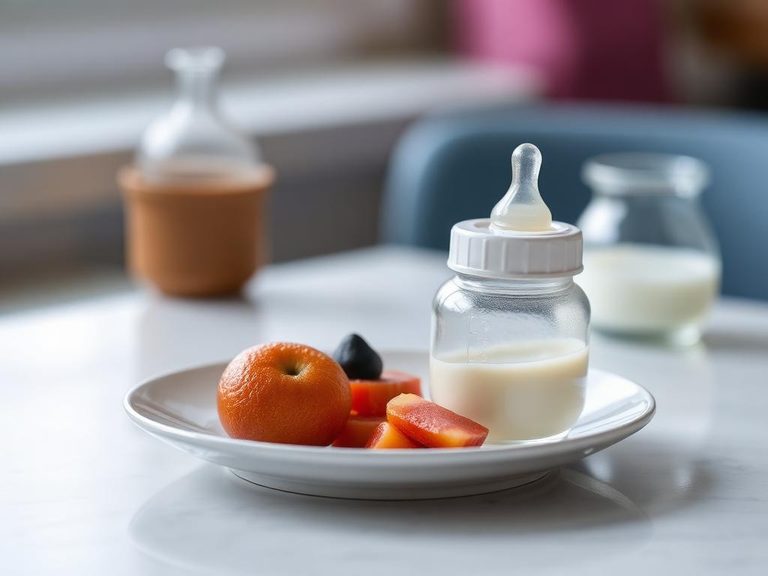
🌍 Where it's eaten
💡 Did you know?
The 'ISOMIL' brand name is a portmanteau of 'iso' (meaning equal or similar) and 'milk,' highlighting its role as a substitute formula.
Full nutrition (USDA data · scales with serving)
| Water | 87.5 g |
| Energy | 66.0 kcal |
| Energy | 274 kj |
| Protein | 1.6 g |
| Total lipid (fat) | 3.6 g |
| Ash | 0.66 g |
| Carbohydrate, by difference | 6.7 g |
| Fiber, total dietary | 0.00 g |
| Total Sugars | 6.7 g |
| Calcium, Ca | 69.0 mg |
| Iron, Fe | 1.2 mg |
| Magnesium, Mg | 5.0 mg |
| Phosphorus, P | 49.0 mg |
| Potassium, K | 71.0 mg |
| Sodium, Na | 29.0 mg |
| Zinc, Zn | 0.49 mg |
| Copper, Cu | 0.05 mg |
| Manganese, Mn | 0.02 mg |
| Selenium, Se | 1.4 ug |
| Vitamin C, total ascorbic acid | 5.9 mg |
| Thiamin | 0.04 mg |
| Riboflavin | 0.06 mg |
| Niacin | 0.89 mg |
| Pantothenic acid | 0.49 mg |
| Vitamin B-6 | 0.04 mg |
| Folate, total | 10.0 ug |
| Folic acid | 10.0 ug |
| Folate, food | 0.00 ug |
| Folate, DFE | 17.0 ug |
| Choline, total | 8.0 mg |
| Vitamin B-12 | 0.30 ug |
| Vitamin B-12, added | 0.30 ug |
| Vitamin A, RAE | 59.0 ug |
| Retinol | 59.0 ug |
| Carotene, beta | 0.00 ug |
| Carotene, alpha | 0.00 ug |
| Cryptoxanthin, beta | 0.00 ug |
| Vitamin A, IU | 197 iu |
| Lycopene | 0.00 ug |
| Lutein + zeaxanthin | 0.00 ug |
| Vitamin E (alpha-tocopherol) | 1.3 mg |
| Vitamin E, added | 1.3 mg |
| Vitamin D (D2 + D3), International Units | 39.0 iu |
| Vitamin D (D2 + D3) | 1.0 ug |
| Vitamin K (phylloquinone) | 7.2 ug |
| Alcohol, ethyl | 0.00 g |
| Caffeine | 0.00 mg |
| Theobromine | 0.00 mg |
Fat & fatty acid profile (per 100g)
| Fatty acids, total saturated | 1.2 g |
| SFA 4:0 | 0.00 g |
| SFA 6:0 | 0.01 g |
| SFA 8:0 | 0.09 g |
| SFA 10:0 | 0.06 g |
| SFA 12:0 | 0.45 g |
| SFA 14:0 | 0.18 g |
| SFA 16:0 | 0.26 g |
| SFA 18:0 | 0.12 g |
| Fatty acids, total monounsaturated | 1.4 g |
| MUFA 16:1 | 0.00 g |
| MUFA 18:1 | 1.4 g |
| MUFA 20:1 | 0.01 g |
| MUFA 22:1 | 0.00 g |
| Fatty acids, total polyunsaturated | 0.84 g |
| PUFA 18:2 | 0.75 g |
| PUFA 18:3 | 0.09 g |
| PUFA 18:4 | 0.00 g |
| PUFA 20:4 | 0.02 g |
| PUFA 20:5 n-3 (EPA) | 0.00 g |
| PUFA 22:5 n-3 (DPA) | 0.00 g |
| PUFA 22:6 n-3 (DHA) | 0.01 g |
| Cholesterol | 0.00 mg |
FAQ
What does 'ready-to-feed' mean?
It means the formula is pre-mixed and sterile in its container, requiring no water or preparation. You can pour it directly into a clean bottle and feed.
Is this formula vegetarian or vegan?
Yes, as a soy-based formula without animal-derived ingredients, it is suitable for vegetarian and vegan diets for infants, as per pediatric guidance.
How is this different from powdered formula?
Ready-to-feed is more convenient and guaranteed sterile, which is crucial for very young infants or those with compromised immune systems. Powdered formula is more economical but requires careful preparation with safe water.
Nutrient density (calculated · NRF9.3)
Nutrient Rich Foods index: beneficial nutrients (protein, fiber, vitamins, minerals) minus saturated fat, added sugar & sodium, per 100 kcal.
NRF9.3 index — Fulgoni, Keast & Drewnowski, 2009. Computed from USDA nutrients.
Weight-loss friendliness (composite index)
Energy density 0.66 kcal/g · 10% calories from protein · 0.0 g fiber · 6.7 g sugar per 100 g.
Composite of energy density (Rolls et al., 1999), protein & fiber satiety, minus sugar. A calculated heuristic — ranks satiety-per-calorie, not a clinical measure.
Dietary load (calculated from USDA values)
Potential renal acid load. Positive = acid-forming, negative = alkaline-forming.
Sodium-to-potassium ratio: 0.41 (lower is better — aim for ≤ 1)
Sodium:potassium per WHO potassium guidance. Computed from USDA nutrients.