

Infant formula, ABBOTT NUTRITION, SIMILAC, ISOMIL, ADVANCE with iron, liquid concentrate
Whole food · Baby Foods

Photo: Wikipedia
This is a liquid concentrate infant formula designed for babies with sensitivity to cow's milk protein, offering a soy-based alternative. It has a smooth, pourable consistency and a mildly sweet, beany taste profile. Nutritionally, it provides a balanced mix of carbohydrates, protein, and fats to support infant growth.
Calorie split: 10% protein · 41% carbs · 49% fat
↓ Full nutrition💚 Why it's loved
Parents value it as a reliable, nutritionally complete option for infants who cannot tolerate standard cow's milk formulas, providing peace of mind. The familiar Similac brand and its established reputation in pediatric nutrition offer a sense of trust and consistency.
⚠️ Watch-outs & how to enjoy it better
Some infants may have a sensitivity or allergy to soy protein itself, which can cause digestive discomfort. The formula contains corn syrup solids and sucrose, which are simple sugars; for this reason, it's not recommended for infants with galactosemia. Always consult a pediatrician before use, especially for infants with known food allergies or metabolic conditions.
Key benefits
- Soy-based protein for cow's milk protein sensitivity
- Iron-fortified to support cognitive development
- Provides essential fatty acids like DHA and ARA
- Lactose-free formula for infants with lactose intolerance
- Concentrated format for easy, customizable preparation
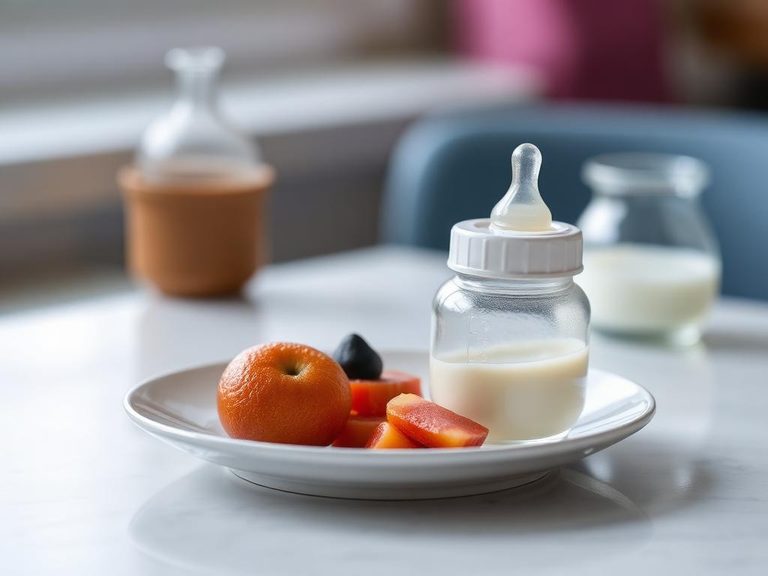
🍽️ Popular dishes
🌍 Where it's eaten
💡 Did you know?
The 'ISOMIL' name is a portmanteau of 'iso' (meaning equal or similar) and 'milk,' highlighting its role as a milk substitute.
Full nutrition (USDA data · scales with serving)
| Water | 75.8 g |
| Energy | 128 kcal |
| Energy | 536 kj |
| Protein | 3.1 g |
| Total lipid (fat) | 7.0 g |
| Ash | 0.88 g |
| Carbohydrate, by difference | 13.2 g |
| Fiber, total dietary | 0.00 g |
| Total Sugars | 13.1 g |
| Calcium, Ca | 134 mg |
| Iron, Fe | 2.3 mg |
| Magnesium, Mg | 10.0 mg |
| Phosphorus, P | 96.0 mg |
| Potassium, K | 138 mg |
| Sodium, Na | 56.0 mg |
| Zinc, Zn | 0.96 mg |
| Copper, Cu | 0.10 mg |
| Manganese, Mn | 0.03 mg |
| Selenium, Se | 2.7 ug |
| Vitamin C, total ascorbic acid | 11.5 mg |
| Thiamin | 0.08 mg |
| Riboflavin | 0.12 mg |
| Niacin | 1.7 mg |
| Pantothenic acid | 0.96 mg |
| Vitamin B-6 | 0.08 mg |
| Folate, total | 19.0 ug |
| Folic acid | 19.0 ug |
| Folate, food | 0.00 ug |
| Folate, DFE | 33.0 ug |
| Choline, total | 15.5 mg |
| Vitamin B-12 | 0.58 ug |
| Vitamin B-12, added | 0.58 ug |
| Vitamin A, RAE | 114 ug |
| Retinol | 114 ug |
| Carotene, beta | 0.00 ug |
| Carotene, alpha | 0.00 ug |
| Cryptoxanthin, beta | 0.00 ug |
| Vitamin A, IU | 380 iu |
| Lycopene | 0.00 ug |
| Lutein + zeaxanthin | 0.00 ug |
| Vitamin E (alpha-tocopherol) | 1.2 mg |
| Vitamin E, added | 1.2 mg |
| Vitamin D (D2 + D3), International Units | 77.0 iu |
| Vitamin D (D2 + D3) | 1.9 ug |
| Vitamin K (phylloquinone) | 14.1 ug |
| Alcohol, ethyl | 0.00 g |
| Caffeine | 0.00 mg |
| Theobromine | 0.00 mg |
Fat & fatty acid profile (per 100g)
| Fatty acids, total saturated | 2.3 g |
| SFA 4:0 | 0.00 g |
| SFA 6:0 | 0.02 g |
| SFA 8:0 | 0.17 g |
| SFA 10:0 | 0.12 g |
| SFA 12:0 | 0.87 g |
| SFA 14:0 | 0.34 g |
| SFA 16:0 | 0.51 g |
| SFA 18:0 | 0.23 g |
| Fatty acids, total monounsaturated | 2.7 g |
| MUFA 16:1 | 0.01 g |
| MUFA 18:1 | 2.6 g |
| MUFA 20:1 | 0.01 g |
| MUFA 22:1 | 0.00 g |
| Fatty acids, total polyunsaturated | 1.6 g |
| PUFA 18:2 | 1.5 g |
| PUFA 18:3 | 0.17 g |
| PUFA 18:4 | 0.00 g |
| PUFA 20:4 | 0.05 g |
| PUFA 20:5 n-3 (EPA) | 0.00 g |
| PUFA 22:5 n-3 (DPA) | 0.00 g |
| PUFA 22:6 n-3 (DHA) | 0.02 g |
| Cholesterol | 0.00 mg |
FAQ
What does 'liquid concentrate' mean for this formula?
It means the formula is a thick liquid that must be diluted with an equal amount of water before feeding, as per the instructions on the can. This differs from ready-to-feed liquid or powder formula.
Is this formula suitable for a baby with a milk allergy?
It is designed for sensitivity to cow's milk protein, but a true milk allergy (involving an immune response) may require a more extensively hydrolyzed or amino acid-based formula. A pediatrician must diagnose and recommend the appropriate formula.
Why does it contain corn syrup solids and sucrose?
These are carbohydrate sources that provide the necessary energy for a growing infant. The formula is designed to meet strict nutritional standards, and these sugars are part of that balanced profile.
Nutrient density (calculated · NRF9.3)
Nutrient Rich Foods index: beneficial nutrients (protein, fiber, vitamins, minerals) minus saturated fat, added sugar & sodium, per 100 kcal.
NRF9.3 index — Fulgoni, Keast & Drewnowski, 2009. Computed from USDA nutrients.
Weight-loss friendliness (composite index)
Energy density 1.28 kcal/g · 10% calories from protein · 0.0 g fiber · 13.1 g sugar per 100 g.
Composite of energy density (Rolls et al., 1999), protein & fiber satiety, minus sugar. A calculated heuristic — ranks satiety-per-calorie, not a clinical measure.
Dietary load (calculated from USDA values)
Potential renal acid load. Positive = acid-forming, negative = alkaline-forming.
Sodium-to-potassium ratio: 0.41 (lower is better — aim for ≤ 1)
Sodium:potassium per WHO potassium guidance. Computed from USDA nutrients.