

Gravy, au jus, canned
Whole food · Soups, Sauces, and Gravies

Photo: Wikipedia
Canned au jus is a thin, savory beef broth concentrate, typically made from meat drippings, seasonings, and sometimes a thickener. It has a deep, umami-rich flavor and a light, watery consistency that coats the palate without heaviness. Nutritionally, it's a very low-calorie, nearly fat-free way to add intense meaty flavor to a dish.
Calorie split: 29% protein · 60% carbs · 11% fat
↓ Full nutrition💚 Why it's loved
People love it for its ability to instantly transform a simple roast or sandwich into a rich, restaurant-quality meal. It's the essential, savory backbone of the classic French Dip sandwich, providing that signature dipping experience.
⚠️ Watch-outs & how to enjoy it better
Its primary downside is often very high sodium content, which can be a concern for those monitoring blood pressure. To mitigate this, look for low-sodium versions, use it sparingly as a flavor enhancer rather than a broth, and pair it with potassium-rich foods like potatoes or leafy greens.
Key benefits
- Adds deep umami flavor for minimal calories (16 kcal/100g)
- Virtually fat-free (0.2g per 100g)
- Provides a quick, savory base for sauces and gravies
- Enhances the flavor of lean proteins like roast beef
- Offers a convenient, shelf-stable flavor boost
🍽️ Popular dishes

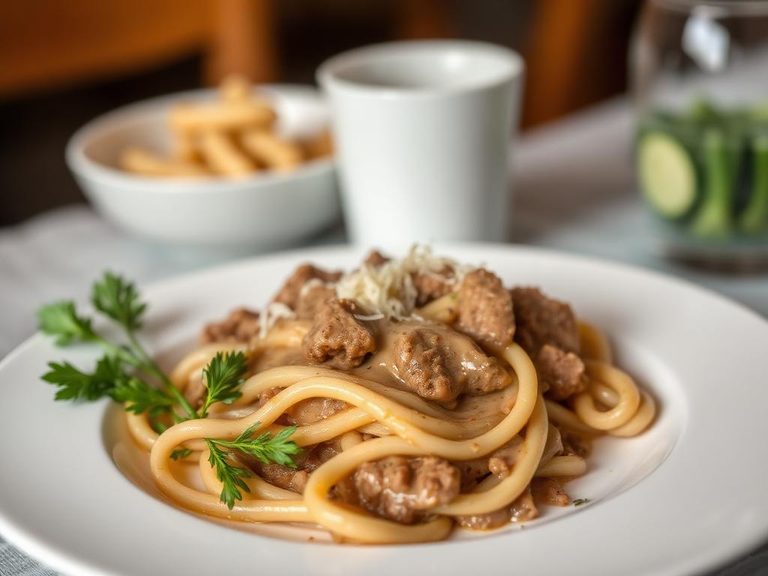
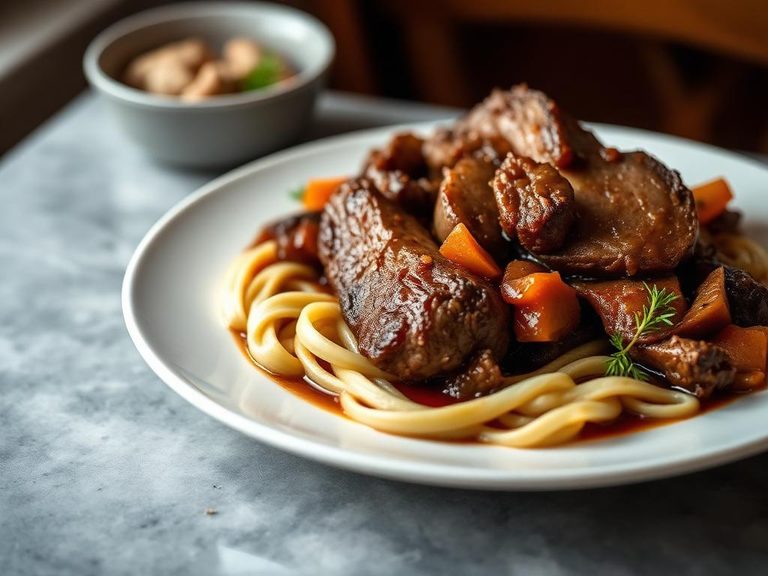
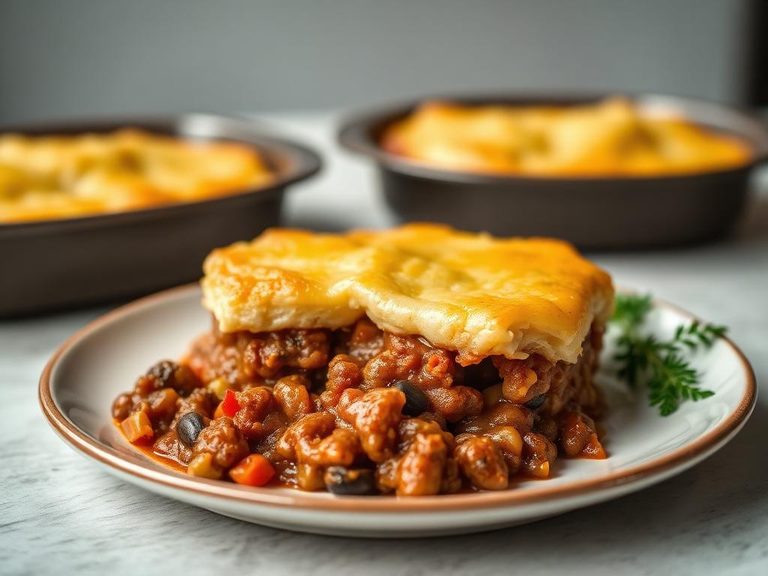
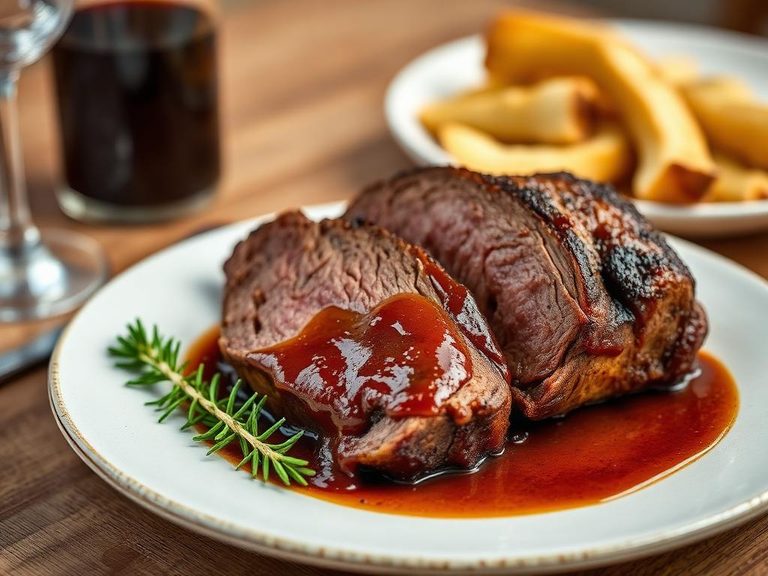
🌍 Where it's eaten
💡 Did you know?
The term 'au jus' is French for 'with juice,' referring to the natural juices released by meat as it cooks, which is the traditional base for this sauce.
Full nutrition (USDA data · scales with serving)
| Water | 94.5 g |
| Energy | 16.0 kcal |
| Energy | 67.0 kj |
| Protein | 1.2 g |
| Total lipid (fat) | 0.20 g |
| Ash | 1.6 g |
| Carbohydrate, by difference | 2.5 g |
| Fiber, total dietary | 0.00 g |
| Calcium, Ca | 4.0 mg |
| Iron, Fe | 0.60 mg |
| Magnesium, Mg | 2.0 mg |
| Phosphorus, P | 30.0 mg |
| Potassium, K | 81.0 mg |
| Sodium, Na | 478 mg |
| Zinc, Zn | 1.0 mg |
| Copper, Cu | 0.10 mg |
| Manganese, Mn | 0.20 mg |
| Selenium, Se | 0.40 ug |
| Vitamin C, total ascorbic acid | 1.0 mg |
| Thiamin | 0.02 mg |
| Riboflavin | 0.06 mg |
| Niacin | 0.90 mg |
| Pantothenic acid | 0.02 mg |
| Vitamin B-6 | 0.01 mg |
| Folate, total | 2.0 ug |
| Folic acid | 0.00 ug |
| Folate, food | 2.0 ug |
| Folate, DFE | 2.0 ug |
| Vitamin B-12 | 0.10 ug |
| Vitamin A, RAE | 0.00 ug |
| Retinol | 0.00 ug |
| Vitamin A, IU | 0.00 iu |
Fat & fatty acid profile (per 100g)
| Fatty acids, total saturated | 0.10 g |
| SFA 12:0 | 0.00 g |
| SFA 14:0 | 0.01 g |
| SFA 16:0 | 0.05 g |
| SFA 18:0 | 0.04 g |
| Fatty acids, total monounsaturated | 0.08 g |
| MUFA 16:1 | 0.01 g |
| MUFA 18:1 | 0.07 g |
| MUFA 20:1 | 0.00 g |
| Fatty acids, total polyunsaturated | 0.01 g |
| PUFA 18:2 | 0.01 g |
| PUFA 18:3 | 0.00 g |
| Cholesterol | 0.00 mg |
Amino acid profile (per 100g)
Estimated from Gravy, HEINZ Home Style, savory beef — USDA does not publish this profile for Gravy.
| Tryptophan | 0.01 g |
| Threonine | 0.03 g |
| Isoleucine | 0.03 g |
| Leucine | 0.06 g |
| Lysine | 0.05 g |
| Methionine | 0.01 g |
| Cystine | 0.01 g |
| Phenylalanine | 0.03 g |
| Tyrosine | 0.02 g |
| Valine | 0.04 g |
| Arginine | 0.06 g |
| Histidine | 0.02 g |
| Alanine | 0.06 g |
| Aspartic acid | 0.07 g |
| Glutamic acid | 0.44 g |
| Glycine | 0.10 g |
| Proline | 0.08 g |
| Serine | 0.04 g |
| Hydroxyproline | 0.04 g |
FAQ
Is canned au jus the same as beef broth?
No. Au jus is a concentrated, seasoned sauce meant to be served with or over meat, often made from drippings. Beef broth is a more dilute, drinkable soup base. Canned au jus is typically much more concentrated and flavorful.
How can I use canned au jus besides for a French Dip?
Use it as a flavorful cooking liquid for rice or quinoa, a base for gravies and stews, a braising liquid for tough cuts of meat, or a savory drizzle over mashed potatoes or roasted vegetables.
Does it contain gluten?
Many brands do, as wheat flour is often used as a thickener. Always check the ingredient list for wheat or gluten if you have an intolerance or celiac disease.
Nutrient density (calculated · NRF9.3)
Nutrient Rich Foods index: beneficial nutrients (protein, fiber, vitamins, minerals) minus saturated fat, added sugar & sodium, per 100 kcal.
NRF9.3 index — Fulgoni, Keast & Drewnowski, 2009. Computed from USDA nutrients.
Weight-loss friendliness (composite index)
Energy density 0.16 kcal/g · 30% calories from protein · 0.0 g fiber · 0.0 g sugar per 100 g.
Composite of energy density (Rolls et al., 1999), protein & fiber satiety, minus sugar. A calculated heuristic — ranks satiety-per-calorie, not a clinical measure.
Dietary load (calculated from USDA values)
Potential renal acid load. Positive = acid-forming, negative = alkaline-forming.
Sodium-to-potassium ratio: 5.90 (lower is better — aim for ≤ 1)
Sodium:potassium per WHO potassium guidance. Computed from USDA nutrients.